
7 Essential Types of Asset-Backed Tokens Explained

Protecting and growing your portfolio in unpredictable markets is a challenge for any institutional investor. Traditional assets like gold, silver, real estate, and commodities offer stability, but actually managing them comes with high costs, limited access, and real logistical headaches. Now, the rise of asset-backed tokens is changing how you can add physical value to your digital investments, giving you flexibility and transparency that traditional methods can’t provide.
This list will show you how different asset-backed tokens work, break down the benefits for institutional portfolios, and highlight what to watch for before you commit. You’ll get clear, actionable insights on using these modern tools for diversification, stability, and secure long-term returns. Get ready to discover practical ways to strengthen your investment strategy with asset-backed tokens that connect real-world assets to the digital age.
Table of Contents
- 1. Understanding Asset-Backed Tokens And Their Value
- 2. Gold-Backed Tokens For Secure Wealth Preservation
- 3. Silver-Backed Tokens And Their Diversification Potential
- 4. Real Estate-Backed Tokens For Stable Returns
- 5. Commodities-Backed Tokens Beyond Precious Metals
- 6. Fiat-Backed Stablecoins And Regulatory Advantages
- 7. Choosing The Right Asset-Backed Token For Your Portfolio
Quick Summary
| Key Message | Explanation |
|---|---|
| 1. Verify Token Backing Regularly | Always check for third-party audit reports confirming that physical assets support the tokens you hold. |
| 2. Focus on Regulatory Compliance | Prioritize tokens operating under clear regulation to ensure legitimacy and protect your investments. |
| 3. Diversify Across Asset Classes | Build a portfolio containing various asset-backed tokens to mitigate risks and enhance resilience. |
| 4. Assess Liquidity Before Investing | Evaluate trading volumes and market conditions to ensure you can easily execute your investment strategy. |
| 5. Explore Programmable Features of Tokens | Utilize tokens with programmable characteristics for added functionality and integration in decentralized finance ecosystems. |
1. Understanding Asset-Backed Tokens and Their Value
Asset-backed tokens represent a fundamental shift in how investors access tangible value through digital means. These tokens are cryptographic representations of real-world assets—typically physical commodities like gold, silver, or other precious metals—that exist on blockchain networks. When you own an asset-backed token, you hold a verifiable claim to the underlying physical reserve, creating a direct connection between digital ownership and concrete material value that doesn’t exist with many other cryptocurrency investments.
The mechanism works like this: a company holding verified physical assets (such as gold bars stored in secure vaults) issues tokens on the blockchain, where each token corresponds to a specific quantity of the underlying asset. This creates what’s known as tokenized commodity exposure, allowing institutional investors worldwide to gain exposure to precious metals without managing physical logistics, insurance, or storage complications. You can track the asset backing through blockchain proof of reserve reports, which provide transparent verification that tokens are genuinely backed by the promised quantities of physical metal. This transparency matters enormously when you’re making investment decisions, particularly if you’re seeking regulatory compliance and institutional-grade security for your portfolio diversification strategy.
What makes these tokens valuable goes beyond simple asset backing. They offer liquidity that physical commodity ownership typically cannot provide—you can trade them on secondary markets nearly instantaneously, whereas selling physical gold requires time, specialist buyers, and transaction costs. They also eliminate geographic barriers, letting you participate in gold-backed digital assets regardless of your location, while maintaining the wealth preservation characteristics that make precious metals attractive during economic uncertainty. For institutional investors focused on risk management and long-term value preservation, this combination of tangible asset backing, blockchain transparency, and trading flexibility creates a compelling investment vehicle that bridges traditional wealth preservation with modern financial technology.
Pro tip: Before investing in any asset-backed token, verify the company publishes regular proof of reserve reports confirming the physical assets actually exist in audited storage facilities, and confirm the token operates under a regulated ERC-20 structure or equivalent standard.
2. Gold-Backed Tokens for Secure Wealth Preservation
Gold-backed tokens represent perhaps the most straightforward application of blockchain technology to wealth preservation. These tokens function as direct digital representations of physical gold bars stored in secure vaults, creating a bridge between traditional precious metal ownership and modern trading flexibility. When you purchase a gold-backed token, you gain verifiable ownership of a proportional share of audited gold reserves, combining the inflation hedge and stability that gold has provided for centuries with the liquidity and transparency that blockchain enables.
The appeal for institutional investors lies in how gold-backed tokens solve multiple investment challenges simultaneously. Gold-backed stablecoins offer digital liquidity while maintaining intrinsic gold value, making them particularly attractive during geopolitical uncertainty and when inflation concerns mount. Unlike traditional fiat-backed stablecoins, these tokens provide a predictable price correlation with physical gold, ensuring your assets maintain purchasing power regardless of monetary policy decisions. You gain fractional ownership benefits, meaning you can own a small portion of gold without purchasing entire bars, and the tokens function across blockchain networks with programmable characteristics that pure physical gold cannot offer. The regulatory clarity surrounding custody and verification of physical reserves continues to develop, creating institutional-grade confidence that your token holdings correspond to actual gold stored in audited facilities.
For your specific situation as an institutional investor, gold-backed tokens address wealth preservation objectives that diversification alone cannot achieve. They shield against dollar devaluation while providing the trading flexibility that geographic diversification demands. You can access global markets, execute transactions nearly instantaneously, and maintain transparency through blockchain proof of reserves without the friction of managing physical logistics, insurance policies, or custody arrangements. Your portfolio gains a stability anchor that replicates gold’s historical role as a crisis hedge while operating within modern digital finance infrastructure.
Pro tip: Verify that any gold-backed token you consider is issued by a provider maintaining regular third-party audits of physical reserves and operating with clearly disclosed custody arrangements in regulated jurisdictions.
3. Silver-Backed Tokens and Their Diversification Potential
Silver-backed tokens offer a compelling diversification strategy that extends beyond the gold focus many institutional investors default to. These tokens digitize physical silver bullion through blockchain, allowing you to own fractional shares of allocated silver reserves without managing the physical storage, insurance, and security complications that accompany direct metal ownership. Leading examples like Kinesis Silver and tSILVER maintain audited bullion backing, providing institutional-grade transparency and security. Silver presents a unique investment profile distinct from gold: it carries industrial demand alongside its precious metal status, creating price dynamics that don’t perfectly correlate with gold movements, making it an effective portfolio diversifier.
The value proposition of tokenized precious metals becomes particularly clear when you consider modern portfolio construction. Silver-backed tokens enhance liquidity and accessibility while reducing the friction associated with traditional bullion ownership. You gain exposure to silver’s inflation-hedging characteristics and its historical role as a crisis asset, but with the trading flexibility that blockchain enables. Unlike storing physical silver bars, which limits your ability to quickly execute transactions or rebalance your portfolio, tokenized silver allows near-instantaneous trading across global markets. The fractional ownership model means you can build a silver position that matches your exact capital allocation strategy rather than being constrained by bar weights and minimums. Additionally, silver-backed tokens integrate seamlessly with decentralized finance ecosystems, opening possibilities for yield generation or additional portfolio optimization strategies that pure physical silver cannot provide.
For institutional investors building multi-asset preservation strategies, silver-backed tokens address regulatory compliance requirements across major jurisdictions including the United States, European Union, and Singapore. Each region maintains established custody models and compliance frameworks, ensuring your silver token investments rest on solid regulatory foundations. This contrasts sharply with purely speculative digital assets lacking underlying value or regulatory clarity. Your portfolio gains meaningful diversification through a second precious metal with distinct industrial demand characteristics, while maintaining the transparency and auditability that institutional stewardship demands.
Pro tip: When evaluating silver-backed tokens, prioritize those with published audit reports from recognized third-party custodians confirming allocated bullion holdings, and verify the token operates within established regulatory frameworks in your investment jurisdiction.
4. Real Estate-Backed Tokens for Stable Returns
Real estate-backed tokens represent a transformative approach to property investment by converting physical real estate into digitized ownership units tradable on blockchain networks. Rather than requiring substantial capital to purchase entire properties or navigating complex syndication arrangements, you can now own fractional stakes in income-generating real estate through tokenized assets. This innovation addresses a fundamental challenge in traditional real estate investing: illiquidity. Properties typically require months to sell and involve significant transaction costs, whereas tokenized real estate can be traded nearly instantaneously on secondary markets, providing you with the flexibility that institutional portfolios increasingly demand.
The mechanics of real estate tokenization create multiple advantages for your investment strategy. Asset tokenization converts property ownership into tradable digital tokens, broadening access beyond wealthy individuals or large institutions while simultaneously reducing transaction costs. You gain exposure to real estate’s historical role as a inflation hedge and stable income generator, but with vastly improved liquidity compared to traditional property ownership. The 24/7 global market access means you can adjust your real estate exposure whenever market conditions warrant, rather than being constrained by traditional real estate trading hours or geographic limitations. Programmable settlement through blockchain automation further streamlines transactions, reducing the legal complexity and transaction delays inherent in conventional property transfers. For institutional investors, this translates directly to improved portfolio efficiency and faster capital redeployment when opportunities shift.
Stable returns from real estate-backed tokens stem from the underlying asset’s cash flow generation. Commercial properties, residential complexes, and other income-producing real estate generate rental income that flows to token holders, creating a tangible return mechanism distinct from speculative price appreciation. This income-focused approach aligns perfectly with institutional investors seeking predictable, asset-backed returns rather than purely speculative gains. However, regulatory clarity remains an evolving landscape across jurisdictions, and custodial arrangements vary in maturity. The emerging tokenized real estate market continues developing robust frameworks addressing these concerns, but understanding the current regulatory environment in your investment jurisdiction remains essential before deploying capital.
Pro tip: Before investing in real estate-backed tokens, thoroughly review the property appraisals, tenant agreements, and custodial arrangements, and verify that the token issuer operates under established regulatory frameworks in your jurisdiction.
5. Commodities-Backed Tokens Beyond Precious Metals
While gold and silver-backed tokens dominate institutional conversations, the universe of commodities-backed tokens extends far beyond precious metals into energy resources, agricultural products, and industrial commodities. These tokens represent direct ownership claims on physical commodities stored in secure facilities, enabling you to access traditional commodity markets through modern blockchain infrastructure. You gain fractional ownership of assets like oil, natural gas, coffee, wheat, and copper without the storage complications, price volatility exposure, or minimum investment thresholds that characterize traditional commodity investing. This expansion transforms how institutional portfolios approach diversification across the full spectrum of physical assets.
The mechanics of tokenized commodities mirror the precious metals model but with broader application across asset classes. Digital representations of physical commodities are issued on blockchains with secure storage and decentralized trading facilitated through smart contracts. You benefit from enhanced asset accessibility since fractional ownership eliminates minimum investment barriers that previously excluded many institutional players from certain commodity markets. Transparent ownership verification through blockchain creates certainty about your stake, while settlement automation reduces the administrative friction inherent in traditional commodity trading. Agricultural commodities, energy futures, and industrial metals all become accessible through standardized token interfaces, allowing you to construct sophisticated multi-commodity strategies that would be extraordinarily difficult to execute through traditional futures or spot markets.
For your portfolio strategy, commodity-backed tokens beyond precious metals provide essential diversification benefits that pure precious metals cannot deliver. Agricultural commodities respond to different supply and demand dynamics than metals, while energy resources carry distinct geopolitical and seasonal patterns. Adding coffee, wheat, or crude oil tokens to your allocation improves uncorrelated diversification compared to metals alone. The tokenization process reshapes investment in commodity markets by increasing liquidity and reducing transaction costs compared to traditional commodity exchanges. You can execute trades 24/7 across global markets with minimal friction, rebalance positions instantly rather than waiting for market opens, and maintain exposure to commodities without managing physical inventory or dealing with futures contract roll dates. Emerging tokens in various commodities promise continued liquidity improvements and increased market participation as the infrastructure matures.
Pro tip: Diversify your commodity token allocation across multiple commodity classes with low price correlation, such as combining precious metals with agricultural and energy tokens, to maximize portfolio resilience during market volatility.
6. Fiat-Backed Stablecoins and Regulatory Advantages
Fiat-backed stablecoins represent a bridge between traditional banking infrastructure and blockchain-based financial systems, offering stability that pure cryptocurrencies cannot match. These tokens maintain a fixed value by being backed by reserves of government-issued currency like dollars, euros, or pounds held in regulated financial institutions. Unlike volatile cryptocurrencies or asset-backed tokens with commodity price fluctuations, fiat-backed stablecoins preserve purchasing power through direct parity with their underlying currency, making them ideal for institutional investors seeking predictable value preservation without exposure to commodity or currency volatility.
The regulatory landscape surrounding fiat-backed stablecoins has evolved significantly in your favor as an institutional investor. Governments and financial regulators worldwide recognize that thoughtful regulatory frameworks can enable stablecoins to function as legitimate payment options within established financial ecosystems. Regulatory frameworks for stablecoins aim to foster innovation while mitigating financial stability risks, ensuring consumer protection, and enabling safe use in payment systems under defined regulatory parameters. This differs markedly from purely speculative cryptocurrencies operating in regulatory gray zones. When you invest in fiat-backed stablecoins issued by regulated institutions meeting capital requirements and prudential standards, you gain institutional-grade safeguards that traditional unregulated tokens cannot provide. The regulatory clarity matters tremendously because it means your stablecoin holdings are protected by the same institutional oversight and consumer protections that govern traditional banking products.
For your portfolio strategy, fiat-backed stablecoins serve as an essential operational tool and tactical holding. They provide immediate liquidity for rapid rebalancing between other asset classes, eliminate settlement delays inherent in traditional currency transfers, and reduce counterparty risk compared to holding cash at individual banks. When regulatory frameworks establish that stablecoin issuers maintain full reserve backing and operate under financial service regulations, you gain confidence that your holdings maintain their stated value. The emergence of government-recognized regulatory perimeters for stablecoin issuance and use transforms them from experimental assets into established financial instruments. This regulatory maturation creates opportunities for institutional investors to use stablecoins not just as speculative holdings but as functional components of sophisticated treasury management and portfolio rebalancing strategies that demand both stability and operational efficiency.
Pro tip: Prioritize fiat-backed stablecoins issued by institutions operating under established regulatory frameworks with full reserve backing verified through transparent, audited financial reporting.
7. Choosing the Right Asset-Backed Token for Your Portfolio
Selecting the appropriate asset-backed tokens for your portfolio requires a systematic evaluation framework that extends beyond simply identifying tokens backed by physical assets. You must assess multiple critical dimensions including the quality of underlying asset backing, regulatory compliance status, operational security measures, liquidity characteristics, and alignment with your specific investment objectives. The proliferation of asset-backed tokens across diverse asset classes means your selection process determines whether these holdings function as stable wealth preservation vehicles or become sources of unnecessary risk and operational friction.
Begin your evaluation by verifying the fundamental backing claims through independent audit reports and proof of reserve documentation. Request detailed information about where physical assets are stored, which custodians hold them, and whether those custodians maintain insurance coverage and regulatory licensing. Check whether the token issuer publishes regular, third-party audited financial statements confirming that token circulation matches actual physical reserves. Next, assess the regulatory framework governing the token’s issuance and operation. Tokens operating under established regulatory oversight in major jurisdictions like the United States, European Union, or Singapore provide substantially greater certainty than those operating in regulatory gray zones. Examine the token’s liquidity profile by reviewing trading volumes on secondary markets, understanding bid-ask spreads, and confirming that you can execute your intended position sizes without undue slippage. Finally, evaluate alignment with your portfolio objectives. Are you seeking inflation hedging through precious metals tokens, diversification through real estate exposure, or operational efficiency through fiat-backed stablecoins? Your answer determines which token types merit inclusion.
Portfolio construction with asset-backed tokens benefits from diversification across multiple asset classes and issuers. Rather than concentrating your holdings in a single gold-backed token, consider building exposure across precious metals, real estate, commodities, and fiat-backed stablecoins. This multi-token approach reduces issuer-specific risk while providing comprehensive asset class exposure. Institutional investors frequently construct token portfolios mirroring their traditional asset allocation strategies, allocating percentages to different token categories that match their overall diversification targets. Start with tokens from established issuers operating under clear regulatory frameworks and demonstrating consistent proof of reserves. As you gain familiarity with the ecosystem and develop conviction around specific token platforms, you can gradually expand your holdings to include emerging tokens showing strong operational and regulatory fundamentals.
Pro tip: Build your asset-backed token portfolio across multiple asset classes and issuers with diversified geographic custody locations, prioritizing tokens from regulated issuers with audited reserves and strong liquidity on major trading platforms.
Below is a comprehensive table summarizing the main points, benefits, and considerations discussed throughout the article, “Understanding Asset-Backed Tokens and Their Value.”
| Topic | Description | Advantages |
|---|---|---|
| Asset-Backed Tokens | Digital representations of physical assets like gold, silver, or real estate, providing verifiable claims to the underlying assets. | Combines tangible asset value with liquidity and global tradability through blockchain technology. |
| Gold-Backed Tokens | Tokens backed by audited physical gold reserves, offering an inflation hedge and consistent value. | Offers wealth preservation, global accessibility, and advanced portfolio application. |
| Silver-Backed Tokens | Tokens representing physical silver reserves, delivering distinct diversification benefits complementary to gold-backed options. | Enables exposure to silver’s unique usage dynamics and liquidity without logistical overhead. |
| Real Estate Tokens | Digital ownership stakes in income-generating real estate assets, enhancing liquidity and accessibility. | Capitalizes on real estate’s inflation hedge and stable income characteristics within modern digital frameworks. |
| Additional Commodities | Extensions to other assets like industrial metals, agriculture, or energy commodities, broadening the asset spectrum. | Facilitates diversification and risk allocation strategies unavailable through traditional commodity markets. |
| Fiat-Backed Stablecoins | Stable digital currencies pegged to government-issued fiat currencies and stored within regulated financial reserves. | Provides stability, liquidity, and minimal volatility, essential for treasury management and operational efficiency. |
| Portfolio Diversification | Incorporating various asset-backed tokens tailored to specific investment requirements, evaluated against regulatory, liquidity, and operational considerations. | Enhances resilience against market volatility while aligning with diversified investment strategies. |
| Regulatory Compliance | Importance of selecting tokens under clear jurisdictional regulations verified by audit documents and proof of reserve statements. | Ensures stable investment foundations while mitigating unnecessary risks. |
Secure Your Wealth with Trusted Asset-Backed Tokens from UK Financial Ltd
Navigating the complex world of asset-backed tokens can be challenging when concerns about transparency, regulatory compliance, and true asset verification arise. This article highlights the importance of proof of reserves and regulatory clarity for investors seeking reliable exposure to precious metals like gold and silver through blockchain technology. If you are aiming to preserve wealth, reduce risk, and gain portfolio diversification with asset-backed tokens that deliver both security and liquidity, your next step is clear.
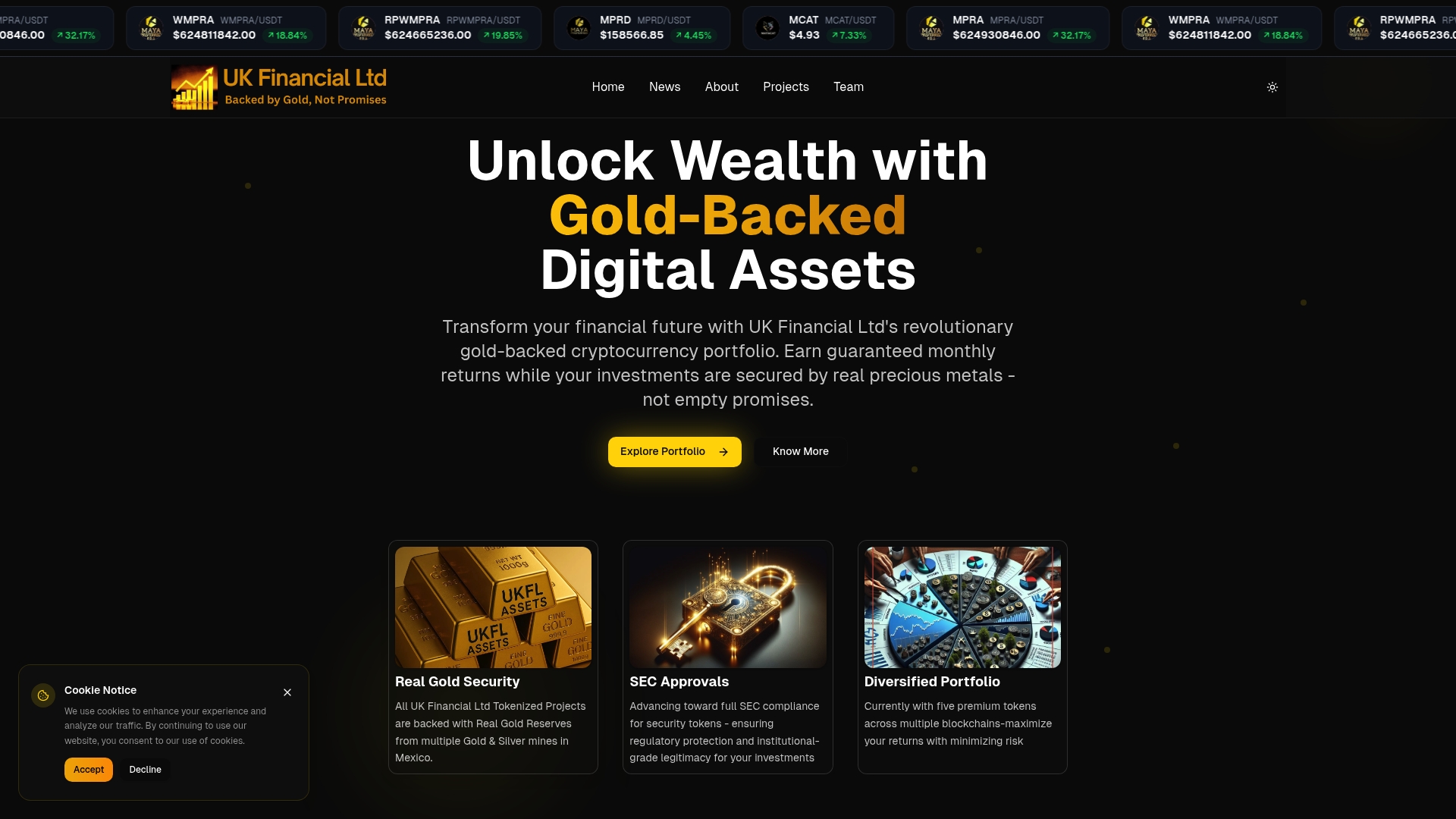
Explore UK Financial Ltd where you gain access to a carefully curated portfolio of gold-backed and silver-backed tokens fully backed by verified physical reserves. Our platform emphasizes transparency with real-time blockchain asset tracking and published proof of reserve reports to give institutional and retail investors the confidence they need. Visit our landing page now to discover how you can integrate secure, regulated asset-backed tokens into your portfolio and benefit from the stability and innovation that these digital assets offer. Act today to protect your wealth with tokens grounded in tangible value.
Frequently Asked Questions
What are asset-backed tokens?
Asset-backed tokens are digital representations of real-world assets, such as gold, silver, or real estate, stored securely. They enable investors to own a proportional value of these assets while benefiting from the liquidity and transparency that blockchain technology offers.
How do gold-backed tokens provide wealth preservation?
Gold-backed tokens offer security by allowing ownership of audited physical gold stored in secure vaults. Invest in these tokens to combine the stability of gold with the trading flexibility provided by digital assets.
What should I look for when evaluating silver-backed tokens?
When evaluating silver-backed tokens, check for published audit reports from recognized custodians to ensure the silver is allocated and secured properly. Consider investing in tokens that operate under established regulatory frameworks to enhance your confidence in their value.
How can I diversify my portfolio with commodities-backed tokens?
You can diversify your portfolio by including various commodities-backed tokens, such as oil, wheat, and copper, alongside precious metals. Aim for a balanced allocation that helps mitigate risk from price fluctuations in individual commodities.
What role do fiat-backed stablecoins play in asset-backed token investment?
Fiat-backed stablecoins serve as a reliable means for maintaining purchasing power in your portfolio by being tied to government-issued currency. Utilize stablecoins for quick transactions and liquidity, ensuring a stable foundation within a diverse investment strategy.
How can I systematically select the right asset-backed tokens?
To select the right asset-backed tokens, assess the quality of the underlying asset, regulatory compliance, and liquidity characteristics of each token. Begin by verifying proof of reserves and independent audits to ensure that your investment aligns with your financial goals.
Recommended
- UK Financial Ltd – Gold-Backed Cryptocurrency Portfolio
- UK Financial Ltd Sets Official 30-Day Conversion Deadline for Three Exchange-Listed Tokens Ahead of Regulated Upgrade
- UK Financial Ltd Confirms Official Corporate Structure of the Maya Preferred Project and Its Dual-Class Token System
- UK Financial Ltd Establishes United States Operations in Delaware, Announces Texas Expansion