
Role of Transparency in Digital Assets: Investor Trust and Compliance

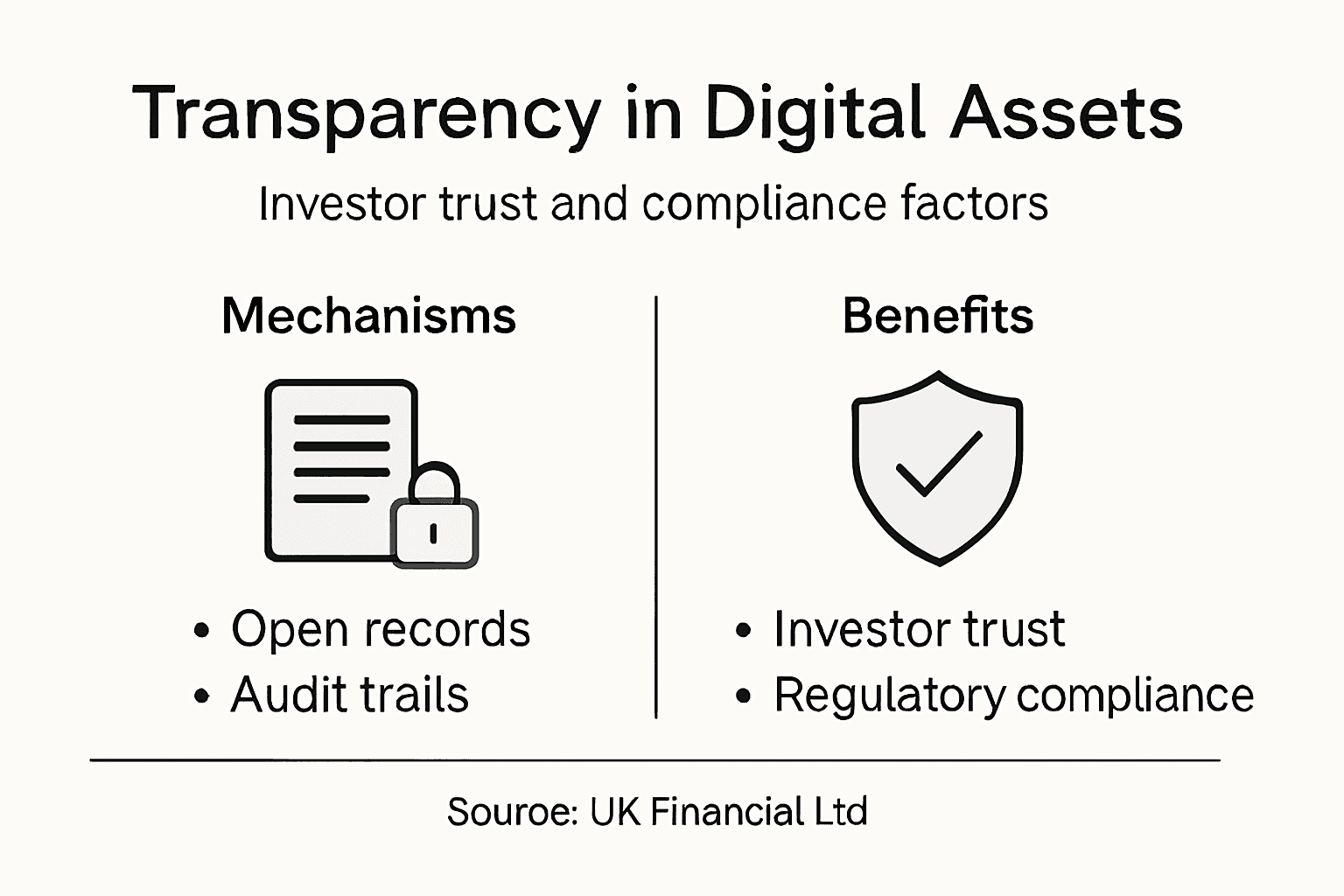
Navigating the world of digital assets can feel daunting when transparency and trust are nonnegotiable for institutional investors. Complex technologies like blockchain now offer ways to deliver verifiable transparency, giving confidence through clear asset ownership, accurate reporting, and real-time reserve validation. Secure, gold-backed tokens are redefining wealth preservation as global compliance standards evolve. This article examines the structured methods that build trust, protect capital, and empower decision-makers to demand real accountability.
Table of Contents
- Defining Transparency In Digital Assets
- Types Of Transparency In Crypto Markets
- Proof Of Reserve And Verification Methods
- Regulatory Compliance And Disclosure Duties
- Risks Of Poor Transparency For Investors
- Building Trust With Transparent Asset-Backed Tokens
Key Takeaways
| Point | Details |
|---|---|
| Transparency is Essential | Comprehensive transparency mechanisms are critical for fostering trust in digital asset investments. |
| Adopt Robust Verification Practices | Utilize Proof of Reserve and third-party audits to validate asset backing and maintain investor confidence. |
| Understand Regulatory Compliance | Stay informed about evolving regulations and ensure proactive compliance to safeguard investments. |
| Monitor for Transparency Risks | Implement structured due diligence processes to evaluate transparency indicators in digital assets to mitigate potential risks. |
Defining Transparency in Digital Assets
Understanding transparency in digital assets represents a critical challenge for institutional investors navigating increasingly complex technological landscapes. Academic perspectives on digital transparency reveal two fundamental approaches that shape our comprehension: the verifiability approach and the performativity approach.
The verifiability approach focuses on transparency as a deliberate process of sharing clear, accurate information. This perspective emphasizes three core characteristics:
- Intentional disclosure of financial details
- Commitment to accuracy and precision
- Demonstrable track record of information integrity
Performativity offers a more nuanced view, recognizing transparency as a complex social process with both intended and unintended consequences. Digital platform transparency challenges highlight that transparency extends beyond mere information sharing to encompass broader governance and accountability frameworks.
In practice, transparency for digital assets means creating comprehensive, accessible systems that allow investors to verify:
- Asset ownership and provenance
- Real-time transaction records
- Underlying reserve mechanisms
- Compliance with regulatory standards
Effective transparency requires technological infrastructure that supports comprehensive, immutable record-keeping while maintaining appropriate privacy protections. Blockchain technologies have emerged as a promising solution, enabling unprecedented levels of verifiable, decentralized information management.

Here’s a comparison of core transparency approaches influencing digital asset markets:
| Approach | Main Focus | Investor Impact | Limitations |
|---|---|---|---|
| Verifiability | Accurate information | Predictable disclosures | May miss social dynamics |
| Performativity | Social process | Adaptive accountability | Potential for unintended outcomes |
| Regulatory Framework | Legal compliance | Enhanced investor protection | Varies across jurisdictions |
| Cryptographic Proofs | Privacy and verification | Strong privacy, granular trust | Technical complexity |
Pro tip: When evaluating digital asset investments, always request and thoroughly review proof of reserve documentation to validate the transparency claims of any platform or token.
Types of Transparency in Crypto Markets
Crypto markets have evolved to develop sophisticated transparency mechanisms addressing complex regulatory challenges. Understanding these transparency types is crucial for institutional investors seeking comprehensive insight into digital asset ecosystems.
The primary types of transparency in crypto markets include:
- Transactional Transparency: Public ledger disclosure of all monetary movements
- Operational Transparency: Detailed reporting of exchange mechanisms and processes
- Technological Transparency: Clear documentation of underlying blockchain infrastructure
- Regulatory Transparency: Comprehensive compliance and governance disclosures
Know-Your-Customer (KYC) verification represents a critical transparency mechanism. Tax policy transparency in crypto markets demonstrates how these verification processes help transform unregulated markets into structured, accountable financial environments.
Moreover, advanced cryptographic tools like zero-knowledge proofs enable nuanced transparency approaches. These technologies allow platforms to validate information without exposing sensitive underlying data, striking a delicate balance between privacy and verifiability.
Transparency in crypto markets is not about total exposure, but strategic, controlled information disclosure that builds investor trust while protecting essential privacy.
The landscape of crypto market transparency continues to evolve, with emerging technologies and regulatory frameworks constantly reshaping disclosure standards. Institutional investors must remain adaptable, understanding that transparency mechanisms are dynamic and increasingly sophisticated.
Pro tip: Always conduct comprehensive due diligence by examining multiple transparency dimensions before making significant digital asset investments.
Proof of Reserve and Verification Methods
Cryptographic verification methods have become increasingly critical in digital asset management, with Proof of Reserve (PoR) emerging as a sophisticated mechanism for establishing investor confidence and financial transparency.
The core components of Proof of Reserve include:
- Merkle Tree Authentication: Cryptographic method for verifying asset balances
- Third-Party Auditing: Independent validation of on-chain asset holdings
- Snapshot-Based Verification: Capturing financial positions at specific moments
- Cryptographic Privacy Proofs: Ensuring data confidentiality during verification
Verification Mechanisms typically involve complex procedural steps. Third-party asset verification techniques demonstrate how digital asset platforms match customer-controlled balances with reported liabilities, creating a transparent ecosystem that builds institutional trust.
However, Proof of Reserve is not a comprehensive solution. These methods provide point-in-time assurance but cannot guarantee future asset custody risks. Sophisticated investors understand that PoR should complement, not replace, traditional financial audit processes.
Proof of Reserve represents a technological bridge between traditional financial transparency and the decentralized digital asset landscape.
Advanced cryptographic techniques continue to evolve, with zero-knowledge proofs and advanced Merkle Tree implementations offering increasingly nuanced approaches to financial verification. The goal remains consistent: maximum transparency with minimum sensitive data exposure.
Pro tip: Request comprehensive Proof of Reserve documentation that includes third-party audit reports and real-time verification mechanisms before making significant digital asset investments.
Regulatory Compliance and Disclosure Duties
Global digital asset regulations represent a complex landscape of evolving legal frameworks designed to protect institutional and retail investors in an increasingly sophisticated financial ecosystem. The regulatory environment demands comprehensive understanding and proactive compliance strategies.
Key regulatory compliance components include:
- Anti-Money Laundering (AML) protocols
- Know-Your-Customer (KYC) verification processes
- Comprehensive financial reporting requirements
- Cross-border transaction monitoring
- Investor protection mechanisms
Disclosure Duties represent a critical aspect of regulatory compliance. Regulatory approaches to digital assets demonstrate that platforms must provide clear, timely, and comprehensive information to regulators and investors, ensuring market integrity and transparency.
The European Union’s Markets in Crypto Assets (MiCA) framework emerges as a pioneering regulatory model, establishing comprehensive guidelines that address the unique challenges of digital assets. This approach emphasizes the need for harmonized regulations that can adapt to the rapidly evolving technological landscape.
Effective regulatory compliance is not about rigid adherence, but about creating a flexible framework that protects investors while supporting financial innovation.
Technological innovations like regulatory sandboxes provide controlled environments for experimenting with decentralized finance products, allowing regulators to understand and adapt to emerging financial technologies. These mechanisms balance innovation with necessary consumer protections.
Pro tip: Develop a comprehensive compliance strategy that anticipates regulatory changes and maintains rigorous documentation of all digital asset transactions and governance processes.
Risks of Poor Transparency for Investors
Financial stability risks in digital assets present a complex landscape of potential investor vulnerabilities. The lack of comprehensive transparency can create systemic challenges that extend far beyond individual investment decisions.
Primary risks associated with poor transparency include:
- Market Manipulation: Increased potential for fraudulent activities
- Valuation Uncertainty: Difficulty in accurately assessing asset worth
- Regulatory Exposure: Higher risk of unexpected legal complications
- Operational Vulnerabilities: Hidden technological and management risks
- Investor Confidence Erosion: Potential for rapid market sentiment shifts
Investment Ecosystem Vulnerabilities become particularly pronounced when transparency mechanisms fail. Digital asset investment risks demonstrate that insufficient disclosure can trigger cascading market disruptions, potentially spreading contagion effects across traditional financial systems.
The complexity of digital asset markets means that opacity can quickly transform from a minor concern into a significant systemic risk. Technological vulnerabilities, regulatory uncertainties, and legal ambiguities compound the challenges faced by investors seeking to make informed decisions.
Transparency is not a luxury in digital asset investments—it is a fundamental prerequisite for responsible financial participation.
Institutional investors must develop sophisticated risk assessment frameworks that can penetrate the often opaque digital asset ecosystem. This requires continuous monitoring, rigorous due diligence, and a willingness to demand comprehensive disclosure from platforms and token issuers.
The following table summarizes key risks for investors when digital asset transparency is insufficient:
| Risk Type | Consequence | Real-World Example |
|---|---|---|
| Market Manipulation | Price distortion | Flash crashes or pump-and-dump |
| Valuation Uncertainty | Mispriced assets | Unexpected asset devaluation |
| Regulatory Exposure | Legal penalties | Compliance fines, asset seizures |
| Operational Failure | Service disruptions | Exchange outages or hacking events |
| Confidence Erosion | Investor withdrawals | Rapid outflows during uncertainty |
Pro tip: Implement a structured due diligence process that systematically evaluates transparency indicators before committing capital to any digital asset investment.
Building Trust With Transparent Asset-Backed Tokens
Transparent vault audits represent a fundamental mechanism for establishing credibility in the digital asset ecosystem. These rigorous verification processes transform abstract investment instruments into tangible, trustworthy financial products.
Key strategies for building investor trust include:
- Independent Third-Party Verification: Comprehensive external audits
- Digital Asset Traceability: Precise tracking of underlying physical reserves
- Real-Time Public Reporting: Transparent disclosure of asset positioning
- Cryptographic Proof Mechanisms: Verifiable asset backing documentation
- Consistent Compliance Documentation: Regulatory alignment and governance
The core principles of trust-building in asset-backed tokens revolve around creating an ecosystem of absolute transparency. Institutional investors demand robust mechanisms that provide clear, unambiguous evidence of asset authenticity and comprehensive reserve management.
Moreover, technological innovations enable increasingly sophisticated verification methods. Blockchain technologies allow for unprecedented levels of granular tracking, where individual gold bars can be digitally linked and traced, providing investors with microscopic insights into their underlying asset compositions.
Trust is not given in digital assets—it is meticulously constructed through consistent, verifiable transparency.
Advanced cryptographic techniques and distributed ledger technologies continue to evolve, offering more nuanced approaches to demonstrating asset backing and ownership. These developments signal a transformative period in how financial trust is conceptualized and maintained in digital environments.
Pro tip: Prioritize platforms that provide comprehensive, real-time asset verification and maintain detailed, independently audited reserve documentation.
Secure Your Digital Asset Investments with Unmatched Transparency
Navigating the complex world of digital assets requires more than just understanding blockchain technology. The article highlights key challenges such as verifying asset ownership, ensuring regulatory compliance, and demanding proof of reserve—all critical to building investor trust and protecting wealth. At UK Financial Ltd, we recognize these concerns and focus on delivering unparalleled transparency through real-time blockchain asset tracking, independently audited proof of reserves, and rigorous compliance with evolving regulations.
Experience confidence with:
- Asset-backed tokens secured by verified gold and silver reserves
- Clear, timely disclosures aligned with investor protection standards
- Advanced cryptographic proofs merging privacy with verifiability

Don’t settle for uncertainty in your digital investments. Visit UK Financial Ltd today to explore our portfolio including the flagship Maya Preferred PRA and discover how transparent asset-backed tokens can protect and grow your wealth. Start your journey towards informed, secure investing now.
Frequently Asked Questions
What is the verifiability approach to transparency in digital assets?
The verifiability approach emphasizes intentional disclosure of clear, accurate information regarding financial details, with a strong commitment to accuracy and a demonstrable track record of information integrity.
How does performativity differ from other views on transparency in digital assets?
Performativity views transparency as a complex social process that involves intended and unintended consequences, focusing on broader governance and accountability frameworks instead of just information sharing.
What role do regulatory compliance and disclosure duties play in digital asset transparency?
Regulatory compliance ensures that digital asset platforms adhere to anti-money laundering, know-your-customer protocols, and provide timely, comprehensive disclosures to maintain market integrity and protect investors.
How can Proof of Reserve mechanisms enhance investor trust in digital assets?
Proof of Reserve mechanisms establish investor confidence by providing cryptographic verification methods that ensure asset holdings are accurately represented, supplemented by third-party auditing to validate claims of asset backing.
Recommended
- UK Financial Ltd Completes Compliance for SEC-Ready ERC-3643 Token Ahead of CATEX Trading
- UK Financial Ltd Executes Compliance Tasks Ahead Of First-Ever ERC-3643 Exchange-Traded Token, SMCAT & Sets Date For Online Investor Governance Vote
- UK Financial Ltd – Gold-Backed Cryptocurrency Portfolio
- UK Financial Ltd Announces CoinMarketCap Supply Verification And Market Positioning Review For Regulated Security Tokens SMPRA And SMCAT
- Crypto Trading Risk Explained: Smarter Automation Choices