
Security Token Offering: Transforming Gold-Backed Investing

Evaluating secure capital allocations often means balancing innovation with uncompromising regulatory standards. For institutional investors and fund managers, gold-backed cryptocurrency offerings present a way to combine physical asset stability with blockchain’s transparency, while meeting stringent compliance requirements. Understanding the essentials of a Security Token Offering (STO) helps you identify opportunities where investor protection, governance, and asset verification converge, so your portfolio benefits from the safeguards and efficiency that institutions require.
Table of Contents
- Defining Security Token Offering Essentials
- Types of Security Tokens—Equity, Debt, Asset-Backed
- Key Features of Gold-Backed Digital Securities
- Global Regulatory Standards and Compliance
- Investor Rights, Risks, and Legal Protections
Key Takeaways
| Point | Details |
|---|---|
| Understanding Security Token Offerings (STOs) | STOs provide a compliant fundraising alternative, linking digital tokens to real underlying assets with enhanced investor protections. |
| Types of Security Tokens | Security tokens can be categorized as equity, debt, and asset-backed, each with unique rights, returns, and compliance needs. |
| Gold-Backed Tokens | Gold-backed digital securities offer a stable investment option, combining the security of physical gold with the efficiency of blockchain technology. |
| Global Regulatory Landscape | Institutional investors must navigate varying regulations across jurisdictions, making due diligence on compliance and governance essential prior to investing. |
Defining Security Token Offering Essentials
A security token offering (STO) is a blockchain-based fundraising mechanism that issues tokenized investment products while maintaining full compliance with securities regulations. Unlike traditional Initial Coin Offerings (ICOs) that operate in regulatory gray zones, STOs anchor digital assets to real underlying value and subject them to the same investor protections required in conventional securities markets. This distinction matters enormously for institutional capital allocation.
At its core, an STO represents your direct ownership stake in a regulated investment product. The tokens themselves function as verifiable digital records on blockchain infrastructure, meaning you gain the transparency and settlement speed of blockchain technology without sacrificing the legal safeguards your institution depends on. Regulated investment products issued on blockchain integrate investor protection mechanisms alongside entrepreneurial finance capabilities, creating a hybrid structure that attracts serious institutional participants.
The defining characteristic separating STOs from other token offerings is regulatory compliance. An STO must comply with applicable securities laws in its jurisdiction, undergo proper legal review, and often include tokens with clear transferability features. This means issuer governance quality directly impacts your fund’s risk assessment and due diligence requirements.
Key operational features include tokenized ownership rights, which can represent equity stakes, debt instruments, or revenue sharing agreements. The underlying assets backing these tokens provide tangible collateral. For gold-backed offerings specifically, proof of reserve verification becomes a critical compliance mechanism that institutional investors increasingly demand.
Market signaling matters as well. Digital representations of investment products on blockchain that include positive signals like established pre-sales and clear governance structures demonstrate higher funding success rates and superior secondary market liquidity. Your institution should evaluate these signals when assessing token viability.
Pro tip: When evaluating any STO opportunity, request detailed documentation on regulatory jurisdiction, reserve verification mechanisms, and governance structure before committing capital. These three factors predict both compliance success and long-term token performance better than most other metrics.
Types of Security Tokens—Equity, Debt, Asset-Backed
Security tokens fall into three primary categories, each representing a distinct investment structure with different rights, returns, and regulatory implications. Understanding these types is essential for institutional investors evaluating STO opportunities, as the token classification directly determines your legal standing, cash flow expectations, and portfolio treatment.
Equity tokens represent ownership shares in a company or project. When you hold equity tokens, you own a proportional stake with associated rights like dividend distributions and voting privileges on governance decisions. These tokens function identically to traditional stock shares but operate on blockchain infrastructure, offering faster settlement and programmable dividend distributions. The regulatory treatment mirrors that of conventional equity securities, meaning issuers must comply with corporate governance standards and shareholder disclosure requirements.
Debt tokens symbolize borrowed capital, functioning like bonds or loan instruments. These tokens represent your creditor position rather than ownership. You receive predetermined interest payments and eventual principal repayment according to a fixed schedule. Debt tokens appeal to institutional investors seeking stable income streams with lower volatility than equity positions. The issuer’s credit quality and repayment capacity become your primary risk considerations.
Asset-backed tokens tie directly to tangible or financial assets. Gold-backed tokens exemplify this category perfectly—each token represents a claim on verified precious metal reserves held in secure storage. Asset-backed tokens can represent real estate, commodities, or artwork, providing collateral backing that distinguishes them from unsecured offerings. This structure appeals strongly to institutional investors prioritizing wealth preservation, as tangible reserves provide transparent value anchoring.

Additional specialized categories exist as well. Income-share tokens generate returns from future revenue streams, while derivative tokens create exposure to underlying asset price movements. Fund tokens represent units in investment funds, and other hybrid structures combine multiple characteristics.
Each token type carries different compliance burdens and investor protections. Equity tokens demand stricter governance oversight, debt tokens require clear repayment mechanisms, and asset-backed tokens necessitate rigorous reserve verification and custody arrangements.
Here is a comparison of key security token types and their primary benefits for institutional investors:
| Token Type | Example Asset | Core Benefit | Primary Risk Mitigation |
|---|---|---|---|
| Equity | Company shares | Dividend and voting rights | Corporate governance |
| Debt | Bonds or loans | Fixed income streams | Creditworthiness assessment |
| Asset-Backed | Gold, real estate | Tangible collateral backing | Reserve verification audits |
Pro tip: When evaluating token types for institutional allocation, prioritize asset-backed securities with established reserve verification procedures over unsecured offerings. The tangible collateral backing provides measurable risk mitigation that significantly outweighs liquidity benefits from newer token structures.
Key Features of Gold-Backed Digital Securities
Gold-backed digital securities combine the stability of physical precious metals with the efficiency of blockchain technology. These tokens represent direct claims on verified gold reserves, creating a bridge between traditional wealth preservation and modern investment infrastructure. For institutional investors, this hybrid structure addresses critical concerns about counterparty risk, inflation exposure, and portfolio diversification.
The foundation of any gold-backed token is transparent custody and verification. Physical gold must be stored by independent custodians in secure vaults, with regular third-party audits confirming reserves match token circulation. This audit trail becomes your institutional safeguard, eliminating the counterparty risk inherent in traditional bullion accounts. Blockchain records create an immutable ledger showing exactly which gold reserves back your specific tokens.
Price stability distinguishes gold-backed tokens from volatile cryptocurrency assets. Your token value tracks directly with spot gold prices, providing predictable correlation rather than speculative price swings. This makes them suitable for portfolio hedging and capital preservation strategies that pure cryptocurrencies cannot reliably accomplish. The tangible nature of gold ensures a floor value regardless of market sentiment.
Gold-backed tokens enable fractional ownership at scale. Instead of purchasing full kilograms or bars, institutional investors can acquire fractional ownership stakes in diversified gold holdings. This fractional structure improves liquidity without sacrificing security. Blockchain settlement means you can execute trades 24/7 globally without waiting for physical logistics or banking hours.
Dynamic hedging capabilities make these tokens valuable for risk management. Recent research shows gold-backed cryptocurrencies maintain low correlation with conventional digital assets during both normal market conditions and crisis periods. This safe-haven feature enhances portfolio resilience when traditional correlations break down.
Legal infrastructure separates serious offerings from speculative projects. Robust frameworks covering storage, custody verification, and settlement processes demonstrate issuer commitment to regulatory compliance. Your institution should demand evidence of these structures before allocating capital.
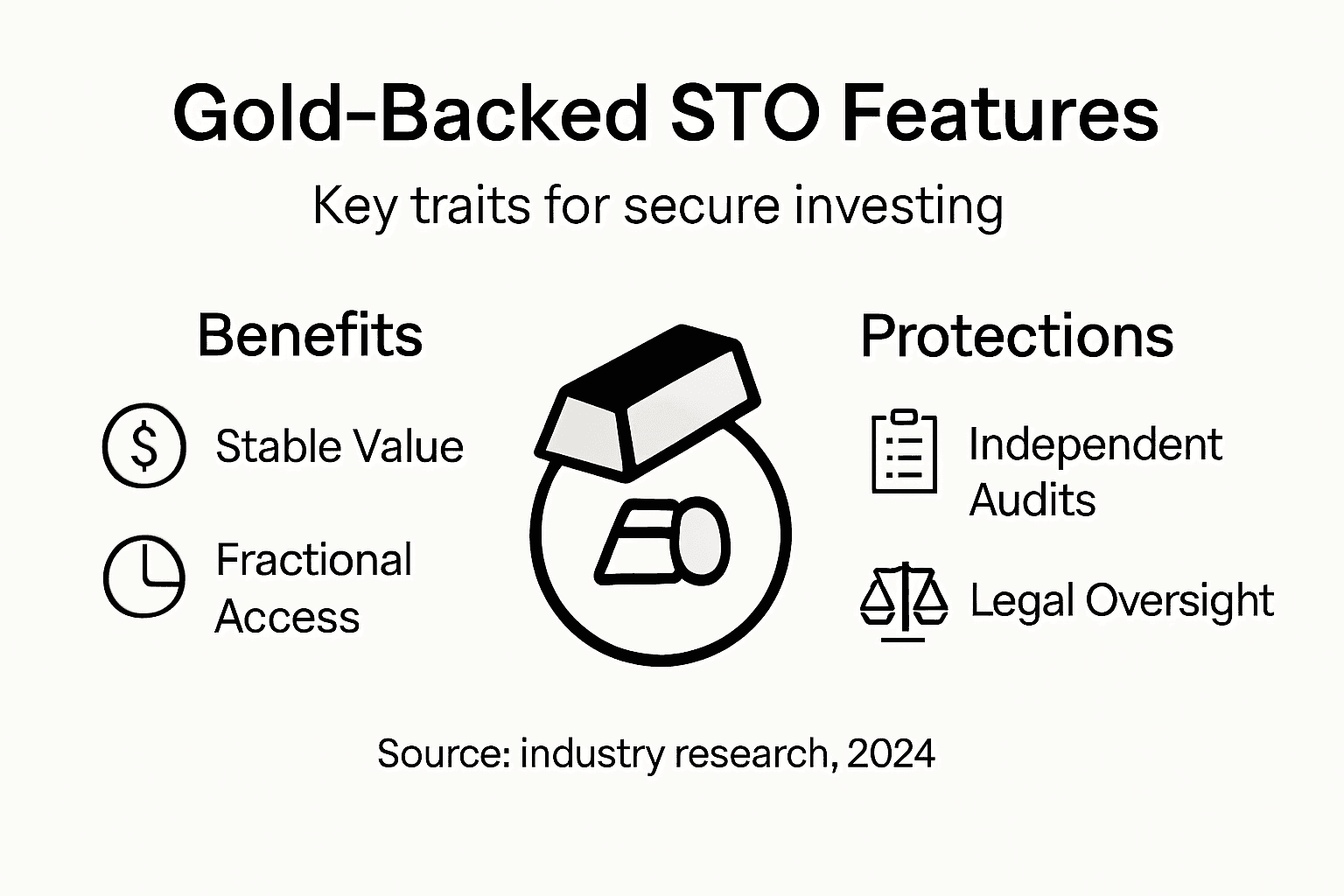
Pro tip: Before committing to any gold-backed token, request independent audit reports confirming reserve backing dated within the past 90 days and verify the custodian’s insurance coverage matches the total token value in circulation.
Global Regulatory Standards and Compliance
Security Token Offerings operate within an evolving regulatory landscape where compliance requirements vary significantly across jurisdictions. For institutional investors deploying capital globally, understanding these differences is non-negotiable. Regulatory frameworks determine whether your investment receives legitimate legal protection or faces operational restrictions that could impair liquidity and returns.
The regulatory environment has accelerated dramatically. Two-thirds of surveyed jurisdictions now actively regulate digital assets including security tokens, moving beyond ambiguity toward defined compliance structures. This global convergence creates both opportunity and complexity. Some jurisdictions embrace STOs through tailored frameworks, while others restrict them through conservative interpretations of existing securities laws.
Anti-money laundering and know-your-customer requirements form the compliance foundation across nearly all major markets. Your institution must verify the STO issuer’s implementation of robust KYC procedures that identify beneficial owners and source of funds. These measures protect your fund from regulatory sanctions and reputational damage. Asset-backed offerings require additional verification that underlying reserves genuinely exist and are properly custodied.
Sandbox frameworks have emerged as practical testing grounds for STO innovation. Several advanced jurisdictions permit limited-scale token offerings within regulatory sandboxes, allowing issuers to demonstrate compliance frameworks before full market launch. Participating in sandbox programs often indicates issuer seriousness and regulatory engagement.
Blockchain-enabled securities compliant with local securities laws benefit from World Bank research identifying best practices across global case studies. The organization emphasizes that harmonizing regulations globally remains a work in progress, with each jurisdiction pursuing slightly different approaches to investor protection and capital market development.
Digital asset regulation trends show diverse approaches focused on creating secure and equitable environments. Decentralized finance policies, custody standards, and settlement mechanisms vary considerably, requiring institutional investors to conduct jurisdiction-specific due diligence for each STO opportunity.
Transparency about regulatory status becomes essential. Reputable issuers clearly disclose their regulatory registrations, jurisdictional restrictions, and compliance certifications. Red flags include vague regulatory claims or operations across unregulated jurisdictions.
Pro tip: Before allocating capital to any STO, request written documentation of the issuer’s regulatory registrations, compliance certifications, and any sanctions history from your fund’s legal counsel. Verify this directly with relevant regulators rather than relying on issuer representations.
The table below summarizes critical compliance and regulatory diligence points institutions should assess when considering an STO:
| Regulatory Area | Key Due Diligence Focus | Impact on Investment |
|---|---|---|
| Jurisdictional Clarity | Legal registrations and oversight | Determines legal protection |
| Reserve & Custody Audits | Recent third-party verification | Verifies asset backing |
| AML/KYC Processes | Beneficial ownership checks | Reduces legal risk |
| Governance Transparency | Publicly disclosed structures | Assures control and rights |
Investor Rights, Risks, and Legal Protections
Investor protections in security token offerings depend critically on the legal structure binding tokens to underlying assets. Unlike traditional securities with centuries of legal precedent, STOs operate within emerging frameworks where token enforceability varies dramatically across jurisdictions. Your institutional risk assessment must account for these legal gaps before capital deployment.
The core issue centers on legal bonding between tokens and assets. When you purchase a security token, you need absolute certainty that your token represents a legally enforceable claim on the underlying asset or cash flows. Robust legal bonding between tokens and underlying assets directly determines asset transferability and legal certainty across different jurisdictions. Weak legal frameworks create situations where token ownership fails to translate into actual asset control during disputes or issuer insolvency.
Direct versus indirect tokenization affects your recovery rights substantially. Direct tokenization means the token itself represents your ownership stake in the underlying asset. Indirect tokenization places a legal intermediary between you and the asset, introducing counterparty risk. Institutional investors must demand direct tokenization structures with clear legal documentation establishing your claim.
Fraud and operational risks require explicit protection mechanisms. Legal frameworks adapted for digital token offerings must include transparency requirements, compliance measures, and consumer protection provisions designed to prevent fraud and manage blockchain-specific risks. Traditional securities law simply does not address custody protocols for digital assets or smart contract execution failures.
Compensation mechanisms remain underdeveloped. If an STO issuer commits fraud or a custodian loses your gold reserves, recovery depends on whether your jurisdiction extends investor protection funds to tokenized assets. Most do not. Your institutional protections rely entirely on issuer solvency and custodian insurance rather than regulatory guarantee funds.
Governance rights vary substantially. Some tokens grant voting participation on business decisions, while others provide only passive income rights. Clarify exactly what governance rights attach to your tokens before investing.
Pro tip: Engage legal counsel in the STO’s primary jurisdiction to review the offering documents and assess the strength of legal bonding between your tokens and underlying assets before any capital commitment.
Secure Your Gold-Backed Investments with Confidence
The article highlights the critical challenges of regulatory compliance, reserve verification, and transparent governance in security token offerings. If you are seeking to overcome the uncertainty of tokenized asset ownership and want clear proof of gold backing combined with full regulatory transparency, then your search ends here. At UK Financial Ltd, we specialize in delivering gold-backed digital securities that prioritize compliance, audited custody, and real-time blockchain tracking. These features directly address the article’s emphasis on legal bonding and independent reserve verification, helping you minimize risks linked to asset-backed tokens.
Explore our portfolio including the flagship Maya Preferred PRA token and discover how transparent proof of reserves and SEC-focused governance can enhance your investment decisions. Take control today and gain peace of mind by investing with a platform that reflects the highest standards of security, regulatory clarity, and verifiable collateral. Visit UK Financial Ltd now to access detailed performance data, legal disclosures, and start securing your wealth with trusted gold-backed digital assets.
Frequently Asked Questions
What is a security token offering (STO)?
A security token offering (STO) is a blockchain-based fundraising method that issues tokenized investment products in compliance with securities regulations, allowing for direct ownership stakes in regulated investment products.
How do gold-backed security tokens work, and what are their benefits?
Gold-backed security tokens represent claims on verified gold reserves stored securely, combining the stability of physical gold with the efficiency of blockchain technology, which improves liquidity and ensures price predictability.
What are the key regulatory compliance requirements for security token offerings?
STOs must adhere to regional securities laws, undergo legal reviews, and implement anti-money laundering (AML) and know-your-customer (KYC) processes to ensure investor protection and compliance.
What are the risks associated with investing in security tokens?
Investing in security tokens carries risks related to legal bonding between tokens and underlying assets, fraud, custodial risks, and the potential lack of investor protection funds in case of issuer insolvency.
Recommended
- UK Financial Ltd – Gold-Backed Cryptocurrency Portfolio
- UK Financial Ltd Establishes United States Operations in Delaware, Announces Texas Expansion
- UK Financial Ltd Receives Recognition In Platinum Crypto Academy’s Cryptonaire Weekly
- UK Financial Ltd Makes History as MayaCat (SMCAT) Becomes the World’s First Exchange-Traded ERC-3643 Security Token
- Bitcoin Becomes Digital Gold As Network Activity Drops 43% / Naijatipsland