
How Secure Are Digital Assets Backed by Gold

Global investment strategies are evolving rapidly as institutional capital seeks both security and compliance. With more than 95 percent of American institutional investors now allocating funds to digital assets, British and European fund managers are under growing pressure to explore innovative solutions like gold-backed tokens. For those in the United Kingdom, understanding how gold-backed digital assets deliver transparency, regulatory confidence, and seamless portfolio diversification is key to staying competitive in a changing market.
Table of Contents
- Digital Assets And Asset-Backed Tokens Defined
- Gold-Backed Cryptocurrencies And Tokenization
- Blockchain Verification And Proof Of Reserves
- Security Risks And Risk Mitigation Strategies
- UK Regulatory Compliance And Investor Protection
- Comparing Physical Gold And Digital Gold Ownership
Key Takeaways
| Point | Details |
|---|---|
| Digital Assets Revolution | Digital assets leverage blockchain technology to enhance ownership and transfer of value without intermediaries, making investment more accessible. |
| Asset-Backed Tokens Value | These tokens connect digital assets to physical or financial resources, enhancing liquidity and creating fractional ownership opportunities. |
| Gold-Backed Advantages | Gold-backed cryptocurrencies offer the stability of gold combined with the efficiency of digital assets, enabling easier investment and trade. |
| Security and Risk Management | Implementing multi-layered security and compliance strategies is essential for protecting digital assets and ensuring investor confidence. |
Digital assets and asset-backed tokens defined
Digital assets represent a transformative financial innovation leveraging blockchain technology to convert traditional value representations into electronic, programmable formats. These digital instruments enable secure, transparent ownership and transfer of value across global networks without traditional intermediaries.
At their core, digital assets rely on distributed ledger technologies757580_EN.pdf) like blockchain to represent various contractual rights and value propositions electronically. This technological infrastructure supports multiple asset types including cryptocurrencies, tokenized securities, and asset-backed tokens – digital representations directly linked to physical or financial assets.
Asset-backed tokens represent a sophisticated subset of digital assets where each token maintains a legal and technological connection to an underlying asset. These tokens legally embody enforceable rights over specific physical or financial resources, creating a bridge between traditional asset ownership and digital financial ecosystems. The token’s value directly correlates with its underlying asset, providing several key characteristics:
- Direct representation of tangible asset value
- Transparent ownership records
- Immutable transaction histories
- Potential for fractional ownership
- Enhanced liquidity and transferability
Institutional investors recognize asset-backed tokens as a method to digitize traditionally illiquid assets, enabling more dynamic and accessible investment strategies. By converting real-world assets into programmable digital tokens, these instruments democratize access to investment opportunities previously restricted by geographical or regulatory constraints.
Pro Tip: Before investing in asset-backed tokens, always verify the legal framework and asset verification mechanisms to ensure legitimate token-to-asset connections.
Gold-backed cryptocurrencies and tokenization
Gold-backed cryptocurrencies represent a sophisticated financial innovation bridging traditional precious metal investment with modern blockchain technology. These digital tokens provide direct ownership of physical gold through blockchain-enabled platforms, offering investors a unique blend of stability and technological flexibility.
Tokenization transforms gold investment by creating digital representations of physical gold reserves, enabling fractional ownership and enhanced liquidity. Financial institutions are exploring gold tokenization strategies that allow investors to own and trade gold-backed digital assets with unprecedented ease and transparency. The process involves several critical mechanisms:
- Direct 1:1 mapping of digital tokens to physical gold reserves
- Regular third-party audits of underlying gold holdings
- Blockchain-verified ownership and transfer records
- Potential for instant global trading
- Lower storage and transaction costs compared to physical gold
Institutional investors find gold-backed cryptocurrencies particularly appealing because they combine gold’s historical wealth preservation characteristics with blockchain’s technological advantages. These tokens eliminate traditional barriers like physical storage, transportation risks, and high transaction fees associated with physical gold trading. Investors can now own, transfer, and trade gold-backed digital assets with just a few clicks, democratizing access to this traditional safe-haven asset.

Pro Tip: Verify the credibility of gold-backed cryptocurrency issuers by examining their reserve auditing processes, regulatory compliance, and transparency of physical gold holdings before investing.
Here’s how asset-backed tokens and gold-backed cryptocurrencies differ in structure and investment benefits:
| Aspect | Asset-Backed Token | Gold-Backed Cryptocurrency |
|---|---|---|
| Underlying Asset | Physical or financial assets | Allocated physical gold |
| Ownership Rights | Legal claim to asset | Digital claim to gold |
| Trading Venue | Private/blockchain networks | Public blockchain exchanges |
| Value Correlation | Depends on various assets | Pegged to gold price |
| Typical Investors | Institutions, high-net-worth | Broader retail adoption |
| Audit Requirements | Varies by jurisdiction | Frequent third-party audits |
Blockchain verification and proof of reserves
Blockchain verification represents a groundbreaking approach to ensuring transparency and authenticity in digital asset management, particularly for gold-backed cryptocurrencies. Blockchain technology enables immutable ownership tracking by creating permanent, unalterable records of asset ownership and transaction histories that cannot be manipulated or deleted.
Proof of reserves serves as a critical mechanism for establishing trust in digital asset ecosystems. Decentralized verification services automatically monitor asset reserves in real-time, providing investors with unprecedented transparency and confidence. This technological innovation addresses several key challenges in traditional asset management:
- Preventing unauthorized token issuance
- Ensuring complete asset collateralization
- Providing real-time transparency of holdings
- Reducing counterparty risks
- Enabling instant independent verification
The technical architecture of blockchain verification involves sophisticated cryptographic techniques that link digital tokens directly to physical asset reserves. Smart contracts can automatically suspend token trading or minting if reserve levels fall below predefined thresholds, creating a self-regulating mechanism that protects investor interests. This approach transforms traditional asset verification from a periodic, manual process to a continuous, automated system that provides instantaneous insights into asset backing and authenticity.
Institutional investors increasingly recognize blockchain verification as a game-changing technology that bridges the gap between traditional financial systems and digital asset management. By providing irrefutable, transparent documentation of asset reserves, these technologies dramatically reduce the potential for fraud, misrepresentation, and financial misconduct.
Pro Tip: Always review the specific blockchain verification mechanisms and proof of reserve protocols before investing in any gold-backed digital asset.
Security risks and risk mitigation strategies
Digital asset security represents a complex landscape of technological and regulatory challenges that require sophisticated, multilayered protection strategies. Comprehensive risk management approaches are critical for digital asset protection to safeguard institutional and individual investor interests against emerging cyber threats and market vulnerabilities.
Cybersecurity measures must address multiple threat vectors through integrated defense mechanisms. The most critical security risks in gold-backed digital assets include:
- Sophisticated malware attacks
- Phishing and social engineering attempts
- Unauthorized blockchain access
- Data breach vulnerabilities
- Advanced persistent threats
- Regulatory compliance failures
Institutional investors must implement comprehensive risk mitigation strategies that combine technological safeguards with robust governance frameworks. This involves developing advanced encryption protocols, implementing multi-factor authentication, conducting regular security audits, and maintaining adaptive incident response plans. The goal is creating a dynamic security ecosystem that can anticipate, detect, and neutralize potential threats before they compromise digital asset integrity.
Effective risk management requires a holistic approach that integrates technological solutions with strategic organizational practices. This means developing comprehensive cybersecurity training programs, establishing clear communication protocols during potential security events, and maintaining transparent reporting mechanisms that allow rapid response to emerging threats.
Pro Tip: Conduct quarterly comprehensive security assessments and maintain an up-to-date incident response plan that includes detailed protocols for potential digital asset compromise scenarios.
Here is a comparison of threat management approaches for digital assets and physical gold:
| Risk Category | Digital Asset Approach | Physical Gold Approach |
|---|---|---|
| Security Breach | Encryption, access control | Physical vault protection |
| Regulatory Compliance | Ongoing audits, KYC/AML | Ownership documentation |
| Transfer Process | Blockchain-based validation | Manual transport/inspection |
| Transparency | Public ledger monitoring | Private ownership records |
| Recovery Options | Smart contract controls | Insurance, legal process |
UK regulatory compliance and investor protection
Digital asset regulation in the United Kingdom represents a sophisticated approach to protecting investor interests while fostering financial innovation. UK regulatory frameworks are evolving to address cryptoasset complexities by implementing comprehensive consumer protection measures that align digital asset markets with traditional financial oversight standards.
New legislation targets cryptoasset service provider accountability through robust regulatory mechanisms designed to enhance market transparency and investor confidence. The key regulatory priorities for gold-backed digital assets include:
- Mandatory operational resilience standards
- Enhanced anti-money laundering protocols
- Comprehensive consumer protection requirements
- Transparent reporting and disclosure mandates
- Rigorous cybersecurity infrastructure guidelines
- Regular compliance and audit mechanisms
Institutional investors must navigate these evolving regulatory landscapes by maintaining strict adherence to the Financial Conduct Authority’s (FCA) guidelines. This involves implementing sophisticated governance frameworks that go beyond minimal compliance, proactively addressing potential regulatory gaps and demonstrating a commitment to maintaining the highest standards of financial integrity and investor protection.
The regulatory approach emphasizes a balanced strategy that supports technological innovation while establishing clear accountability mechanisms. By creating a structured environment that protects investor interests, the UK aims to position itself as a global leader in responsible digital asset management, offering a secure and transparent ecosystem for gold-backed cryptocurrency investments.
Pro Tip: Consult with specialized regulatory compliance experts who understand the nuanced requirements of gold-backed digital assets to ensure comprehensive adherence to emerging UK financial regulations.
Comparing physical gold and digital gold ownership
Gold ownership has dramatically transformed with the emergence of digital technologies, offering investors unprecedented flexibility in how they approach this traditional safe-haven asset. Investor preferences are shifting between physical and digital gold formats, reflecting the evolving landscape of investment strategies and technological capabilities.
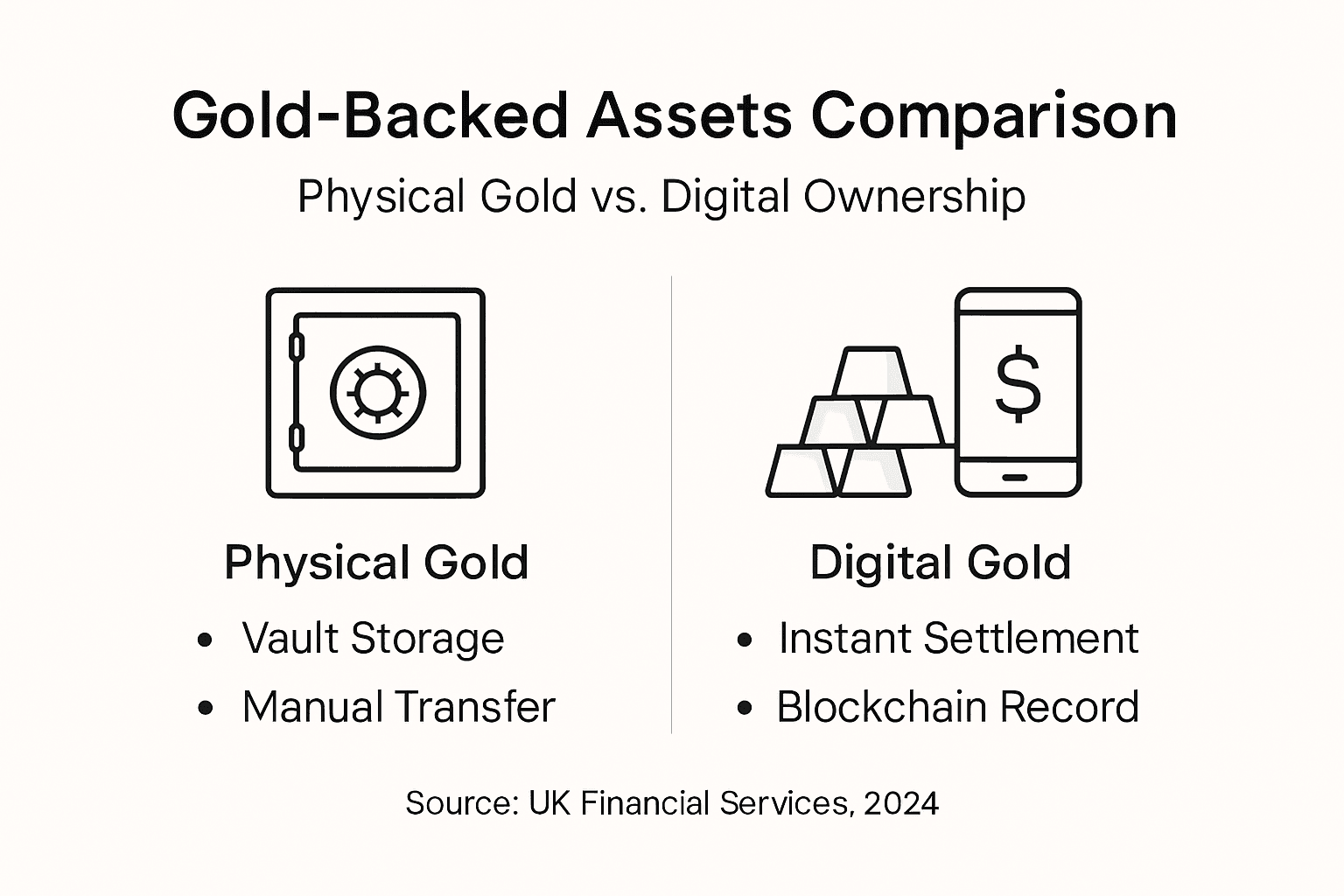
Traditional physical gold ownership presents distinct advantages and limitations compared to its digital counterparts:
Physical Gold Advantages:
- Tangible asset with direct ownership
- No technological dependency
- Cultural and psychological sense of security
- No counterparty risk
- Potential for private, anonymous transactions
Digital Gold Advantages:
- Instant global transferability
- Fractional ownership possibilities
- Lower storage and transportation costs
- Enhanced liquidity
- Real-time tracking and transparency
- Simplified international trading
Institutional investors increasingly recognize digital gold as a sophisticated investment vehicle that bridges traditional asset preservation with modern technological innovation. Digital gold tokens provide a seamless mechanism for gold investment, eliminating many logistical challenges associated with physical gold while maintaining the fundamental value proposition of gold as a hedge against economic uncertainty.
The transition from physical to digital gold represents more than a technological shift—it’s a fundamental reimagining of asset ownership. Digital gold allows investors to maintain gold’s intrinsic value while leveraging blockchain’s transparency, divisibility, and global accessibility, creating a more dynamic and responsive investment ecosystem.
Pro Tip: Diversify your gold investment strategy by maintaining a balanced portfolio that includes both physical and digital gold assets to optimize risk management and investment flexibility.
Secure Your Investment with Verified Gold-Backed Digital Assets
The article highlights critical challenges around the security, transparency, and legal verification of digital assets backed by gold. Investors worry about counterfeit tokens, unclear proof of reserves, and regulatory compliance gaps. At UK Financial Ltd, we address these exact concerns by offering a platform that emphasizes blockchain verification, real-time proof of reserves, and strict regulatory adherence to protect your investment. Our portfolio of asset-backed cryptocurrencies like the Maya Preferred PRA provides confidence through transparent ownership records and ongoing audits, bridging the gap between traditional gold investment and digital innovation.
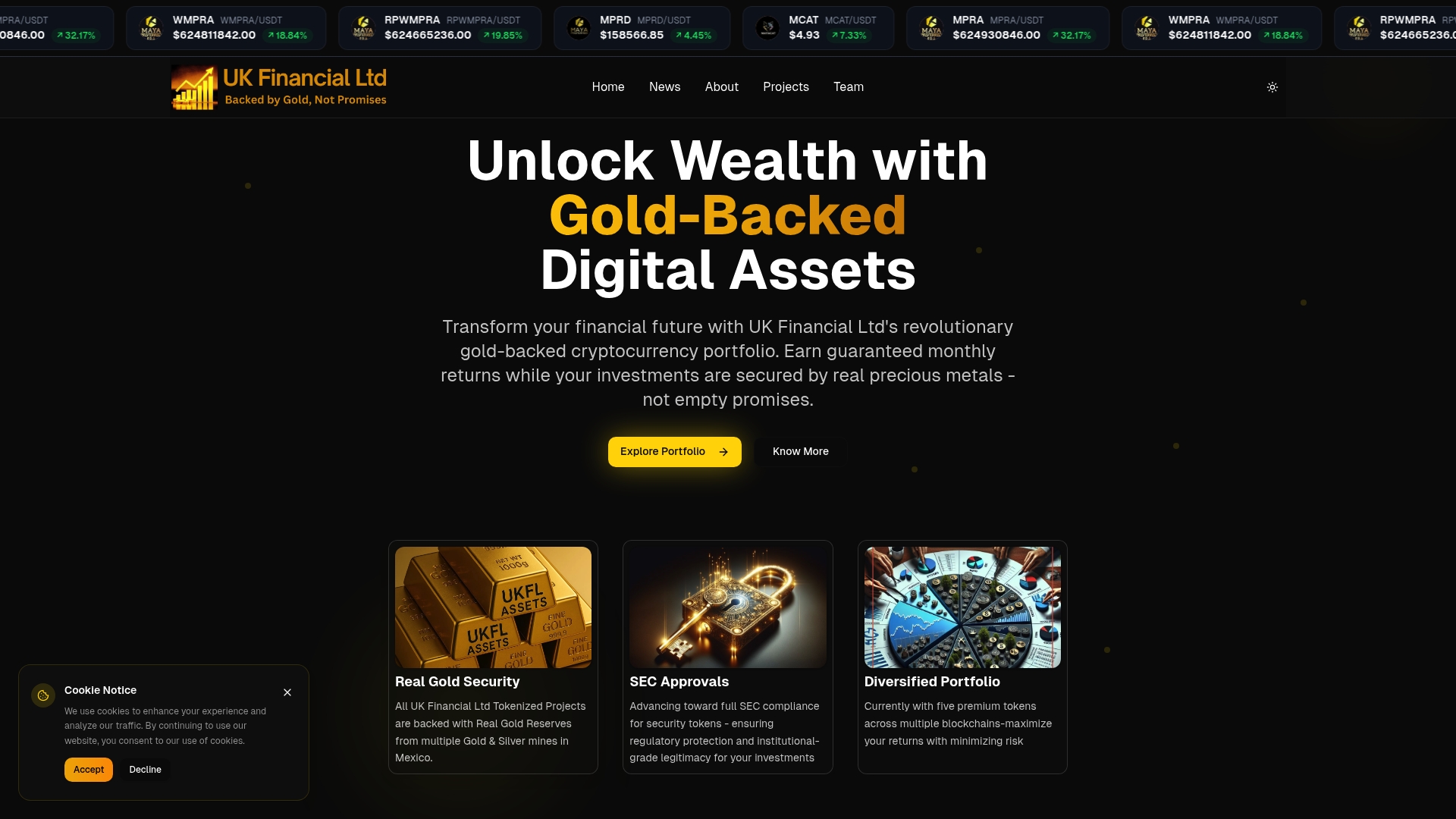
Explore a trusted way to benefit from gold-backed digital assets designed with your security in mind. Visit UK Financial Ltd now to access live token performance data, proof of reserve reports, and discover how we combine precious metal stability with cutting-edge blockchain technology. Secure your financial future today by joining a platform committed to transparency, regulatory compliance, and investor protection.
Frequently Asked Questions
What are digital assets backed by gold?
Digital assets backed by gold are digital tokens that represent ownership of physical gold reserves through blockchain technology, providing a blend of stability and flexibility for investors.
How do blockchain verification and proof of reserves enhance the security of gold-backed digital assets?
Blockchain verification ensures transparency through immutable records of ownership, while proof of reserves provides real-time monitoring of asset backing, enhancing investor confidence and security.
What security risks are associated with gold-backed digital assets?
Key security risks include cyberattacks, unauthorized access to blockchain networks, and regulatory compliance failures, which necessitate comprehensive risk management strategies to mitigate these threats.
Why should investors consider both physical and digital gold ownership?
Combining physical and digital gold ownership allows investors to benefit from the tangible security of physical gold while enjoying the liquidity and ease of trading offered by digital gold assets.
Recommended
- UK Financial Ltd – Gold-Backed Cryptocurrency Portfolio
- UK Financial Ltd Establishes United States Operations in Delaware, Announces Texas Expansion
- News | UK Financial Ltd
- UK Financial Ltd Executes Compliance Tasks Ahead Of First-Ever ERC-3643 Exchange-Traded Token, SMCAT & Sets Date For Online Investor Governance Vote
- Gold, silver prices hold steady with ‘underlying bullish trend’ in place