
Role of Gold in Digital Assets: Institutional Impact

Gold-backed digital assets are reshaping how portfolios achieve resilience in uncertain global markets. Institutional investors face ongoing challenges with volatility, inflation, and the need for transparent, secure solutions. By combining physical gold’s enduring value with real-time blockchain transparency and independent third-party audits, these SEC-compliant tokens offer a modern path to diversification, price stability, and proactive compliance—all essential for institutional-grade wealth preservation.
Table of Contents
- Gold-Backed Digital Assets Explained
- Types of Gold-Backed Tokens and Their Features
- Blockchain Integration, Transparency, and Security
- Regulatory Frameworks and Compliance Essentials
- Portfolio Diversification: Institutional Benefits and Risks
- Comparing Gold-Backed Tokens to Alternatives
Key Takeaways
| Point | Details |
|---|---|
| Gold-Backed Digital Assets | These assets blend the security of gold with blockchain efficiency, providing stability and transparency for investors. |
| Operational Advantages | Gold-backed tokens allow for instant transactions, reducing settlement times and operational costs compared to traditional gold trading. |
| Regulatory Compliance | The regulatory landscape for gold-backed tokens varies by jurisdiction, requiring careful consideration for institutional investors. |
| Portfolio Diversification | Gold-backed tokens serve as effective diversification tools, providing protection against market volatility and geopolitical risks. |
Gold-Backed Digital Assets Explained
Gold-backed digital assets represent a hybrid financial instrument that marries the tangible security of physical precious metals with the efficiency and transparency of blockchain technology. These are digital tokens secured by verified gold reserves held in institutional vaults, allowing investors to own fractional interests in physical gold without the logistical complexities of direct ownership. Unlike speculative cryptocurrencies, gold-backed tokens derive their value directly from gold’s market price, creating a stable store of value that moves predictably with precious metals markets rather than market sentiment or technological adoption cycles.
The core appeal for institutional investors lies in how these assets function as price-stable instruments while maintaining blockchain advantages. When you purchase a gold-backed digital asset, you’re acquiring a claim on specific quantities of physical gold held by regulated custodians. This architecture offers several practical benefits: your holdings can be transferred instantly on blockchain networks without the 3-5 day settlement delays of traditional gold trading, you gain real-time transparency through gold backing verification systems, and you eliminate counterparty risk through independent third-party audits that confirm reserve adequacy. The token represents your ownership stake in precisely measured gold amounts, eliminating the valuation uncertainty that plagues unverified digital assets.
What makes these particularly valuable in diversified portfolios is their low correlation with traditional financial assets, which means they move independently from stocks, bonds, and conventional currencies. During periods of geopolitical instability or market volatility, gold-backed digital assets have historically provided portfolio cushioning because institutional investors simultaneously reduce risk exposure across correlated assets while increasing gold positions. The blockchain infrastructure enables you to establish or liquidate positions rapidly, access your holdings from any jurisdiction with internet connectivity, and participate in secondary markets that operate 24/7 without the geographic and time-zone constraints of physical precious metals trading. The technology layer also creates permanent, auditable records of ownership transfers and reserve status, addressing the transparency gaps that have historically plagued certain precious metals markets.
Pro tip: Verify that any gold-backed digital asset provider maintains independently audited reserves and publishes real-time proof-of-reserve reports on-chain. This distinction separates institutional-grade offerings from unverified competitors, directly impacting your actual wealth protection and regulatory compliance standing.
Types of Gold-Backed Tokens and Their Features
Gold-backed tokens come in distinct structural formats, each designed to serve different investment objectives and regulatory environments. The primary distinction separates fully backed tokens from fractional reserve models, with each approach offering different trade-offs between security assurances and operational flexibility. Fully backed tokens maintain a one-to-one relationship between circulating tokens and physical gold held in secure vaults, meaning every token in circulation has an equivalent ounce or gram of gold backing it. This structure appeals to conservative institutional investors prioritizing absolute capital preservation, as it eliminates any maturity mismatch or reserve deficiency risk. Fractional reserve tokens, by contrast, maintain partial gold backing while allowing greater liquidity and lower transaction costs. These tokens circulate more freely and trade more actively, making them attractive for institutions seeking exposure to gold price movements without accepting the liquidity constraints of fully backed alternatives.

Beyond reserve structure, gold-backed token variations differ significantly in their legal architecture, transferability mechanisms, and integration pathways with traditional financial systems. Some tokens grant token holders direct ownership claims on specific bullion, while others provide contractual claims that require custodian cooperation for redemption. The transferability dimension matters considerably for institutional portfolios: tokens built on Ethereum or other mature blockchain networks offer immediate, irreversible settlement and 24-hour market access, whereas custodian-dependent models may require business-day processing windows and intermediary approval. Token issuance structures also vary, with some providers using fixed supplies tied directly to vault contents and others maintaining dynamic supplies that expand or contract based on demand. Your selection criteria should prioritize which combination serves your specific operational requirements: Do you need instant settlement for active trading, or will periodic redemption windows suffice? Do you require direct bullion claims, or do custodian-backed agreements provide sufficient assurance? These decisions directly impact your actual liquidity, counterparty risk exposure, and regulatory classification in your home jurisdiction.
Price stability mechanisms represent another critical differentiation point among token varieties. Some gold-backed tokens maintain price stability through arbitrage mechanisms where token holders can redeem directly at fixed rates, while others rely on market pricing that fluctuates with spot gold prices. The former approach reduces your trading flexibility but eliminates slippage, whereas the latter provides tighter integration with gold markets but may introduce minor pricing deviations. Institutional investors should also evaluate whether token designs include governance participation, staking opportunities, or yield generation features layered atop the gold backing. These supplementary features can enhance returns but may introduce additional complexity, regulatory scrutiny, or concentration risk if the income generation mechanism fails or underperforms.
Pro tip: Compare the redemption terms, settlement timelines, and custodial arrangements of competing gold-backed tokens before committing capital, as these operational details determine whether a token aligns with your fund’s settlement infrastructure and risk management protocols.
Here’s a comparison of gold-backed digital tokens based on structure, security, and operational relevance:
| Token Structure | Security Mechanism | Operational Benefit |
|---|---|---|
| Fully backed | One-to-one gold vaulting, audits | Maximum capital preservation |
| Fractional reserve | Partial backing, broader audits | Higher liquidity, lower transaction cost |
| Direct bullion claim | Holder has legal title to specific gold | Precise ownership, simple redemption |
| Custodian-backed contract | Claim enforced via custodian agreement | Smoother integration, flexible access |
Blockchain Integration, Transparency, and Security
Blockchain technology fundamentally transforms how gold-backed assets operate by creating permanent, tamper-proof records of ownership and transaction history. When you acquire a gold-backed token, your purchase is recorded on a distributed ledger that no single entity can alter retroactively. This immutability directly addresses a historical problem in precious metals markets: the difficulty in proving continuous chain of custody and detecting counterfeit or double-counted reserves. The blockchain acts as a shared ledger that all parties can verify independently, eliminating the need to blindly trust a single custodian or clearing house. Every token transfer, redemption request, and reserve verification is permanently etched into the ledger, creating an audit trail that institutional compliance departments can review at any time. This architecture is particularly valuable for fund managers who must satisfy regulatory requirements around asset verification and who face liability if holdings turn out to be misrepresented.
Transparency in gold-backed tokens operates through multiple reinforcing mechanisms beyond simple blockchain recording. Smart contracts managing gold reserves automatically execute predetermined actions when specific conditions are met, such as triggering redemptions when token holders submit withdrawal requests or automatically adjusting token supplies when vault contents change. These self-executing agreements eliminate the discretionary decisions that create opacity in traditional precious metals arrangements. Regular third-party audits complement the blockchain layer by physically inspecting vaults, verifying gold quantities and purity, and publishing audit reports that can be cross-referenced against on-chain reserve data. The most sophisticated providers publish real-time proof-of-reserve systems that allow you to verify current holdings without waiting for periodic audit cycles. You can essentially audit the system continuously rather than relying on point-in-time snapshots that become obsolete within hours.
Security architecture for gold-backed tokens employs layered protections addressing both digital and physical threats. Cryptographic keys and multi-signature wallets prevent unauthorized movement of tokens or backing reserves, requiring multiple parties to approve significant transactions. This multi-party requirement means that even if one key holder’s security is compromised, the entire system remains protected. Decentralized consensus mechanisms prevent double-spending attacks where someone could attempt to use the same token twice, a problem that plagued early cryptocurrency attempts but that mature networks like Ethereum have effectively solved. Physical security addresses counterparty risk by distributing gold holdings across multiple geographically separate vaults operated by independent custodians, ensuring that no single facility failure or malicious actor can compromise the entire reserve base. Institutional investors should verify that token providers employ independent security audits of both their cryptographic infrastructure and physical vault arrangements, creating overlapping verification systems that catch problems multiple parties would otherwise miss.
Pro tip: Request direct access to a provider’s proof-of-reserve dashboard and verify that it updates in real-time with publicly verifiable data; this distinction separates providers offering genuine on-chain transparency from those offering periodic reports that lag actual market conditions.
Regulatory Frameworks and Compliance Essentials
The regulatory treatment of gold-backed digital assets remains one of the most complex variables determining whether institutional investors can legally acquire them. Regulators worldwide have not converged on a single classification, meaning the same token might be treated as a commodity in one jurisdiction, a security in another, and a currency equivalent in a third. This fragmentation creates genuine compliance challenges for fund managers operating across borders. In the United States, the Securities and Exchange Commission (SEC) examines whether gold-backed tokens constitute securities under the Howey Test, which evaluates whether an investment involves pooling money, expecting profits from the efforts of others, and lacking inherent utility. If classified as a security, tokens must either register with the SEC or qualify for an exemption, triggering substantial compliance costs and ongoing reporting obligations. Conversely, the Commodity Futures Trading Commission (CFTC) may classify gold-backed tokens as commodities derivatives, subjecting them to different regulatory oversight. European regulators approach this through Markets in Crypto-Assets Regulation (MiCA), which applies rules based on token functionality rather than underlying assets. Understanding your home jurisdiction’s specific framework is not optional—it directly determines whether you can legally hold or trade these assets.
Anti-money laundering (AML) and know-your-customer (KYC) requirements represent unavoidable compliance components for any credible gold-backed token provider. These measures require token issuers and exchanges to verify investor identities, conduct background screening, and maintain detailed records of transactions above specified thresholds. For institutional investors, this translates into providing corporate documentation, beneficial ownership disclosures, and sources of funds verifications. Transparent reserve audits and consumer protection standards form another pillar of compliance, with regulators increasingly demanding that providers submit to independent audits and publish verifiable proof that physical gold actually exists and matches circulating token supplies. This audit layer exists specifically to prevent the fraud scenarios that plagued unregulated precious metals markets historically. Regulators also scrutinize whether token designs include adequate investor protections, such as clear redemption procedures, dispute resolution mechanisms, and segregated custody arrangements that protect your holdings even if the token issuer becomes insolvent.
Compliance essentials for institutional adoption involve meeting financial regulation standards including licensing for money transmission and securities registration. Issuers pursuing mainstream institutional acceptance must proactively align with evolving regulatory expectations across multiple jurisdictions rather than waiting for clear guidance. This means establishing governance structures that facilitate regulated secondary market trading, ensuring transparency of gold reserves exceeds minimum requirements, and safeguarding investor rights through contractual documentation that anticipates regulatory changes. Fund managers should evaluate whether prospective token providers have secured relevant licenses in major markets, undergone regulatory pre-approval processes, or maintained ongoing dialogue with financial regulators. Providers demonstrating this proactive compliance posture create substantially lower execution risk for your portfolio allocations, as they have already navigated the regulatory hurdles that could later disqualify unvetted alternatives.
Pro tip: Request documentation of a gold-backed token provider’s regulatory filings, licenses, and audit certifications in your home jurisdiction before committing capital, and verify directly with your compliance counsel that holdings meet your fund’s investment mandate requirements.
The following table highlights key regulatory and compliance considerations for institutional adoption:
| Regulator/Framework | Classification Focus | Institutional Impact |
|---|---|---|
| SEC (U.S.) | Securities (Howey Test) | Registration, reporting, exemptions needed |
| CFTC (U.S.) | Commodities/derivatives | Different oversight, varied compliance |
| MiCA (EU) | Token function over asset type | Functional rules, not asset-dependent |
| AML/KYC requirements | Identity and transaction verification | Corporate docs, ongoing monitoring |
Portfolio Diversification: Institutional Benefits and Risks
Gold-backed digital assets function as a diversification tool by introducing an asset class with fundamentally different return drivers than equities, bonds, and traditional currencies. When your portfolio experiences stress from geopolitical events, inflation spikes, or equity market corrections, gold typically moves in the opposite direction. This negative correlation is not incidental—it reflects gold’s historical role as a safe-haven asset that investors buy precisely when they distrust other investments. Gold-backed tokens replicate this protective characteristic while adding operational advantages: you can access these assets instantly through digital platforms rather than navigating the physical logistics of bullion trading, and you can integrate them seamlessly into modern portfolio management systems that track all holdings in real-time. For institutional fund managers, this means achieving diversification benefits without accepting the friction costs that traditionally accompanied precious metals exposure. A pension fund holding equities and bonds might historically struggle to maintain a meaningful gold allocation because the transaction costs and custody complexities made small positions uneconomical. Gold-backed tokens eliminate this friction, allowing you to maintain precise allocations without disproportionate operational overhead.
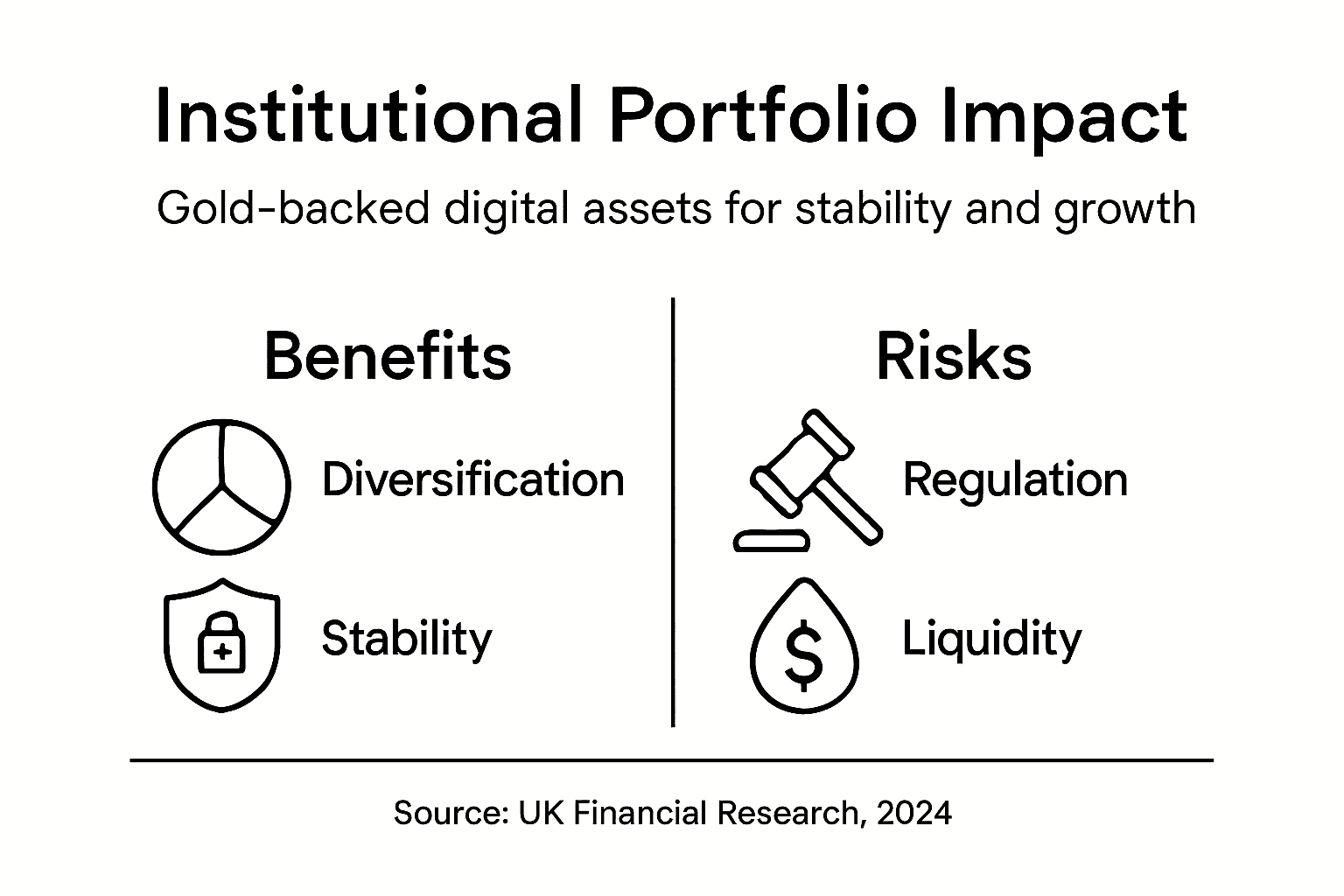
The hedging mechanics work particularly well during financial crises when correlation patterns shift dramatically. Gold-backed tokens provide stable, low-correlation assets that hedge against macroeconomic risks and traditional market volatility, delivering the safe-haven effect when you need it most. Historical data shows that during the 2008 financial crisis and again during the 2020 pandemic market shock, gold prices surged while equity indices collapsed, providing precisely the diversification benefit portfolio theory predicts. The digital token format enhances this benefit by enabling rapid rebalancing: if your equity allocation drops from 60 percent to 50 percent due to market decline, you can instantly rebalance back to target weights using token redemptions and purchases, capturing the “buy low” benefits of disciplined rebalancing without waiting for traditional settlement cycles. Unlike physical gold, which requires shipping, insurance, and vault allocation coordination across holdings, tokens settle within hours, making tactical rebalancing economically feasible.
Risks require equally serious consideration before allocating significant capital to gold-backed tokens. Regulatory uncertainty remains genuine despite increasing clarity, as jurisdiction-specific classification changes could suddenly affect your ability to hold or trade positions. Liquidity risks exist particularly for emerging or lesser-known tokens where secondary market depth may prove insufficient to exit positions without meaningful price impact during stress events. Technological vulnerabilities in smart contract code or blockchain infrastructure, though rare in mature networks, create tail risks that traditional assets do not present. Counterparty risks centered on gold custody remain material: if a token provider’s custodian experiences fraud, theft, or insolvency, your holdings face recovery uncertainty regardless of the blockchain’s technical security. You must also evaluate whether the token issuer itself faces financial stress that could disrupt operations, affect reserve audits, or force unfavorable redemption terms during market crises.
Pro tip: Allocate gold-backed tokens to portfolio positions where diversification benefits outweigh operational risks, starting with established providers operating in your home jurisdiction with demonstrated track records of regulatory compliance and independent audit transparency.
Comparing Gold-Backed Tokens to Alternatives
The digital asset ecosystem presents institutional investors with multiple stablecoin options, each built on fundamentally different backing mechanisms. Fiat-backed stablecoins like USDC or USDT maintain reserves denominated in government currencies such as dollars or euros, offering the broadest acceptance across cryptocurrency exchanges and trading platforms. These tokens provide exceptional liquidity and near-universal recognizability, making them ideal for operational convenience and rapid settlement of transactions. However, fiat-backed alternatives inherit the weaknesses of their underlying currencies: they cannot protect you from inflation or monetary policy shifts, they expose you to central bank decisions that may devalue the reference currency, and they provide no diversification benefit during currency crises. A fund manager holding fiat stablecoins during periods of aggressive central bank money printing experiences real purchasing power erosion, exactly when you would most benefit from portfolio protection. Commodity-backed alternatives like oil futures or agricultural derivatives offer diversification similar to gold-backed tokens, but they introduce different risk profiles: agricultural commodities face harvest volatility, energy commodities spike unpredictably with geopolitical supply disruptions, and metal commodities beyond gold exhibit higher correlation with industrial activity cycles.
Gold-backed tokens occupy a distinctive middle ground by offering characteristics that pure fiat stablecoins cannot match while providing more stable value than speculative commodity alternatives. Gold tokens deliver better inflation hedging and portfolio risk reduction compared to fiat-backed stablecoins, which may have lower liquidity in emerging markets or face regulatory restrictions in certain jurisdictions. The critical distinction emerges during macroeconomic stress: when fiat stablecoins struggle with confidence issues or face regulatory uncertainty, gold-backed tokens derive value from tangible physical assets that maintain purchasing power across economic cycles. Fiat stablecoins essentially promise that the token issuer will honor redemptions in government currency, a promise that works perfectly until it does not. Gold-backed tokens make a different promise: your token represents physical gold in a vault, a claim that remains valid regardless of whether currency systems experience disruption. This distinction explains why institutional investors increasingly view gold tokens as a distinct asset class rather than merely another stablecoin variant.
Liquidity and operational cost tradeoffs merit careful evaluation before deciding between alternatives. Fiat-backed stablecoins typically enjoy deeper secondary market liquidity because they are more widely integrated into retail and institutional trading infrastructure, meaning you can instantly convert large positions without moving prices. Gold-backed tokens face narrower liquidity pools that can introduce slippage on large trades, though this disadvantage shrinks as the market develops and more trading venues integrate these assets. Gold tokens may have lower liquidity and higher operational costs than fiat stablecoins due to physical gold custody requirements, vault auditing expenses, and smaller trading volumes, which translates to larger bid-ask spreads and potential price impact on institutional-scale transactions. Regulatory clarity also differs dramatically: fiat-backed stablecoins navigate well-established frameworks in most developed markets, while gold-backed alternatives face evolving regulatory scrutiny that could improve or worsen their legal status. Your specific decision depends entirely on your priorities: if you prioritize maximum liquidity and regulatory certainty, fiat stablecoins serve you better. If you prioritize inflation protection and portfolio diversification independent of currency systems, gold-backed tokens offer advantages that no fiat alternative can replicate.
Pro tip: Structure a core allocation to gold-backed tokens for their diversification and inflation-hedging properties, while maintaining fiat stablecoin positions for operational flexibility and immediate settlement needs, rather than viewing them as interchangeable alternatives.
Unlock the Full Potential of Gold-Backed Digital Assets with UK Financial Ltd
Navigating the complexities of gold-backed digital assets requires transparency, security, and regulatory compliance. This article highlights the challenges institutional investors face, from regulatory uncertainty to custody risks and liquidity concerns. If you want to convert these challenges into opportunities for wealth preservation and portfolio diversification, there is no better place than UK Financial Ltd. We provide a trusted platform where you can access fully backed gold tokens with real-time blockchain asset tracking and verified proof-of-reserve reports that ensure your holdings are secure and transparent.
Experience the confidence that comes with investing in a regulated ecosystem featuring tokens like the Maya Preferred PRA and MayaCat meme coin, all backed by tangible precious metals. Start protecting your portfolio with inflation-hedging gold-backed tokens today at UK Financial Ltd. Learn more about our governance, live token performance, and compliance initiatives to make informed investment decisions now.
Frequently Asked Questions
What are gold-backed digital assets?
Gold-backed digital assets are digital tokens that are secured by verified gold reserves held in institutional vaults, allowing investors to own fractional interests in physical gold while benefiting from the efficiency and transparency of blockchain technology.
How do gold-backed tokens differ from traditional cryptocurrencies?
Unlike traditional cryptocurrencies, which can be highly speculative, gold-backed tokens derive their value directly from the market price of gold, offering a more stable store of value that is less influenced by market sentiment or technological adoption cycles.
What are the benefits of using gold-backed digital assets in an investment portfolio?
Gold-backed digital assets provide diversification, stability, and protection against market volatility; they typically have low correlation with traditional financial assets, making them effective hedges during periods of geopolitical instability or economic uncertainty.
What regulatory challenges do gold-backed digital assets face?
Gold-backed digital assets face complex regulatory frameworks that can classify them differently based on jurisdiction, which may impact their legality, compliance requirements, and investor protections. Understanding the specific regulations in your jurisdiction is crucial before investing.
Recommended
- UK Financial Ltd – Gold-Backed Cryptocurrency Portfolio
- UK Financial Ltd Establishes United States Operations in Delaware, Announces Texas Expansion
- UK Financial Ltd Executes Compliance Tasks Ahead Of First-Ever ERC-3643 Exchange-Traded Token, SMCAT & Sets Date For Online Investor Governance Vote
- News | UK Financial Ltd
- Role of AI in Cryptocurrency – Smarter, Safer Trading