
Risks of Digital Asset Investment – What Fund Managers Must Know

Over the past five years, institutional allocations to digital assets have grown by more than 32 percent as american and European fund managers seek stability and compliance in an unpredictable climate. As regulatory shifts and market shocks create uncertainty, global investors are looking to gold-backed tokens for risk mitigation and effective diversification. Understanding the nuances between classic cryptocurrencies, digital gold assets, and evolving compliance demands is vital for strategic, secure participation in this dynamic investment space.
Table of Contents
- Digital Asset Investments Explained And Debunked
- Gold-Backed Tokens Versus Classic Cryptos
- Navigating Global Regulatory And Compliance Demands
- Market Volatility And Liquidity Concerns
- Cybersecurity, Custody, And Technology Risks
Key Takeaways
| Point | Details |
|---|---|
| Digital Assets Require Risk Management | Limit digital asset exposure to no more than 5% of the overall investment portfolio to maintain financial balance. |
| Gold-Backed Tokens Offer Stability | These tokens provide a hedge against volatility and are tied to tangible asset value, making them a safer investment option. |
| Navigate Regulatory Landscapes Carefully | Institutional investors should stay informed about evolving regulations to ensure compliance and mitigate risks. |
| Prioritize Cybersecurity in Digital Investments | Develop a comprehensive cybersecurity strategy, including third-party audits and incident response teams, to address unique digital asset risks. |
Digital Asset Investments Explained and Debunked
Digital assets represent a revolutionary investment category that has transformed financial landscapes since Bitcoin’s inception in 2009. Emerging as an alternative investment vehicle, these electronically created and exchanged instruments challenge traditional financial paradigms through cryptographic security and decentralized network structures.
Unlike conventional assets, digital assets derive value from technological utility rather than governmental backing. Cryptocurrencies, tokens, and digital collectibles constitute this diverse ecosystem, offering investors unprecedented opportunities for portfolio diversification. Their core characteristics include:
- Cryptographic security
- Decentralized transaction processing
- Global accessibility
- Potential for high returns
- Reduced intermediary involvement
Investors must recognize the significant volatility inherent in digital assets. While they present potential for substantial gains, the market remains highly speculative and susceptible to rapid value fluctuations. Regulatory environments continue evolving, creating additional layers of complexity for institutional and retail investors alike.
Professional Insight: Develop a comprehensive risk management strategy that limits digital asset exposure to no more than 5% of your overall investment portfolio to maintain balanced financial positioning.
Gold-Backed Tokens Versus Classic Cryptos
Gold-backed tokens represent a sophisticated financial innovation that bridges traditional asset security with blockchain technology. Research demonstrates their unique hedging capabilities during market volatility, distinguishing them from conventional cryptocurrencies through enhanced stability and intrinsic value protection.
Unlike standard cryptocurrencies that derive value purely from speculative market dynamics, gold-backed tokens are anchored to physical gold reserves. This fundamental difference provides several critical advantages:
- Direct correlation with tangible asset value
- Reduced price volatility compared to classic cryptocurrencies
- Built-in hedging mechanism against economic uncertainty
- Transparent asset backing through verifiable reserve reports
- Lower susceptibility to pure market sentiment fluctuations
Institutional investors increasingly view gold-backed tokens as a sophisticated risk management instrument. While classic cryptocurrencies offer potential for high returns, they simultaneously present substantial volatility risks. Gold-backed tokens, by contrast, provide a more measured approach to digital asset investment, combining blockchain’s technological innovation with gold’s historical wealth preservation characteristics.
Here’s a side-by-side comparison to help distinguish classic cryptocurrencies from gold-backed tokens:
| Attribute | Classic Cryptocurrencies | Gold-Backed Tokens |
|---|---|---|
| Value Source | Market speculation and demand | Directly tied to physical gold |
| Volatility | High; prices swing rapidly | Lower; prices move with gold |
| Main Investor Appeal | Potential for large gains | Stability and hedging features |
| Transparency | Varies by project | Reserve verification typically required |
| Use Case | Digital payment and trading | Asset-backed investing, risk mitigation |
Professional Insight: Conduct thorough due diligence on the specific gold reserves and verification mechanisms underlying any gold-backed token before making investment commitments.
Navigating Global Regulatory and Compliance Demands
Digital asset regulation represents a complex and rapidly evolving landscape that demands sophisticated understanding from institutional investors. Global regulatory frameworks are increasingly focusing on creating comprehensive standards for digital asset management, with significant variations across different international jurisdictions.
The regulatory environment for digital assets involves multiple critical components that investors must carefully navigate:
- Anti-money laundering (AML) protocols
- Know-your-customer (KYC) requirements
- Cross-border transaction compliance
- Securities classification standards
- Taxation reporting mechanisms
Jurisdictional equivalence and local regulatory nuances play a crucial role in shaping digital asset investment strategies. Institutional investors must develop a granular understanding of regional differences, recognizing that regulatory approaches can dramatically impact operational capabilities, risk management, and potential investment outcomes.

Successful navigation of this complex regulatory terrain requires proactive compliance strategies, continuous education, and adaptive technological infrastructure. Fund managers must implement robust monitoring systems that can rapidly respond to shifting regulatory requirements across multiple international markets.
Professional Insight: Develop a dedicated compliance team with specialized expertise in international digital asset regulations and invest in adaptive regulatory technology platforms that can provide real-time regulatory tracking and reporting capabilities.
Market Volatility and Liquidity Concerns
Market volatility represents a fundamental challenge in digital asset investment landscapes. The European Central Bank’s financial analysis reveals dramatic market capitalization fluctuations, with total digital asset values experiencing significant corrections, underscoring the inherent unpredictability of these investment instruments.
Digital asset markets are characterized by several critical volatility drivers:
- Speculative trading behaviors
- Rapid regulatory environment changes
- Significant market sentiment shifts
- Limited institutional participation
- Global macroeconomic uncertainties
Investors must develop comprehensive risk mitigation strategies to navigate these turbulent market conditions. Understanding liquidity constraints becomes paramount, as digital assets can unexpectedly become illiquid, potentially amplifying market disruptions during periods of intense price movements.
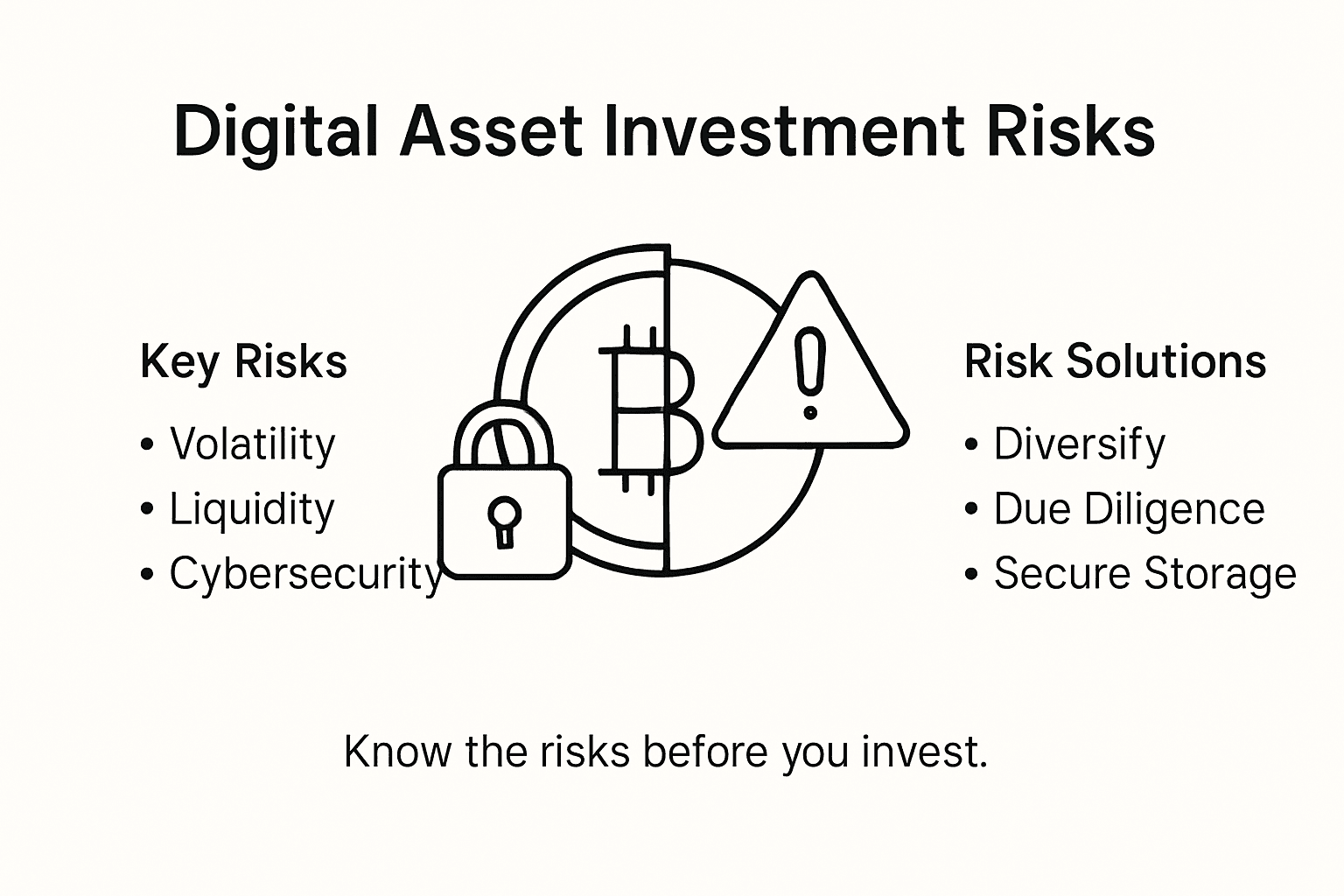
Institutional investors require sophisticated risk management frameworks that incorporate dynamic portfolio allocation, advanced hedging techniques, and real-time market monitoring. Implementing adaptive strategies that can rapidly respond to market shifts will be crucial in managing potential financial exposure and minimizing downside risks.
Professional Insight: Establish a robust risk management protocol that includes automated stop-loss mechanisms, diversified asset allocation, and continuous market sentiment analysis to proactively mitigate potential volatility-related losses.
Cybersecurity, Custody, and Technology Risks
Digital asset custody represents a complex technological and security challenge that fundamentally differs from traditional financial asset management. Digital asset custody requires unique approaches to cryptographic key management and understanding the nuanced characteristics of permissioned and permissionless blockchain ledgers, creating unprecedented operational risks for institutional investors.
Cybersecurity risks in digital asset management encompass multiple critical domains:
- Private key compromise vulnerabilities
- Sophisticated hacking techniques
- Operational infrastructure failures
- Smart contract potential exploitations
- Cross-platform transaction security gaps
Advanced risk mitigation strategies have emerged to address these technological challenges, including multi-signature wallet architectures and comprehensive cold storage implementations. Institutional investors must develop robust technological frameworks that integrate advanced cryptographic controls, continuous security monitoring, and adaptive incident response protocols.
Below is a summary of key risk domains and how advanced institutions address them in digital asset custody:
| Risk Area | Example Threat | Institutional Mitigation |
|---|---|---|
| Private Key Security | Key theft or misplacement | Multi-signature wallets, cold storage |
| Infrastructure Failure | System outages, server loss | Redundant systems, regular backups |
| Smart Contract Exposure | Code bugs, exploits | Rigorous audits, real-time monitoring |
| Transaction Security | Cross-chain vulnerabilities | Encrypted channels, access controls |
Navigating the digital asset security landscape demands a proactive, multilayered approach that combines technological sophistication with rigorous governance structures. Fund managers must invest in continuous security training, implement cutting-edge technological safeguards, and maintain flexible risk management strategies capable of adapting to emerging technological threats.
Professional Insight: Develop a comprehensive cybersecurity strategy that includes regular third-party security audits, implement zero-trust authentication protocols, and maintain dedicated incident response teams specialized in blockchain and digital asset security.
Secure Your Digital Asset Investments with Gold-Backed Stability
Navigating the complex risks of digital asset investments requires solutions that prioritize transparency, regulatory compliance, and security. This article highlights critical challenges such as market volatility, cybersecurity threats, and evolving global regulations. For fund managers aiming to protect portfolios while embracing blockchain innovation, traditional cryptocurrencies can present unacceptable risks.
UK Financial Ltd offers a dependable alternative through gold-backed digital tokens that combine technological advancement with the intrinsic value of precious metals. Our tokens, including the flagship Maya Preferred PRA, deliver verified asset backing with real-time blockchain tracking and proof of reserve reports. This approach addresses volatility concerns with a tangible asset base and supports compliance through robust governance and planned SEC alignment.
Explore our portfolio of secure, asset-backed cryptographic tokens designed for both retail and institutional investors seeking wealth preservation and diversification at UK Financial Ltd.

Take control of your digital asset strategy today by choosing investments anchored in verified gold and silver reserves. Visit UK Financial Ltd now to discover how our innovative tokens can help you mitigate risk and build a resilient portfolio in a fast-changing regulatory landscape. Learn more about our secure offerings at UK Financial Ltd and make informed decisions with confidence.
Frequently Asked Questions
What are the main risks associated with digital asset investments?
Digital asset investments are subject to significant volatility, cybersecurity threats, regulatory uncertainties, and liquidity concerns. Investors must develop comprehensive strategies to mitigate these risks effectively.
How does market volatility affect digital assets compared to traditional investments?
Market volatility in digital assets can lead to rapid price swings due to speculative trading behavior and market sentiment shifts, whereas traditional investments typically experience more stability and established valuation metrics.
What security measures should fund managers implement for digital asset custody?
Fund managers should consider multi-signature wallets, cold storage solutions, regular security audits, and comprehensive incident response protocols to protect digital assets from cybersecurity threats and key management vulnerabilities.
Why is regulatory compliance important in digital asset investments?
Regulatory compliance is crucial as it shapes operational capabilities and risk management strategies. Navigating the complex landscape of anti-money laundering (AML), know-your-customer (KYC), and securities classification standards is essential to avoid legal challenges and enhance investment outcomes.
Recommended
- UK Financial Ltd – Gold-Backed Cryptocurrency Portfolio
- UK Financial Ltd Sets Official 30-Day Conversion Deadline for Three Exchange-Listed Tokens Ahead of Regulated Upgrade
- UK Financial Ltd Confirms Official Corporate Structure of the Maya Preferred Project and Its Dual-Class Token System
- News | UK Financial Ltd
- Gold im Barbell-Portfolio: Edelmetalle zur Absicherung – GoldSilberMarkt