
Why Institutional Investors Choose Crypto Assets

Most American institutional investors now view digital assets as a legitimate source of diversification, with over 60 percent of global funds actively allocating to crypto-backed products. The demand for secure, asset-backed digital assets has grown as financial professionals seek new approaches for portfolio resilience and regulatory compliance. This article explores how innovative cryptocurrency strategies offer institutional investors effective wealth preservation, balanced exposure, and compliance with evolving regulatory requirements in safe, transparent markets.
Table of Contents
- Institutional Investing In Crypto Explained
- Types Of Digital Assets Institutions Prefer
- Benefits Of Asset-Backed Crypto Tokens
- Regulatory Compliance And Security Standards
- Risk Assessments And Mitigating Factors
Key Takeaways
| Point | Details |
|---|---|
| Institutional Adoption of Crypto | Cryptocurrency is increasingly viewed as a legitimate asset class by institutional investors, emphasizing portfolio diversification and long-term value. |
| Diverse Investment Approaches | Institutions utilize methods such as direct purchases, derivatives, and blockchain funds, prioritizing risk management and strategic evaluation. |
| Asset Categories of Interest | Institutional investors favor categories like cryptocurrencies, tokenized securities, and exchange-traded products for their potential stability and access to liquidity. |
| Importance of Regulatory Compliance | Maintaining robust regulatory frameworks and security protocols is essential for institutional investors to navigate the digital asset landscape effectively. |
Institutional Investing in Crypto Explained
Cryptocurrency investment has rapidly transformed from a niche retail market into a sophisticated institutional asset class. Financial professionals are increasingly recognizing digital assets as legitimate investment vehicles with significant portfolio diversification potential. Global institutional cryptocurrency adoption trends reveal a strategic shift toward integrating blockchain-based investments into mainstream financial strategies.
Institutional investors approach crypto assets through multiple sophisticated mechanisms. These include direct token purchases, cryptocurrency derivatives, blockchain-focused investment funds, and tokenized asset portfolios. Unlike retail investors who often chase short-term gains, institutional investors prioritize rigorous due diligence, comprehensive risk management, and long-term value generation. They carefully evaluate factors such as technological infrastructure, regulatory compliance, market liquidity, and potential economic disruption potential.
The institutional crypto investment landscape encompasses several critical investment categories. These range from Bitcoin and Ethereum as foundational digital assets to emerging tokenized securities, decentralized finance (DeFi) platforms, and blockchain infrastructure investments. Institutional strategies often involve multi-asset approaches, combining traditional financial instruments with digital assets to create balanced, forward-looking investment portfolios that leverage blockchain technology’s transformative potential.
Here’s a comparison of institutional approaches to digital asset investing:
| Investment Method | Description | Typical Use Case | Business Impact |
|---|---|---|---|
| Direct Token Purchase | Buying cryptocurrencies outright | Portfolio diversification | Immediate market exposure |
| Crypto Derivatives | Contracts based on crypto price movements | Hedging and speculation | Risk control and gains potential |
| Blockchain Investment Funds | Pooled capital into blockchain companies | Focused sector exposure | Long-term growth opportunities |
| Tokenized Asset Portfolios | Assets represented as tradable tokens | Access to illiquid assets | Increased liquidity and flexibility |
Pro tip: Before entering cryptocurrency markets, institutional investors should develop comprehensive risk assessment frameworks that include thorough technological, regulatory, and market liquidity evaluations.
Types of Digital Assets Institutions Prefer
Institutional investors are increasingly diversifying their portfolios with a strategic mix of digital assets, carefully selecting investments that offer robust performance and risk management potential. Institutional digital asset preferences demonstrate a nuanced approach to integrating blockchain-based investments across multiple asset categories.
The primary digital asset categories attracting institutional capital include cryptocurrencies, tokenized securities, and exchange-traded products. Cryptocurrencies like Bitcoin and Ethereum remain foundational investments, viewed as potential store of value and hedge against traditional market volatility. Tokenized securities represent an emerging frontier, offering fractional ownership in traditionally illiquid assets such as real estate, private equity, and alternative investment vehicles. These assets provide unprecedented liquidity and accessibility for institutional investors seeking diversified investment strategies.

Exchange-traded products (ETPs) have emerged as a particularly attractive vehicle for institutional investors. Digital asset investment vehicles demonstrate growing interest in regulated, structured investment products that provide exposure to digital assets while maintaining compliance with existing financial frameworks. Stablecoins, backed by fiat currencies, offer additional stability and serve as critical bridge assets between traditional and digital financial ecosystems.
The table below summarizes digital asset categories favored by institutions:
| Asset Type | Key Features | Common Rationale | Example Asset |
|---|---|---|---|
| Cryptocurrencies | Decentralized, volatile | Store of value, hedge | Bitcoin, Ethereum |
| Tokenized Securities | Fractional ownership, liquid | Diversification, access | Real estate tokens |
| Exchange-Traded Products | Regulated, structured exposure | Compliance, convenience | Crypto ETPs, ETFs |
| Stablecoins | Fiat-backed, price stability | Transactional bridge | USDC, USDT |
Pro tip: Conduct comprehensive due diligence on digital asset investment vehicles, focusing on regulatory compliance, underlying asset quality, and long-term performance potential before allocation.
Benefits of Asset-Backed Crypto Tokens
Asset-backed crypto tokens represent a revolutionary approach to digital investments, providing institutional investors with unprecedented financial opportunities. Asset-backed token development enables investors to transform traditional assets into flexible, transparent digital instruments that offer enhanced market accessibility and reduced transaction complexity.
The fundamental benefits of asset-backed tokens include improved liquidity, fractional ownership, and regulatory compliance. These digital assets allow institutions to convert traditionally illiquid assets like real estate, art, or private equity into tradable tokens that can be easily bought, sold, and transferred globally. Tokenized asset characteristics demonstrate how blockchain technology provides unprecedented transparency and security, reducing operational costs and eliminating intermediary risks associated with conventional asset management.
Institutional investors particularly appreciate asset-backed tokens for their ability to provide stable value propositions. Unlike volatile cryptocurrencies, these tokens are directly linked to tangible assets, offering a more predictable investment vehicle. The tokens can represent various asset classes, including precious metals, real estate, commodities, and even intellectual property rights, enabling sophisticated portfolio diversification strategies that were previously impossible in traditional financial markets.
Pro tip: Conduct rigorous due diligence on the underlying asset quality, token governance structure, and regulatory compliance before investing in any asset-backed crypto token.
Regulatory Compliance and Security Standards
Institutional investors navigating the digital asset landscape must prioritize robust regulatory frameworks and comprehensive security protocols. International regulatory frameworks have evolved significantly to address the complex challenges posed by cryptocurrency and blockchain-based investments, creating structured approaches to ensure financial stability and investor protection.
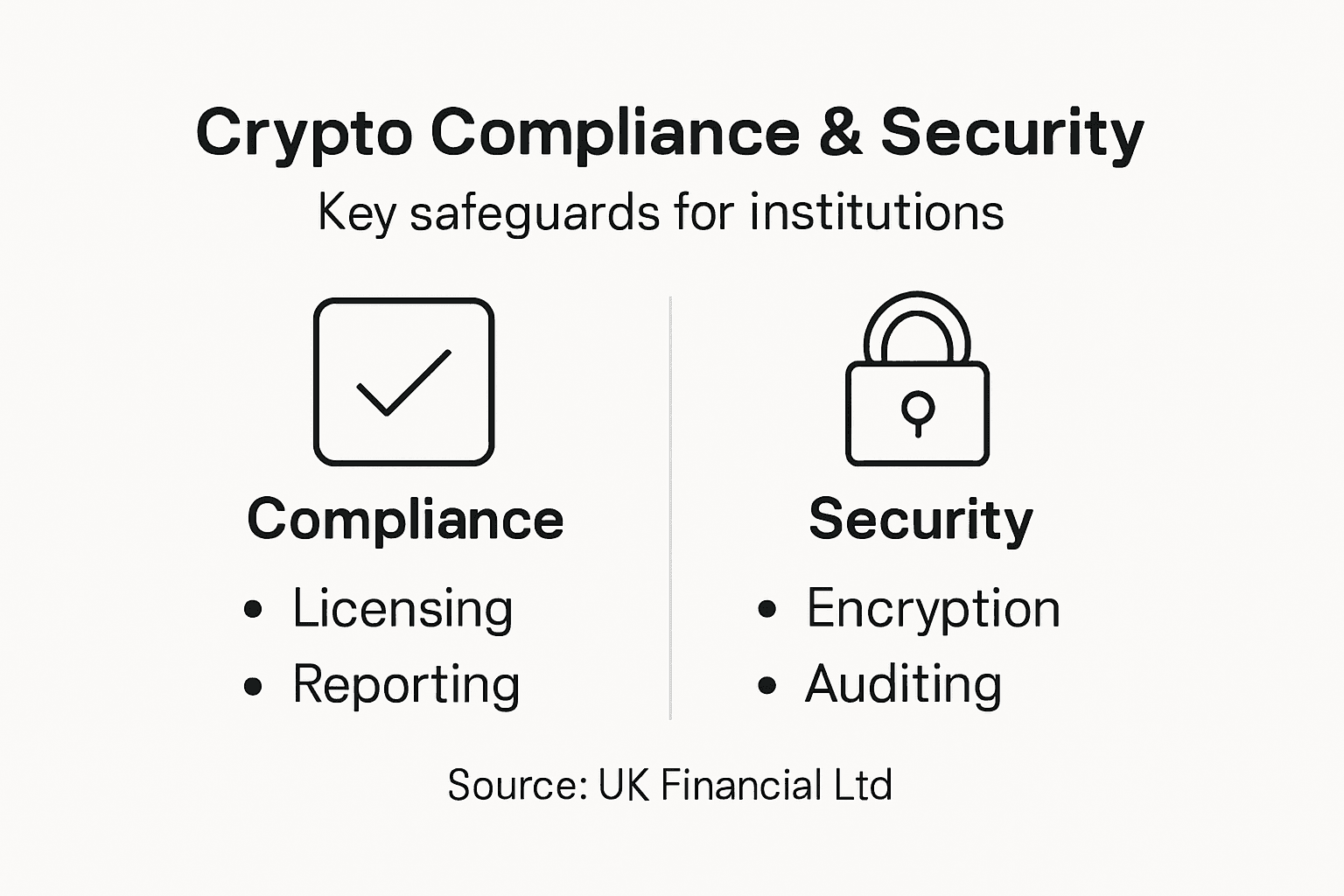
The critical components of regulatory compliance for digital assets encompass multiple strategic dimensions. Licensing requirements, disclosure standards, and consumer protection mechanisms form the foundational pillars of institutional cryptocurrency governance. Cryptocurrency custody standards demonstrate the intricate security protocols necessary for maintaining institutional-grade asset management. These standards include rigorous private key management, comprehensive ownership verification processes, and advanced transfer authentication mechanisms that protect against potential fraud and unauthorized transactions.
Security standards in digital asset management extend beyond traditional regulatory compliance, incorporating sophisticated technological safeguards. Institutional investors must implement multi-layered security approaches, including cold storage solutions, encrypted transaction protocols, and continuous monitoring systems. Advanced blockchain forensics, real-time transaction tracking, and comprehensive audit trails provide additional layers of protection, ensuring transparency and minimizing potential risks associated with digital asset investments.
Pro tip: Develop a comprehensive compliance checklist that integrates technological security measures with regulatory requirements, and regularly update your framework to address emerging digital asset governance standards.
Risk Assessments and Mitigating Factors
Institutional investors must develop comprehensive risk management strategies that go beyond traditional financial risk evaluation methods. Crypto-asset Operational Risk Management frameworks represent a critical approach to systematically identifying, analyzing, and mitigating potential vulnerabilities in digital asset investments.
The primary risk categories institutions must carefully assess include counterparty risk, cybersecurity threats, regulatory compliance, and market volatility. Institutional crypto risk management has evolved to incorporate sophisticated technological solutions, including AI-driven monitoring tools, real-time risk assessment platforms, and advanced insurance protocols. These technologies enable institutions to develop dynamic risk mitigation strategies that adapt to the rapidly changing digital asset landscape, providing comprehensive protection against potential financial and operational challenges.
Effective risk assessment in crypto investments requires a multi-layered approach that combines technological innovation with rigorous analytical frameworks. Institutions must implement comprehensive due diligence processes, including in-depth asset valuation, blockchain forensics, transaction tracking, and continuous compliance monitoring. Advanced risk management techniques involve creating adaptive strategies that can quickly respond to emerging threats, market fluctuations, and regulatory changes, ensuring robust protection of institutional investment portfolios.
Pro tip: Develop a flexible, technology-driven risk assessment framework that combines AI-powered monitoring, comprehensive compliance checks, and real-time adaptive strategies to effectively manage digital asset investment risks.
Unlock Secure, Asset-Backed Crypto Investments with UK Financial Ltd
Institutional investors face the challenge of finding transparent, regulated, and secure digital assets that go beyond volatile cryptocurrencies. This article highlights the importance of asset-backed tokens, rigorous regulatory compliance, and thorough risk assessments in creating a stable and trustworthy crypto portfolio. If you value stable value propositions and want to leverage blockchain technology with the confidence of verified gold and silver reserves, UK Financial Ltd offers a powerful solution.
Our platform specializes in gold-backed digital assets such as the flagship Maya Preferred PRA and other innovative tokens, all designed to meet institutional standards for security and transparency. With features like real-time blockchain asset tracking, proof of reserve reports, and full regulatory alignment plans, UK Financial Ltd bridges the gap between traditional asset security and forward-looking crypto innovation. Explore our full portfolio and see how asset-backed tokens support portfolio diversification while providing stability against market volatility.
Discover how to enhance your investment strategy with trusted, gold-secured cryptocurrencies by visiting UK Financial Ltd today.
Experience the confidence of investing in digital assets backed by real precious metals.

Take the next step toward secure, transparent digital investing. Visit UK Financial Ltd now to access detailed token information, real-time performance data, and compliance insights. Your path to regulated, asset-backed crypto exposure starts here.
Frequently Asked Questions
Why are institutional investors increasingly interested in crypto assets?
Institutional investors recognize cryptocurrencies as legitimate investment vehicles that offer significant portfolio diversification potential, allowing them to access new market opportunities and enhance long-term value generation.
What types of digital assets do institutional investors prefer?
Institutional investors typically focus on cryptocurrencies like Bitcoin and Ethereum, tokenized securities, and exchange-traded products (ETPs)—all of which align with their strategies for risk management and performance optimization.
How do institutional investors evaluate the risks associated with crypto investments?
Institutional investors conduct comprehensive risk assessments that include evaluating counterparty risk, cybersecurity threats, regulatory compliance, and market volatility, employing advanced technologies to mitigate these risks effectively.
What are the benefits of asset-backed crypto tokens for institutions?
Asset-backed tokens provide institutions with improved liquidity, fractional ownership, and enhanced regulatory compliance, transforming traditionally illiquid assets into tradable digital instruments that offer stable value propositions.
Recommended
- UK Financial Ltd Executes Compliance Tasks Ahead Of First-Ever ERC-3643 Exchange-Traded Token, SMCAT & Sets Date For Online Investor Governance Vote
- UK Financial Ltd – Gold-Backed Cryptocurrency Portfolio
- UK Financial Ltd Establishes United States Operations in Delaware, Announces Texas Expansion
- UK Financial Ltd Sets Official 30-Day Conversion Deadline for Three Exchange-Listed Tokens Ahead of Regulated Upgrade
- Regulatory Frameworks for Crypto: Ensuring Global Compliance