
How to Choose Gold-Secured Digital Assets Safely

Securing wealth through gold-backed digital assets demands more than just interest in new financial instruments. For institutional investors and crypto fund managers, the challenge is ensuring each token combines authentic physical gold reserves with strong regulatory oversight and transparent audits. The process calls for careful examination of asset backing, compliance frameworks, and blockchain transparency. This guide brings you a clear checklist for evaluating gold-backed digital assets, helping you identify truly reliable options for diversification and preservation.
Table of Contents
- Step 1: Define Your Gold-Backed Asset Criteria
- Step 2: Assess Regulatory Compliance and Proof of Reserves
- Step 3: Analyze Token Structure and Blockchain Integration
- Step 4: Evaluate Transparency and Audit Mechanisms
- Step 5: Verify Liquidity and Risk Management
Quick Summary
| Key Message | Explanation |
|---|---|
| 1. Verify Physical Gold Backing | Ensure that every token is backed by verifiable physical gold held in secure, regulated facilities. |
| 2. Assess Regulatory Compliance | Confirm alignment with international financial regulations to protect your investment and ensure credibility. |
| 3. Analyze Token Structure | Understand the type of token you are investing in, as each has different legal and regulatory implications. |
| 4. Evaluate Transparency Protocols | Investigate the frequency and depth of audits to ensure continuous proof of asset backing. |
| 5. Check Liquidity and Risk Management | Assess how quickly assets can be converted and evaluate safeguards against market volatility. |
Step 1: Define your gold-backed asset criteria
Pinpointing the right gold-backed digital assets requires strategic research and understanding of key evaluation factors. You’ll want to systematically assess potential investments by examining their core characteristics and compliance standards.
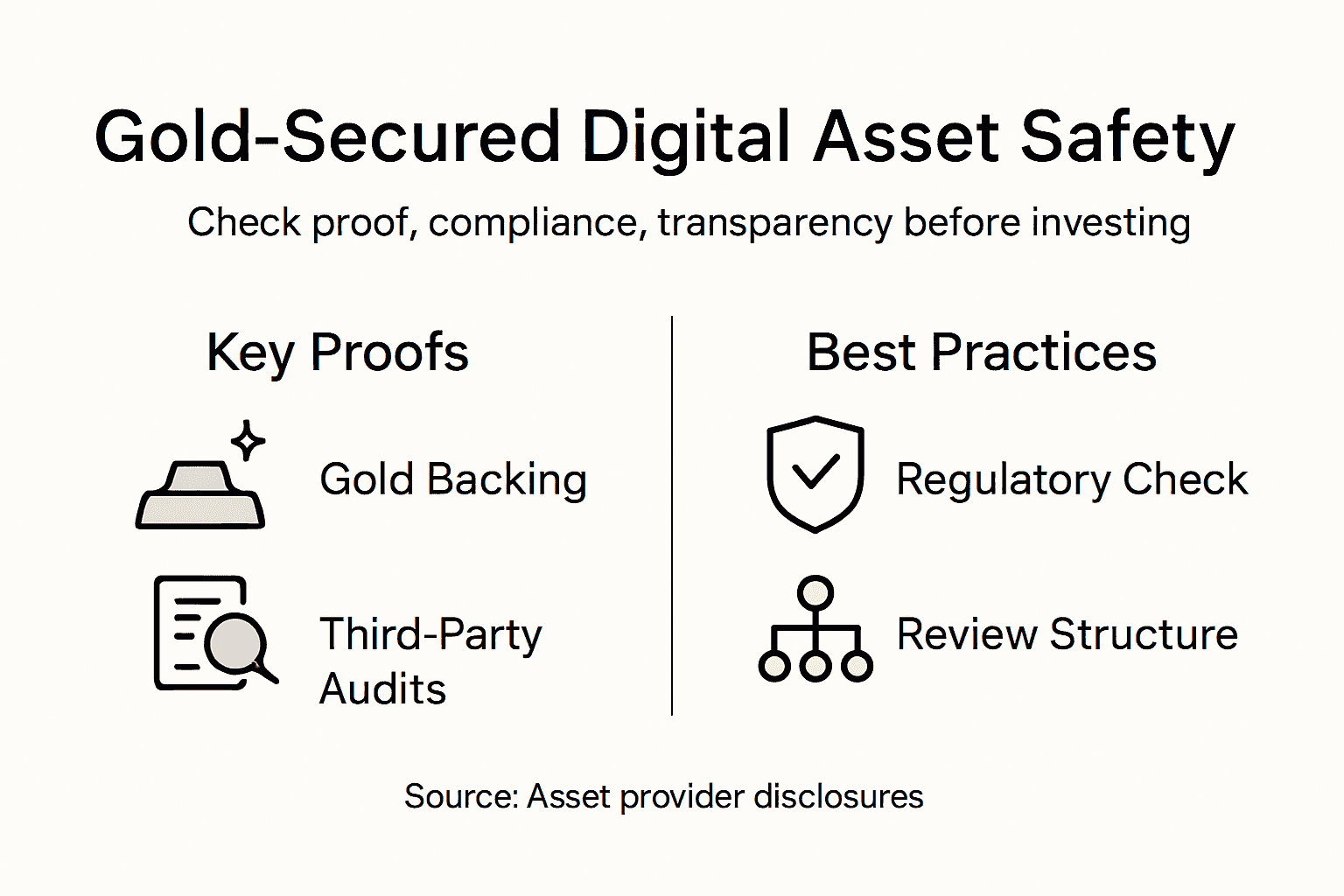
Start by focusing on three critical parameters for evaluating gold-secured digital tokens. First, verify the token’s physical gold backing through transparent third-party audits. Each token should represent a precise, verifiable quantity of physical gold held in secure, regulated storage facilities. This ensures your investment has genuine intrinsic value beyond digital representation.
- Check total gold reserve quantity
- Confirm storage location and security protocols
- Review frequency and transparency of gold reserve audits
- Validate third-party verification mechanisms
Second, investigate the regulatory compliance of the digital asset. Global financial guidelines require crypto assets to meet stringent legal standards. Seek tokens that demonstrate clear alignment with international financial regulations, ensuring investor protection and institutional credibility.
Gold-backed digital assets must represent transparent, legally compliant investments with verifiable physical reserves.
Key regulatory factors include:
- Jurisdictional registration status
- Compliance with securities laws
- Clear investor rights documentation
- Established governance framework
Pro tip: Request comprehensive documentation proving gold reserves and regulatory compliance before making any investment commitments.
Step 2: Assess regulatory compliance and proof of reserves
Investors must rigorously evaluate the regulatory standing and reserve verification mechanisms of gold-backed digital assets to ensure transparency and mitigate potential financial risks. Your goal is to develop a comprehensive understanding of the asset’s legal and operational framework.
Begin by examining the legal compliance framework through comprehensive regulatory guidelines. This involves deep investigation into several critical dimensions of regulatory adherence:
- Anti-money laundering (AML) certification
- Know Your Customer (KYC) protocols
- Jurisdictional registration status
- International financial regulatory alignment
Next, focus on proof of reserves verification. Global financial oversight mechanisms require transparent documentation demonstrating the actual gold reserves backing the digital token. This means requesting and meticulously reviewing independent audit reports that confirm the precise quantity, location, and authenticity of physical gold holdings.
Robust proof of reserves is the cornerstone of credible gold-backed digital asset investments.
Key verification steps include:
- Request most recent third-party audit reports
- Verify gold storage facility credentials
- Confirm total reserve quantity and valuation
- Check frequency of reserve verification processes
Pro tip: Cross-reference multiple independent sources to validate the legitimacy of gold reserve claims and regulatory compliance documentation.

Step 3: Analyze token structure and blockchain integration
Understanding the intricate details of a gold-backed digital asset’s token structure and blockchain technology is crucial for making informed investment decisions. You’ll need to dive deep into the technical and legal frameworks that define how these digital assets function and represent physical gold reserves.
Start by examining the token classification framework through academic research on digital asset structures. Different token types carry distinct legal and regulatory implications:
- Utility tokens
- Security tokens
- Commodity-backed tokens
- Direct claim tokens
Next, investigate the blockchain integration mechanisms. Blockchain transparency research reveals critical considerations for evaluating how blockchain architecture impacts asset representation and investor protection. Key aspects to analyze include smart contract design, transaction traceability, and the precise mapping of token rights to physical gold reserves.
The blockchain architecture determines the true transparency and reliability of gold-backed digital assets.
Essential blockchain evaluation criteria:
- Smart contract complexity
- Transaction transparency
- Real-time reserve tracking capabilities
- Immutability of token ownership records
Pro tip: Request detailed technical documentation explaining the specific blockchain protocol and smart contract architecture supporting the gold-backed token.
Compare these common token classifications for gold-backed assets:
| Token Type | Legal Status | Rights to Gold |
|---|---|---|
| Utility Token | Usually unregulated | No direct gold claim |
| Security Token | Regulated as a security | Ownership or profit rights linked to gold |
| Commodity-Backed | Commodity regulations apply | Each token equals set gold amount |
| Direct Claim Token | Legally enforceable claim | Token holder can redeem physical gold |
Step 4: Evaluate transparency and audit mechanisms
Verifying the authenticity and reliability of gold-backed digital assets requires a systematic approach to examining their transparency and audit protocols. Your objective is to develop a comprehensive understanding of how these assets maintain their credibility through rigorous verification processes.
Begin by investigating the audit verification framework using digital gold storage models. Look for tokens that demonstrate robust transparency mechanisms, which typically include:
- LBMA-certified gold bar documentation
- Frequent external audit reports
- Detailed reserve verification processes
- Comprehensive storage facility credentials
Next, scrutinize the regulatory guidance for transparency standards. Central bank digital asset guidelines recommend examining the frequency and depth of third-party audit mechanisms. This involves analyzing how often reserves are independently verified and how transparently those results are published.
True transparency means continuous, verifiable proof of asset backing beyond mere periodic reporting.
Critical audit evaluation criteria:
- Frequency of external audits
- Comprehensiveness of reserve verification
- Public disclosure of audit results
- Independent auditor credentials
Pro tip: Request comprehensive audit trail documentation that shows a consistent history of transparent and verified gold reserve reporting.
Step 5: Verify liquidity and risk management
Evaluating the financial resilience of gold-backed digital assets requires a meticulous approach to understanding their liquidity potential and comprehensive risk mitigation strategies. Your goal is to assess how quickly these assets can be converted and what safeguards protect your investment against market volatility.
Begin by analyzing the liquidity mechanisms through international financial policy recommendations. Focus on understanding the asset’s convertibility and trading characteristics:
- Speed of asset conversion
- Trading volume across platforms
- Fiat currency exchange rates
- Transaction cost structures
- Market depth and scalability
Next, conduct a thorough risk management assessment. Digital gold investing insights highlight critical factors for evaluating potential market risks:
- Custodian reliability ratings
- Historical price volatility
- Regulatory compliance frameworks
- Operational risk controls
- Stress testing documentation
Effective risk management means anticipating potential market disruptions before they impact your investment.
Key risk evaluation parameters:
- Capital buffer requirements
- Market correlation analysis
- Counterparty risk assessment
- Emergency liquidity provisions
Pro tip: Request comprehensive stress testing reports and conduct independent analysis of the asset’s performance during previous market fluctuations.
Here’s a summary comparing core evaluation steps for gold-backed digital assets:
| Step | Main Focus | Investor Impact |
|---|---|---|
| Asset Selection | Physical gold backing validation | Ensures true intrinsic value |
| Compliance Check | Regulatory alignment review | Reduces legal and fraud risk |
| Technical Review | Blockchain and token structure | Confirms transparency, traceability |
| Audit Verification | Independent audit process | Builds trust in asset backing |
| Liquidity & Risk | Market convertibility, risk controls | Supports exit flexibility, capital safety |
Secure Your Investment in Gold-Backed Digital Assets with Confidence
Choosing gold-secured digital assets safely requires careful evaluation of physical gold backing, regulatory compliance, blockchain transparency, and liquidity. At UK Financial Ltd, we understand the challenges investors face when verifying proof of reserves and assessing token structures to protect their wealth from market volatility and legal risks. Our platform offers a trustworthy solution by combining real-time blockchain tracking with independent audit reports, ensuring your investment is backed by tangible precious metals and stringent governance.
Explore how we address critical pain points like transparency, third-party verification, and SEC compliance within our diverse portfolio including the Maya Preferred PRA and MayaCat meme coin. By visiting UK Financial Ltd, you gain access to detailed information on our project-specific tokens, continuous proof of reserve documentation, and up-to-date token performance data that empower you to invest with clarity and security.
Looking for a gold-backed digital asset platform that delivers transparency, regulatory assurance, and robust risk management?
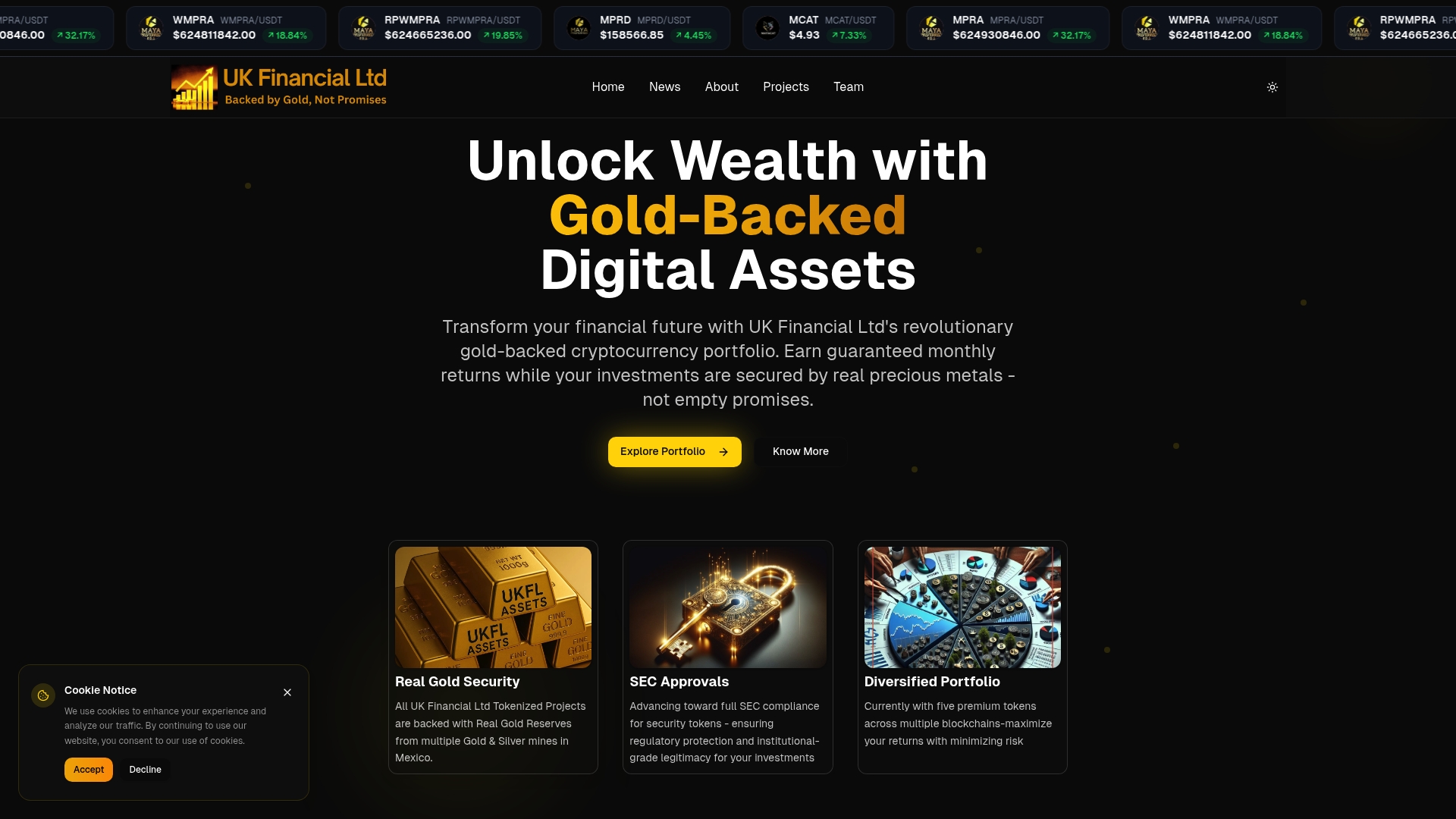
Discover the difference of investing with UK Financial Ltd. Visit our website now to explore our asset-backed tokens, review technical documentation, and take advantage of secure, fully audited investment opportunities designed to safeguard your financial future.
Frequently Asked Questions
What are the key criteria for evaluating gold-secured digital assets?
To evaluate gold-secured digital assets safely, focus on three key criteria: physical gold backing, regulatory compliance, and proof of reserves. Start by verifying the token’s physical gold reserves through third-party audits and confirm its legal adherence by analyzing its registration status and investor rights documentation.
How can I assess the regulatory compliance of a gold-backed digital token?
To assess regulatory compliance, investigate the asset’s adherence to international financial guidelines. Review its anti-money laundering (AML) certifications and Know Your Customer (KYC) protocols, checking for any relevant jurisdictional regulations.
What steps should I take to verify proof of reserves for a gold-backed digital asset?
To verify proof of reserves, request recent third-party audit reports that confirm the quantity and location of physical gold holdings. Review the documentation carefully to ensure it meets transparency standards set by global financial oversight mechanisms.
How can I analyze the blockchain integration of gold-backed tokens?
To analyze blockchain integration, examine the token’s classification and the smart contract design. Assess how transaction transparency and real-time reserve tracking capabilities are implemented, which are critical for ensuring investor protection.
What factors should I consider regarding liquidity and risk management for gold-backed assets?
Consider the asset’s convertibility, trading volume, and transaction costs to evaluate its liquidity. Perform a risk management assessment by reviewing the custodian’s reliability and historical price volatility, ensuring you understand how market fluctuations may impact your investment.
Recommended
- UK Financial Ltd – Gold-Backed Cryptocurrency Portfolio
- UK Financial Ltd Establishes United States Operations in Delaware, Announces Texas Expansion
- UK Financial Ltd Receives Recognition In Platinum Crypto Academy’s Cryptonaire Weekly
- Why Getting a Government Gateway Is Great
- How It Works | SabiSend – International Money Transfer Comparison