
Guide to Managing Crypto Portfolios for Asset Security

Most British retail investors are now joining American counterparts in seeking safer ways to build cryptocurrency portfolios. With market volatility and frequent regulatory updates, the quest for secure, asset-backed tokens has never felt more critical. Studies show diversified portfolios with clear compliance controls can cut downside risk by over 45 percent compared to less structured holdings. This guide walks you through practical steps for assessing risk, selecting trustworthy digital assets, and building a resilient portfolio aligned with strict UK and global regulation.
Table of Contents
- Step 1: Assess Risk Tolerance And Diversification Needs
- Step 2: Select Secure, Asset-Backed Crypto Tokens
- Step 3: Allocate Funds To Balance Portfolio Exposure
- Step 4: Monitor Performance With Real-Time Blockchain Tools
- Step 5: Verify Compliance And Audit Reserve Reports
Quick Summary
| Key Insight | Explanation |
|---|---|
| 1. Assess Your Risk Tolerance | Evaluate your financial goals and risk capacity to create a balanced strategy. |
| 2. Choose Secure Asset-Backed Tokens | Prioritize digital assets with strong legal protections and underlying value to minimize risk. |
| 3. Implement Strategic Fund Allocation | Distribute investments across various cryptocurrencies to maximize returns while managing risk. |
| 4. Monitor Performance Regularly | Use advanced tracking tools to evaluate portfolio health and adapt strategies based on market changes. |
| 5. Verify Compliance Thoroughly | Establish a rigorous process to confirm the authenticity and transparency of your cryptocurrency holdings. |
Step 1: Assess risk tolerance and diversification needs
Cryptocurrency portfolio management requires a strategic approach to understanding your personal risk appetite and constructing a balanced investment framework. By carefully evaluating your financial goals and risk capacity, you can develop a robust investment strategy that protects your assets while maximizing potential returns.
Starting your assessment involves a comprehensive review of your current financial situation and investment experience. Research on portfolio diversification suggests analyzing multiple factors including your income stability, investment timeline, and overall financial objectives. Begin by categorizing your risk profile: conservative investors might allocate smaller percentages to cryptocurrency, while aggressive investors could dedicate more substantial portions. Consider creating a detailed spreadsheet tracking your current assets, existing investment allocations, and potential cryptocurrency exposure.
A systematic approach involves mapping your risk tolerance across different cryptocurrency categories. Some digital assets exhibit higher volatility, while others provide more stable returns. Global cryptocurrency risk analysis indicates that strategic diversification across multiple blockchain assets can mitigate individual investment risks. Aim to distribute your investments across established cryptocurrencies like Bitcoin and Ethereum, alongside emerging tokens with strong technological foundations.
Pro Tip: Create a personal risk matrix that assigns percentage allocations based on your comfort level and financial goals, regularly reviewing and rebalancing your portfolio to maintain optimal diversification.
Here’s a summary of common cryptocurrency risk profiles and typical allocation patterns:
| Risk Profile | Sample Crypto Allocation | Main Objectives |
|---|---|---|
| Conservative | 10-20% | Capital preservation |
| Moderate | 30-50% | Balanced growth and security |
| Aggressive | 60% or more | Maximizing high returns |
Step 2: Select secure, asset-backed crypto tokens
Selecting secure asset-backed cryptocurrency tokens requires a strategic approach that prioritizes financial safety and regulatory compliance. Your goal is to identify digital assets with robust underlying value and strong legal protections that minimize investment risk and provide tangible asset representation.
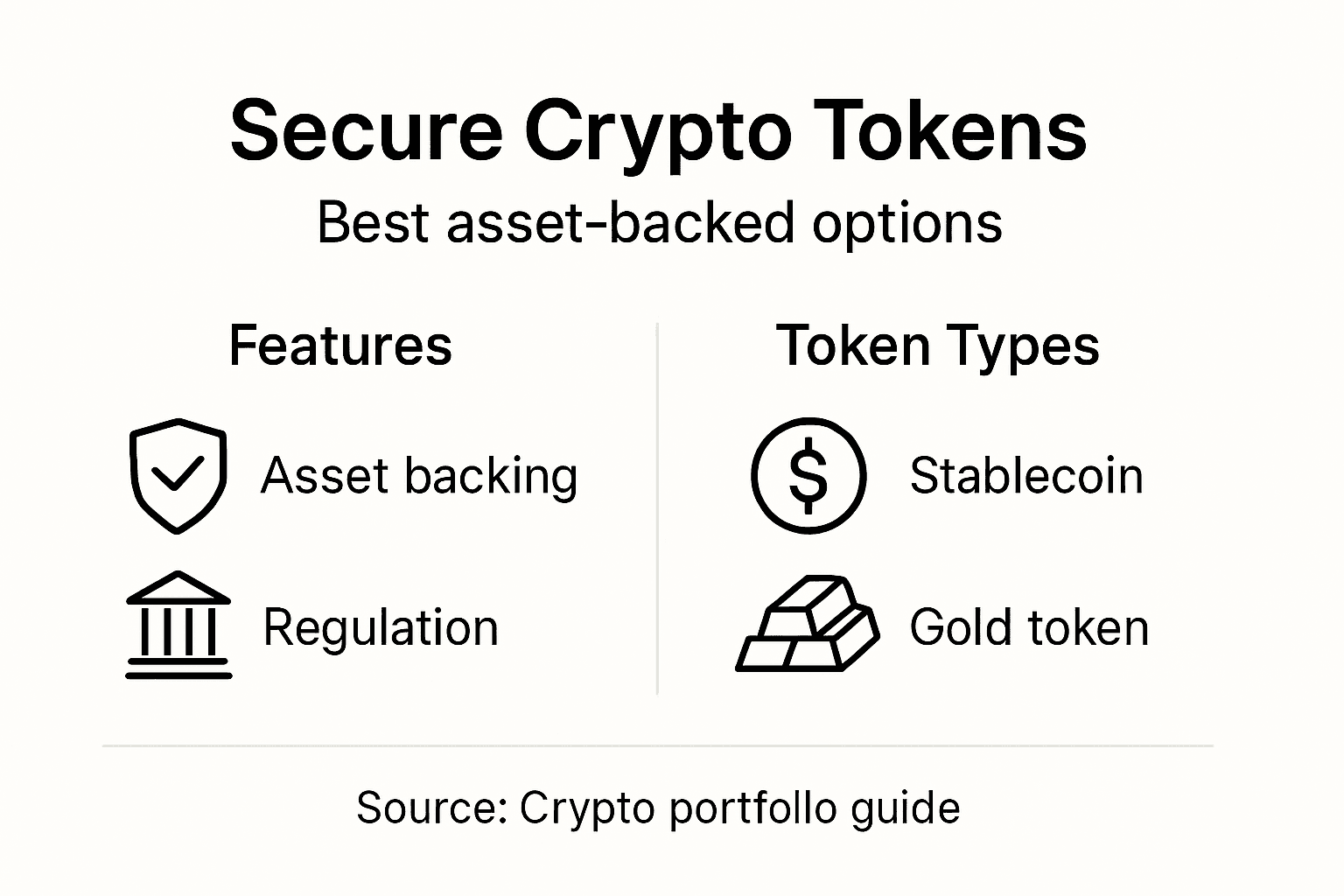
Begin by examining tokens with verifiable asset reference mechanisms that demonstrate clear regulatory compliance. Stablecoins and tokens backed by physical assets like gold or government securities offer more predictable value propositions. Investigate the token’s legal framework, checking for explicit documentation about the underlying asset reserves and the issuer’s financial transparency. Tokenization processes provide legally enforceable claims, so prioritize tokens with detailed proof of reserve reports and third-party audited asset allocations.
When evaluating potential investments, conduct comprehensive due diligence by analyzing the token’s historical performance, technological infrastructure, and the credibility of its issuing organization. Look for tokens with clear redemption mechanisms, transparent reserve management, and demonstrated regulatory adherence. Examine the asset backing ratio, ensuring that each token represents a precise and verifiable fraction of the underlying physical asset.
Pro Tip: Maintain a rigorous screening checklist that evaluates each potential asset-backed token across multiple dimensions including legal compliance, asset verification, historical stability, and issuer reputation.
This table compares key asset-backed crypto token features by asset type:
| Token Type | Asset Backing | Typical Stability | Compliance Level |
|---|---|---|---|
| Stablecoin | Fiat currency | Very stable | High regulatory focus |
| Gold-backed | Physical gold | Stable | Often third-party audits |
| Bond-backed | Government bonds | Stable/moderate | Strict legal standards |
| Real estate | Property holdings | Moderate | Varies by jurisdiction |
Step 3: Allocate funds to balance portfolio exposure
Effective cryptocurrency portfolio management requires strategic fund allocation that balances potential returns with calculated risk. Your primary objective is to distribute investment capital across different digital assets in a manner that maximizes potential gains while minimizing overall portfolio volatility.

Implement a systematic approach to fund allocation by utilizing advanced portfolio optimization frameworks that incorporate dynamic risk management techniques. Start by determining percentage allocations based on your risk tolerance and investment goals. Typically, investors might consider allocating 50 to 70 percent to established cryptocurrencies like Bitcoin and Ethereum, with the remaining 30 to 50 percent distributed among emerging tokens and asset-backed digital securities. Pay close attention to each asset’s historical performance, market capitalization, and correlation with other holdings to ensure true diversification.
Consider implementing a tiered allocation strategy that segments your investments into core holdings, growth opportunities, and speculative assets. Core holdings should represent stable cryptocurrencies with proven track records, while growth opportunities might include promising blockchain technologies with strong development teams. The speculative portion allows for calculated risks with potential high-reward tokens that align with emerging market trends.
Pro Tip: Develop a quarterly rebalancing strategy that automatically adjusts your portfolio allocations to maintain your original risk profile and capitalize on changing market dynamics.
Step 4: Monitor performance with real-time blockchain tools
Tracking your cryptocurrency portfolio requires sophisticated real-time monitoring strategies that provide comprehensive insights into your digital asset performance. Your goal is to develop a systematic approach for evaluating investment health and detecting potential opportunities or risks quickly and efficiently.
Utilize advanced blockchain monitoring technologies that enable granular tracking of transaction volumes, price movements, and smart contract interactions. These tools allow you to establish automated alerts for significant portfolio changes, helping you make informed decisions about asset reallocation. Consider implementing platforms that offer comprehensive dashboards integrating multiple blockchain networks, providing a holistic view of your cryptocurrency investments. Low-code monitoring solutions can simplify this process, allowing even novice investors to gain deep insights without requiring extensive technical expertise.
Develop a consistent monitoring routine that includes daily portfolio reviews, weekly performance analyses, and monthly deep-dive assessments. Focus on key performance indicators such as total portfolio value, individual asset performance, correlation between different cryptocurrencies, and comparative market benchmarks. Pay special attention to sudden price volatilities, unusual transaction patterns, and broader market trends that might impact your investment strategy.
Pro Tip: Create customized monitoring dashboards that consolidate data from multiple blockchain networks and set up automated email or mobile notifications for significant portfolio movements.
Step 5: Verify compliance and audit reserve reports
Ensuring the integrity of your cryptocurrency investments requires a systematic approach to verifying compliance and thoroughly examining reserve reports. Your primary objective is to establish a rigorous verification process that validates the authenticity and transparency of your digital asset holdings.
Begin by leveraging comprehensive financial reporting guidelines that provide structured frameworks for assessing portfolio completeness and internal controls. Scrutinize reserve reports by cross-referencing blockchain transaction records, verifying asset backing, and confirming that each token maintains the promised reserve ratio. Portfolio compliance documentation can help you systematically track and validate your digital asset holdings across multiple blockchain networks, ensuring real-time transparency and regulatory adherence.
Develop a methodical audit process that includes quarterly deep dive reviews of your cryptocurrency portfolio. Request and analyze official reserve attestation documents from token issuers, paying close attention to third-party audit certifications, asset composition details, and verification timestamps. Look for tokens that provide frequent, transparent reporting and demonstrate consistent compliance with regulatory standards. Maintain a detailed log of all verification activities, including dates of review, sources consulted, and any discrepancies discovered during your audit process.
Pro Tip: Create a standardized checklist for reserve report verification that includes specific criteria for asset authentication, regulatory compliance, and transparency benchmarks.
Secure Your Crypto Portfolio with Transparent Gold-Backed Assets
Managing cryptocurrency portfolios can be challenging when seeking both growth and security. The article emphasizes the importance of asset-backed tokens, compliance verification, and real-time performance monitoring to reduce risk and maximize returns. If you want to overcome volatility and ensure your investments are backed by tangible value, it is critical to adopt secure tokens grounded in real assets like gold and silver.
At UK Financial Ltd, we specialize in offering a diverse portfolio of gold-backed digital assets designed for investors who prioritize transparency, regulatory compliance, and security. Our platform features tokens such as Maya Preferred PRA and MayaCat meme coin, all supported by verified precious metal reserves and backed by detailed proof of reserve reports. With real-time blockchain tracking and live token performance data, you gain full control and clarity over your holdings.
Elevate your portfolio strategy by incorporating trustworthy, asset-backed cryptocurrencies today.
Are you ready to protect and grow your digital assets with proven stability?

Explore our secure offerings at UK Financial Ltd and start building a diversified, compliant crypto portfolio that aligns with your risk tolerance and investment goals. Visit us now to discover how to bridge asset security with innovative blockchain technology.
Frequently Asked Questions
How do I assess my risk tolerance for cryptocurrency investments?
To assess your risk tolerance, evaluate your financial situation, investment timeline, and overall objectives. Create a personal risk matrix to categorize your comfort level with different cryptocurrency allocations and regularly adjust it to reflect any changes in your circumstances.
What are the key considerations for selecting secure, asset-backed crypto tokens?
When selecting asset-backed tokens, verify their legal compliance and asset backing through transparent reserve documentation. Confirm that the issuer has a strong financial reputation and a reliable track record to minimize risks associated with your investments.
How should I allocate funds across my cryptocurrency portfolio?
Allocate funds by determining percentages based on your risk profile, typically designating 50 to 70 percent to established cryptocurrencies like Bitcoin and Ethereum. Create a tiered allocation strategy to segment investments into core holdings, growth opportunities, and speculative assets to optimize returns while managing risk.
What tools can I use to monitor my cryptocurrency portfolio effectively?
Utilize real-time blockchain monitoring technologies that provide insights into transaction volumes, price movements, and overall portfolio performance. Set automated alerts for significant changes to help you make timely decisions about asset reallocation and maintain a healthy investment strategy.
How can I verify compliance and audit reserve reports for my crypto assets?
To verify compliance, develop a systematic audit process that includes reviewing reserve reports and cross-referencing blockchain transaction records. Conduct quarterly deep-dive reviews of your portfolio to confirm asset backing and ensure regulatory adherence, maintaining a detailed log of all verification activities to track any discrepancies.
Recommended
- UK Financial Ltd – Gold-Backed Cryptocurrency Portfolio
- UK Financial Ltd Executes Compliance Tasks Ahead Of First-Ever ERC-3643 Exchange-Traded Token, SMCAT & Sets Date For Online Investor Governance Vote
- UK Financial Ltd Establishes United States Operations in Delaware, Announces Texas Expansion
- UK Financial Ltd Sets Official 30-Day Conversion Deadline for Three Exchange-Listed Tokens Ahead of Regulated Upgrade
- Global Wealth Management Guide: Secure Cross-Border Success
- Crypto Regulatory Trends 2025: What Compliance Officers Need to Know