
Digital Asset Diversification: Reducing Risk in 2026

Nearly 80 percent of institutional portfolios now include some level of crypto exposure, yet many American fund managers still struggle to manage risk effectively in this volatile space. As digital asset markets surge ahead, understanding true diversification is essential for protecting client capital and meeting strict regulatory standards. This article offers insight into the evolving structure of digital asset diversification, helping you identify secure, compliant solutions while positioning your investments to weather uncertainty.
Table of Contents
- Defining Digital Asset Diversification Today
- Types of Digital Assets and Their Roles
- How Diversification Works in Crypto Portfolios
- Compliance, Regulation, and Proof of Reserve
- Key Risks, Mistakes, and Security Measures
Key Takeaways
| Point | Details |
|---|---|
| Digital Asset Diversification | Invest across cryptocurrencies, tokens, and securities to manage risk while capitalizing on growth opportunities. |
| Regulatory Compliance | Understand and adhere to evolving regulations to ensure protection against fraud and market manipulation. |
| Security Measures | Implement robust security protocols, including cold storage and multi-factor authentication, to safeguard investments. |
| Portfolio Rebalancing | Regularly review and adjust your asset allocation to respond to market changes and maintain a balanced investment strategy. |
Defining Digital Asset Diversification Today
Digital asset diversification represents a sophisticated investment strategy leveraging emerging technological platforms to spread financial risk across multiple digital ecosystems. Digital asset allocation in 2026 encompasses a complex array of electronic investment vehicles including cryptocurrencies, blockchain tokens, digital securities, and programmable financial instruments.
Investors exploring digital diversification must recognize its fundamental differences from traditional portfolio management. Unlike conventional asset classes, digital assets operate within decentralized networks that offer unprecedented transparency and global accessibility. These assets are characterized by high volatility, rapid technological innovation, and unique risk-return profiles that challenge standard investment methodologies. The emergence of blockchain technology has transformed digital diversification from a speculative approach to a strategic financial tool with measurable performance metrics.
The strategic implementation of digital asset diversification requires a nuanced understanding of technological infrastructures, regulatory environments, and market dynamics. Institutional investors increasingly view digital assets as a critical component of comprehensive portfolio management, recognizing their potential to provide uncorrelated returns and hedge against traditional market fluctuations. Successful strategies involve careful selection of assets across different blockchain protocols, token types, and technological domains to minimize concentrated risk.
Pro Tip: Always allocate no more than 5-10% of your total portfolio to digital assets to maintain a balanced risk profile while capturing potential high-growth opportunities.
Types of Digital Assets and Their Roles
Digital assets represent a dynamic and evolving ecosystem of investment instruments that extend far beyond traditional financial offerings. Digital asset classifications encompass a broad spectrum of electronic value representations, each with unique characteristics, technological foundations, and investment potential.
The primary categories of digital assets include cryptocurrencies, crypto-tokens, security tokens, utility tokens, and digital collectables. Cryptocurrencies like Bitcoin and Ethereum serve as decentralized monetary instruments, operating on independent blockchain networks with predetermined supply mechanisms. Crypto-tokens, by contrast, are built atop existing blockchain infrastructures and can represent various forms of value, from investment rights to access tokens for specific platforms. Security tokens represent legally compliant digital representations of traditional financial securities, offering fractional ownership in real-world assets like real estate, corporate equity, or investment funds.
Understanding the regulatory landscape is crucial when exploring digital asset types. Virtual asset regulatory standards mandate rigorous compliance protocols, requiring providers to implement robust customer verification, transaction monitoring, and reporting mechanisms. This regulatory framework ensures transparency, mitigates financial risks, and protects investors from potential fraud or market manipulation. Utility tokens provide access to specific blockchain-based services or platforms, while non-fungible tokens (NFTs) represent unique digital collectables with verifiable scarcity and ownership tracking.
Pro Tip: Conduct thorough due diligence on each digital asset type, examining its technological infrastructure, regulatory compliance, and real-world utility before making investment decisions.
Here’s a quick comparison of major digital asset types and their primary investment roles:
| Asset Type | Key Characteristics | Typical Use Case | Regulatory Consideration |
|---|---|---|---|
| Cryptocurrency | Decentralized, capped supply | Store of value, payments | Varies by country, evolving laws |
| Security Token | Represents real-world assets | Fractional ownership, equity | Must comply with securities rules |
| Utility Token | Platform/service access | Network function, governance | Subject to consumer protection |
| NFT | Unique identifier, scarcity | Digital collectibles, art | IP and ownership verification |
How Diversification Works in Crypto Portfolios
Crypto portfolio diversification is a sophisticated risk management strategy designed to optimize investment performance across the complex digital asset landscape. Crypto portfolio diversification involves strategically allocating investments across multiple digital assets with distinct technological foundations, market capitalizations, and risk profiles to mitigate potential market volatilities.

Successful diversification requires a nuanced approach that goes beyond simple asset allocation. Investors must carefully analyze correlations between different cryptocurrencies, considering factors such as blockchain technology, market capitalization, trading volume, and underlying economic drivers. By constructing portfolios that include a mix of established cryptocurrencies like Bitcoin and Ethereum, alongside emerging altcoins and tokens representing different technological sectors, investors can create a more resilient investment strategy. The goal is to balance high-potential assets with more stable digital investments, thereby reducing overall portfolio risk.
Portfolio diversification principles) suggest spreading investments across assets that respond differently to market conditions. In the crypto ecosystem, this means selecting digital assets from various sectors such as decentralized finance (DeFi), non-fungible tokens (NFTs), privacy coins, and infrastructure tokens. The objective is to create a portfolio where potential losses in one asset class can be offset by gains in another, ultimately smoothing out overall investment performance and reducing exposure to systematic market risks.
Pro Tip: Implement a systematic rebalancing strategy every 3-6 months to maintain your desired asset allocation and adapt to rapidly changing crypto market dynamics.
Compliance, Regulation, and Proof of Reserve
Digital asset compliance represents a critical framework that ensures transparency, security, and legal integrity within the rapidly evolving cryptocurrency ecosystem. The regulatory landscape has transformed dramatically, with global financial authorities implementing stringent standards to mitigate risks associated with digital asset transactions, money laundering, and fraudulent activities.
The Financial Action Task Force (FATF) has established comprehensive guidelines that mandate rigorous customer due diligence, transaction monitoring, and reporting protocols for virtual asset providers. These regulations require institutions to implement robust know-your-customer (KYC) procedures, maintain detailed transaction records, and immediately report suspicious financial activities. Proof of reserve practices have emerged as a crucial mechanism for demonstrating the financial health and asset backing of digital asset platforms, providing investors with verifiable evidence that custodians maintain sufficient reserves to cover customer balances.
Crypto regulatory reforms in 2026 are increasingly focusing on integrating digital assets into mainstream financial systems while providing enhanced investor protections. Countries like Japan are leading this transformation by reclassifying cryptocurrencies as legitimate financial products, reducing crypto taxation, and creating more transparent regulatory frameworks. Proof of reserve audits have become a standard practice, with independent third-party verifications providing real-time insights into the actual holdings of digital asset platforms, thereby building trust and accountability in the cryptocurrency marketplace.
Pro Tip: Always verify an exchange’s proof of reserve documentation and regulatory compliance before committing any substantial investment, and prioritize platforms with transparent, independently audited financial reporting.
Key Risks, Mistakes, and Security Measures
Digital asset ecosystem risks represent a complex landscape of technological, financial, and operational challenges that require sophisticated risk management strategies. The digital investment environment demands a comprehensive understanding of potential vulnerabilities, from market volatility to sophisticated cybersecurity threats, that can potentially compromise investor assets and portfolio performance.
The most critical risks in digital asset investments include market fragility, operational failures, regulatory uncertainty, and technological vulnerabilities. Institutional investors must implement robust multi-layered security protocols that encompass advanced encryption technologies, multi-factor authentication, cold storage solutions, and continuous monitoring systems. Common mistakes investors make involve inadequate risk assessment, overexposure to high-volatility assets, neglecting comprehensive due diligence, and failing to maintain updated security infrastructure.
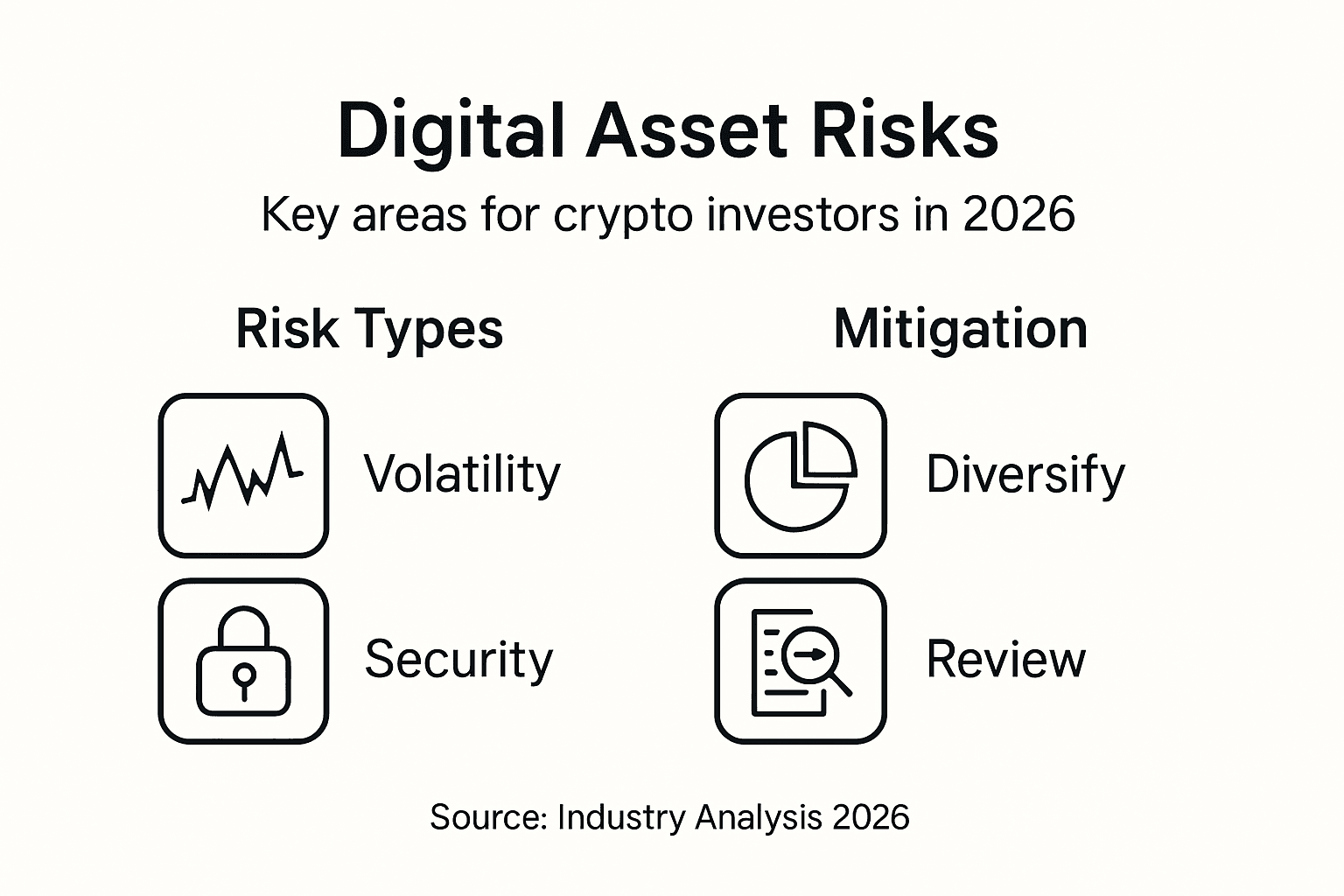
Cybersecurity infrastructure has become increasingly sophisticated, requiring investors to adopt proactive security measures that go beyond traditional financial protection strategies. This includes implementing comprehensive risk management frameworks, utilizing hardware wallets, conducting regular security audits, maintaining diversified asset allocations, and staying informed about emerging technological and regulatory developments. Effective risk mitigation demands a holistic approach that combines technological safeguards, regulatory compliance, and continuous educational investment.
Pro Tip: Implement a quarterly comprehensive security review of your digital asset portfolio, including penetration testing, wallet security assessments, and thorough analysis of your asset allocation strategy.
This table summarizes common risks in digital asset investing alongside recommended security measures:
| Risk Type | Example Challenge | Security Solution | Investor Action |
|---|---|---|---|
| Market Volatility | Sudden price swings | Diversification | Track asset correlations |
| Operational Failure | Exchange downtime | Cold storage | Choose reputable platforms |
| Cyber Threats | Phishing, hacking attacks | Multi-factor authentication | Use hardware wallets |
| Regulatory Change | New compliance requirements | Continuous monitoring | Stay updated on regulations |
Enhance Your Digital Asset Diversification with Secure Gold-Backed Tokens
The article highlights the challenge of managing risk in a volatile digital asset market by diversifying portfolios across different blockchain technologies and asset types. Investors face uncertainty from regulatory shifts, market swings, and security vulnerabilities. Your goal is to reduce exposure to these risks while seeking growth and transparency in your investments. At UK Financial Ltd, we address these exact concerns by offering a unique suite of gold and silver-backed digital tokens that blend the innovation of blockchain with the stability of precious metals. This approach provides real-world asset backing to strengthen your digital diversification strategy and mitigate market volatility.

Discover how our platform combines proof of reserve transparency, regulatory compliance, and real-time blockchain tracking to empower both retail and institutional investors. Explore flagship options like the Maya Preferred PRA token and innovative project-based tokens designed for security and long-term wealth preservation. Take control of your digital asset portfolio by visiting UK Financial Ltd now and experience a new paradigm in secure, asset-backed cryptocurrency investing. Secure your future today with a diversified portfolio grounded in tangible value.
Frequently Asked Questions
What is digital asset diversification?
Digital asset diversification is an investment strategy that spreads financial risk across multiple digital assets, such as cryptocurrencies, blockchain tokens, and digital securities, to enhance potential returns and reduce exposure to volatility.
How does diversification work in crypto portfolios?
Diversification in crypto portfolios involves strategically allocating investments across various digital assets with different technological foundations, market capitalizations, and risk profiles. This approach aims to balance high-potential assets with more stable investments to mitigate overall risk.
What are the key risks associated with digital asset investments?
Key risks include market volatility, operational failures, regulatory uncertainty, and technological vulnerabilities. Investors should implement robust security measures and maintain a diversified portfolio to manage these risks effectively.
Why is compliance important in digital asset investing?
Compliance is crucial in digital asset investing as it ensures transparency, security, and legal integrity. It helps protect investors from fraud and market manipulation by enforcing customer due diligence, transaction monitoring, and reporting protocols.
Recommended
- UK Financial Ltd – Gold-Backed Cryptocurrency Portfolio
- UK Financial Ltd Establishes United States Operations in Delaware, Announces Texas Expansion
- UK Financial Ltd Executes Compliance Tasks Ahead Of First-Ever ERC-3643 Exchange-Traded Token, SMCAT & Sets Date For Online Investor Governance Vote
- UK Financial Ltd Sets Official 30-Day Conversion Deadline for Three Exchange-Listed Tokens Ahead of Regulated Upgrade
- Top 5 Gold Companies 2025 | Best Gold IRA Companies