
Cryptocurrency Transparency: Building Investor Trust Today

What truly sets a secure digital asset apart is its commitment to clear, verifiable information and robust governance. For institutional and accredited investors, blockchain transparency is no longer a buzzword but an essential requirement for wealth preservation. Modern platforms use public ledger technology, proof of reserve protocols, and regulatory compliance to address lingering misconceptions and deliver confidence in gold-backed cryptocurrency investments. This article details the mechanisms and standards investors should demand to safeguard assets and build trust in a rapidly evolving financial environment.
Table of Contents
- Defining Cryptocurrency Transparency And Common Misconceptions
- Types Of Transparency In Digital Assets Explained
- How Proof Of Reserve And Asset Verification Work
- Regulatory Compliance Driving Transparency Standards
- Investor Rights, Risks And Best Practices
Key Takeaways
| Point | Details |
|---|---|
| Understanding Transparency | Cryptocurrency transparency is supported by blockchain technology, allowing for public transaction verification and reducing fraud opportunities. |
| Proof of Reserve Importance | Investors should seek exchanges that provide proof of reserves and regulatory compliance to ensure financial security. |
| Regulatory Compliance Role | Regulatory frameworks are essential for establishing trust and transparency standards in cryptocurrency markets, aligning them with traditional finance. |
| Investor Rights and Risks | Investors have rights to verifiable information and protections, which require vigilance and comprehensive risk assessments in a decentralized market. |
Defining Cryptocurrency Transparency and Common Misconceptions
Cryptocurrency transparency represents a complex ecosystem of technological trust mechanisms designed to provide investors with verifiable asset information. Unlike traditional financial systems, blockchain technology enables unprecedented levels of public transaction tracking and verification, challenging longstanding perceptions about digital asset opacity.
Many investors harbor fundamental misunderstandings about cryptocurrency transparency. Public perceptions reveal significant skepticism surrounding the technological foundations of digital assets. Common misconceptions include:
- Believing cryptocurrencies are inherently anonymous and untraceable
- Assuming blockchain transactions cannot be monitored
- Thinking cryptocurrency exchanges operate without regulatory oversight
- Perceiving digital assets as completely decentralized and uncontrollable
In reality, blockchain technology offers remarkable transparency through its distributed ledger system. Every transaction is permanently recorded, creating an immutable public record that anyone can inspect. Blockchain transparency means each financial movement becomes traceable, reducing opportunities for fraudulent activities.
Investor activism demands increased accountability particularly following high-profile exchange failures. Modern cryptocurrency platforms recognize that transparency involves more than simple transaction logging – it requires comprehensive proof of reserves, ethical governance, and clear communication with stakeholders.
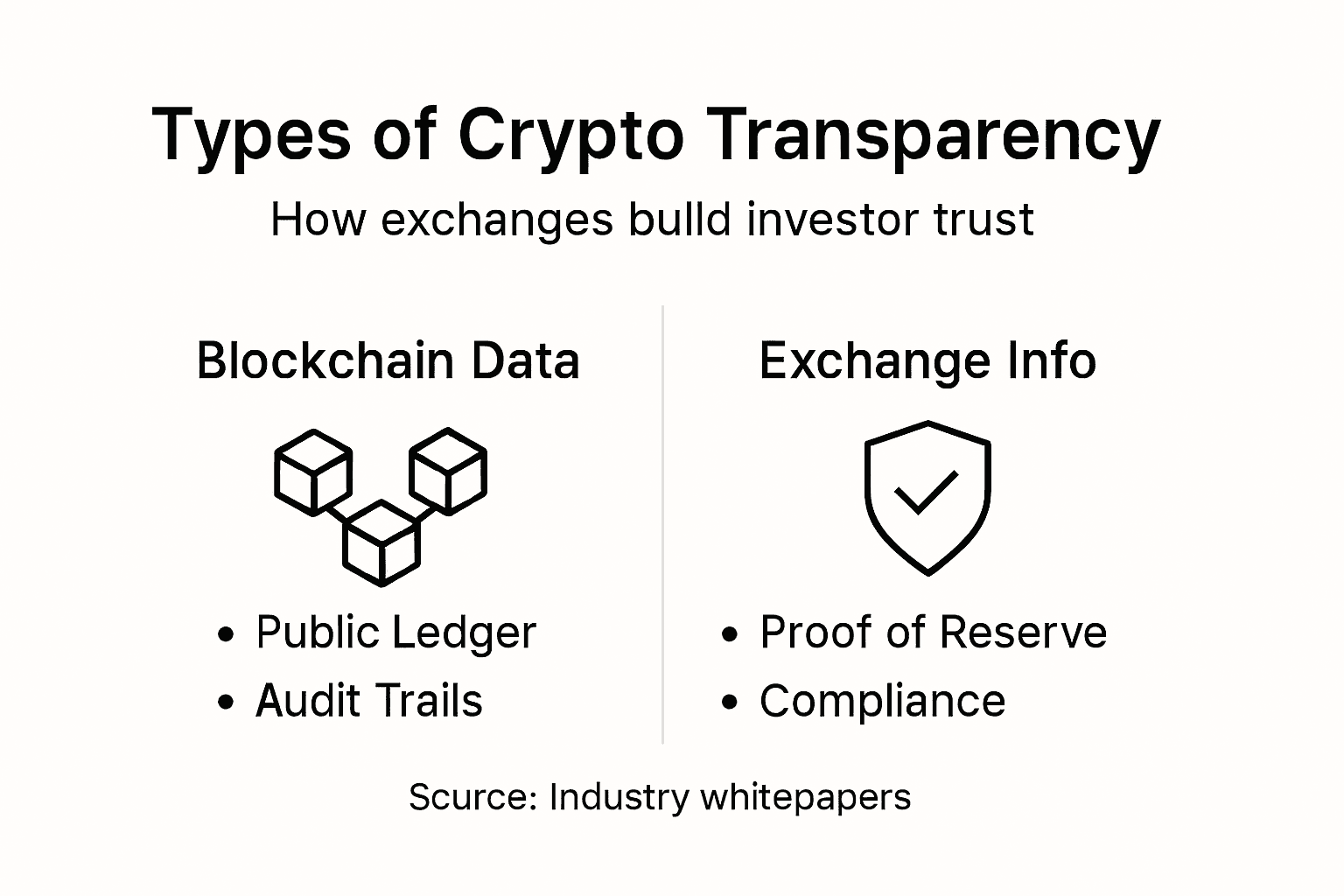
Transparency in cryptocurrency goes beyond technological capabilities. It represents a fundamental commitment to building trust through verifiable, open financial systems that empower investors with complete information about their digital assets.
Pro tip: Always verify an exchange’s proof of reserves and regulatory compliance before investing in any cryptocurrency platform.
Types of Transparency in Digital Assets Explained
Digital asset transparency represents a multifaceted approach to providing investors with comprehensive visibility into financial instruments and their underlying mechanisms. Unlike traditional financial systems, cryptocurrency platforms offer multiple layers of transparency that go beyond conventional disclosure methods.
Tokenization creates unique transparency mechanisms that fundamentally transform how investors understand digital assets. These mechanisms can be categorized into several distinct types:
- Public Ledger Transparency: Allows complete tracking of all transactions
- Ownership Transparency: Provides clear documentation of asset ownership
- Price Linkage Transparency: Shows direct connections between token value and underlying assets
- Regulatory Disclosure Transparency: Demonstrates compliance with legal frameworks
The complexity of digital asset transparency extends beyond simple transaction records. Systematic reviews of cryptocurrency markets reveal intricate relationships between different transparency types that impact market behavior, liquidity, and investor confidence.

Exchange transparency plays a critical role in building investor trust. This involves providing real-time information about trading volumes, asset reserves, operational practices, and comprehensive financial disclosures. Modern digital asset platforms are increasingly adopting robust transparency protocols to differentiate themselves in a competitive marketplace.
Understanding these transparency types empowers investors to make more informed decisions, reducing risks associated with opaque financial instruments and creating a more accountable digital asset ecosystem.
Here’s a summary of major factors influencing digital asset transparency and their investor impact:
| Factor | Description | Investor Impact |
|---|---|---|
| Blockchain Public Ledger | Fully visible transaction record | Easy audit, reduced fraud |
| Proof of Reserve | Verifiable asset backing | Trust in exchange solvency |
| Regulatory Compliance | Adhering to legal standards | Enhanced security, trust |
| Asset Verification | Independent review of holdings | Greater investor confidence |
| Exchange Disclosure | Public reporting of reserves and practices | Informed investment decisions |
Pro tip: Always cross-reference multiple transparency sources before making any significant digital asset investment.
How Proof of Reserve and Asset Verification Work
Proof of Reserve represents a critical mechanism for establishing trust and transparency in digital asset platforms. This sophisticated process provides investors with verifiable evidence that cryptocurrency exchanges maintain sufficient financial backing for customer deposits and holdings.
Cryptocurrency exchanges implement rigorous verification protocols to demonstrate their financial stability. The asset verification process typically involves several key components:
- Cryptographic proof generation
- Third-party independent audits
- Real-time balance verification
- Transparent documentation of holdings
- Comprehensive financial reporting
Asset verification requires multiple layers of technical and financial scrutiny. Global regulatory standards mandate detailed documentation to ensure exchanges maintain adequate reserves matching customer balances. These protocols help prevent potential insolvency and protect investor interests.
The technical implementation of Proof of Reserve involves complex cryptographic techniques that allow exchanges to demonstrate ownership of assets without revealing sensitive individual transaction details. This approach balances transparency with necessary privacy protections, enabling investors to verify overall platform stability without compromising individual account information.
Modern digital asset platforms are increasingly adopting these verification mechanisms as a standard practice, recognizing that trust is the fundamental currency in cryptocurrency markets. By providing clear, verifiable evidence of their financial standing, exchanges can differentiate themselves and attract more sophisticated investors.
Pro tip: Request and review the most recent Proof of Reserve documentation before committing significant funds to any cryptocurrency platform.
Regulatory Compliance Driving Transparency Standards
Regulatory compliance has emerged as the primary catalyst for establishing comprehensive transparency standards in cryptocurrency markets. International bodies are systematically developing frameworks that transform how digital assets are monitored, reported, and governed.
Global regulatory frameworks create transparency protocols designed to protect investor interests across multiple dimensions. These compliance mechanisms address critical areas including:
- Anti-money laundering verification
- Tax reporting requirements
- Transaction monitoring systems
- Cross-border financial disclosures
- Investor protection standards
Cryptocurrency regulatory standards continue evolving rapidly. International initiatives standardize crypto transaction reporting through comprehensive mechanisms like the OECD’s Crypto-Asset Reporting Framework (CARF). These efforts aim to align digital asset markets with traditional financial regulatory expectations while maintaining the innovative potential of blockchain technologies.
The implementation of robust regulatory compliance frameworks represents a significant maturation of the cryptocurrency ecosystem. By establishing clear guidelines, international regulators are creating an environment that balances technological innovation with investor protection, reducing market volatility and increasing institutional confidence.
Modern cryptocurrency platforms recognize that regulatory compliance is no longer optional but a fundamental requirement for maintaining market legitimacy and attracting sophisticated investors who demand transparent, well-governed financial instruments.
The table below compares traditional financial systems and cryptocurrency platforms in terms of transparency:
| Aspect | Traditional Finance | Cryptocurrency Platforms |
|---|---|---|
| Transaction Visibility | Limited, often private | Publicly accessible blockchain |
| Regulatory Oversight | Centralized authorities | Mixture of local/global rules |
| Asset Verification | Supplier audits, manual | Cryptographic, real-time proofs |
| Investor Controls | Standard disclosures | Transparent, frequently updated |
| Decentralization | Central bank managed | Distributed ledger, user-driven |
Pro tip: Stay informed about evolving regulatory standards by regularly reviewing updates from international financial oversight organizations.
Investor Rights, Risks and Best Practices
Investor rights in cryptocurrency markets represent a complex landscape of evolving protections and responsibilities. Understanding these rights requires comprehensive knowledge of potential risks and strategic approaches to digital asset investments.
Investor activism drives market transparency by demanding accountability from cryptocurrency platforms. Critical investor rights include:
- Right to verifiable asset information
- Right to transparent fee structures
- Right to secure asset custody
- Right to regulatory protection
- Right to fair trading practices
Cryptocurrency investment risks encompass multiple dimensions that sophisticated investors must carefully evaluate. Comprehensive risk analysis reveals critical investment challenges including market volatility, potential fraud, and information asymmetry. Successful navigation requires thorough due diligence and proactive risk management strategies.
The decentralized nature of cryptocurrency markets creates unique challenges for investor protection. Unlike traditional financial systems, digital asset platforms often lack standardized safeguards, making individual investor education and vigilance paramount. Investors must develop sophisticated strategies that balance potential returns with comprehensive risk assessment.
Modern cryptocurrency platforms are increasingly recognizing the importance of investor rights, implementing more robust transparency protocols and governance mechanisms to attract sophisticated institutional investors who demand comprehensive protection and clear operational standards.
Pro tip: Develop a multi-layered risk assessment strategy that combines technological understanding, regulatory awareness, and continuous market research.
Experience True Cryptocurrency Transparency Backed by Verified Precious Metals
The challenge of trusting digital assets amidst concerns about transparency and regulatory compliance requires solutions that put investor confidence first. UK Financial Ltd addresses these critical pain points by offering gold-backed and silver-backed cryptocurrency tokens with real-time blockchain asset tracking and publicly available proof of reserve reports. This approach directly tackles the need for verifiable asset information and exchange transparency outlined in the article while providing investors with secure, asset-backed exposure.

Discover token performance data and governance details at UK Financial Ltd to see how you can invest with greater assurance. Don’t let uncertainty about cryptocurrency transparency hold you back. Visit our platform now and take advantage of innovative digital asset solutions designed to protect your investments and meet evolving regulatory standards. Explore the benefits of asset verification and regulatory compliance by checking out the flagship Maya Preferred PRA and other uniquely backed tokens. Begin building trust in your cryptocurrency portfolio today.
Frequently Asked Questions
What is cryptocurrency transparency?
Cryptocurrency transparency refers to the ability of investors to access verifiable information about digital assets and their transactions. It is facilitated by blockchain technology, which allows public tracking and monitoring of all transactions.
How does Proof of Reserve contribute to transparency in cryptocurrency exchanges?
Proof of Reserve ensures that cryptocurrency exchanges can provide verifiable evidence of their financial backing for customer deposits. This involves third-party audits and real-time balance verification, which build trust between exchanges and their users.
What types of transparency exist in digital assets?
Digital assets exhibit several types of transparency, including public ledger transparency (tracking transactions), ownership transparency (asset ownership clarity), price linkage transparency (connection between token value and assets), and regulatory disclosure transparency (compliance with laws).
Why is regulatory compliance important for cryptocurrency transparency?
Regulatory compliance is crucial as it establishes standards for transparency in cryptocurrency markets. Compliance mechanisms, such as anti-money laundering verification and transaction monitoring, help protect investors and enhance the legitimacy of digital asset platforms.
Recommended
- UK Financial Ltd – Gold-Backed Cryptocurrency Portfolio
- UK Financial Ltd Receives Recognition In Platinum Crypto Academy’s Cryptonaire Weekly
- UK Financial Ltd Executes Compliance Tasks Ahead Of First-Ever ERC-3643 Exchange-Traded Token, SMCAT & Sets Date For Online Investor Governance Vote
- How Far Away Is Open Banking In New Zealand