
Crypto Portfolio Diversification: Shielding Assets From Volatility

Only a small fraction of american institutional investors hold fully diversified crypto portfolios, yet the risks of concentrated exposure can be significant. As market uncertainty persists, the need to blend return potential with wealth preservation has never been more urgent for global fund managers. This guide offers practical methods and insights to help you construct a resilient digital asset strategy anchored by compliance, security, and asset backing.
Table of Contents
- Crypto Portfolio Diversification Explained
- Types Of Asset-Backed Crypto Diversification
- Key Strategies For Secure Token Allocation
- Regulatory Compliance And Proof Of Reserves
- Risks, Common Pitfalls, And Mitigation Methods
Key Takeaways
| Point | Details |
|---|---|
| Crypto Diversification is Essential | Spreading investments across various cryptocurrencies minimizes risk and optimizes returns, especially in highly volatile markets. |
| Asset-backed Tokens Offer Stability | Integrating asset-backed cryptocurrencies can enhance portfolio stability and reduce volatility compared to traditional cryptocurrencies. |
| Rigorous Token Allocation Strategies | Implementing structured token allocation and compliance monitoring is crucial for maximizing strategic value and minimizing risk. |
| Identify and Mitigate Risks | Constantly evaluate market volatility, technological vulnerabilities, and regulatory shifts to develop proactive risk management strategies. |
Crypto portfolio diversification explained
Crypto portfolio diversification represents a strategic approach to managing digital assets by spreading investment across multiple cryptocurrencies, tokens, and blockchain-based financial instruments to minimize risk and optimize potential returns. Understanding the complex interconnected crypto ecosystem is fundamental to developing a robust investment strategy.
The core principle of crypto diversification involves allocating investments across different asset types, including stablecoins, utility tokens, governance tokens, and decentralized finance (DeFi) instruments. Unlike traditional financial markets, cryptocurrency portfolios require nuanced strategies due to high volatility and rapid market transformations. Institutional investors typically aim to balance high-risk, high-reward tokens with more stable assets that provide consistent value preservation.
Successful diversification demands a comprehensive understanding of correlation dynamics between different crypto assets. Sophisticated investors analyze factors like market capitalization, trading volume, technological infrastructure, regulatory compliance, and historical performance. Stablecoins play a critical role in this process, offering a nominal anchor within turbulent market conditions and providing liquidity during market fluctuations.
Pro tip: Develop a systematic rebalancing strategy that reassesses your crypto portfolio allocation quarterly, ensuring your risk exposure remains aligned with your investment objectives and market conditions.
Types of asset-backed crypto diversification
Asset-backed cryptocurrencies represent a sophisticated investment mechanism that anchors digital tokens to tangible or financial assets, providing enhanced stability and reduced volatility compared to traditional cryptocurrencies. Empirical research demonstrates that different types of asset-backed tokens can significantly influence portfolio risk management strategies.

The primary categories of asset-backed cryptocurrencies include precious metal-backed tokens, fiat currency-backed stablecoins, commodity-linked tokens, and real estate digital securities. USD-backed tokens are particularly prevalent, offering investors a direct link to traditional financial markets while maintaining the technological advantages of blockchain infrastructure. Gold-backed cryptocurrencies provide an alternative approach, allowing investors to gain exposure to precious metal markets through digital asset platforms.
Comprehensive academic analysis reveals that asset-backed cryptocurrencies interact uniquely with traditional investment portfolios. Institutional investors strategically integrate these tokens to optimize risk-adjusted returns, leveraging their distinctive correlation patterns with global financial markets. Factors such as underlying asset quality, regulatory compliance, and transparent reserve mechanisms become critical in evaluating the potential diversification benefits of these digital financial instruments.
Here’s a summary comparing major asset-backed cryptocurrency types and their impact on portfolio stability:
| Token Type | Backing Asset | Stability Impact | Institutional Usage Example |
|---|---|---|---|
| USD-backed Stablecoin | U.S. Dollar | Very high | Portfolio cash reserve |
| Gold-backed Token | Physical Gold | Medium to high | Hedge against inflation |
| Commodity-backed Token | Oil or Real Estate | Medium | Diversification into real assets |
| Crypto-backed Stablecoin | Cryptocurrency | Lower than fiat-backed | DeFi lending platforms |
Pro tip: Conduct thorough due diligence on the specific reserve mechanisms and audit processes of asset-backed crypto tokens before integration into your investment portfolio, ensuring transparency and genuine asset backing.
Key strategies for secure token allocation
Token allocation best practices represent a critical framework for institutional investors seeking to minimize risk and maximize strategic value in cryptocurrency portfolios. These strategies encompass a comprehensive approach to distributing digital assets across various investment channels, emphasizing transparency, regulatory compliance, and long-term sustainability.
The primary components of secure token allocation involve careful segmentation of tokens across multiple strategic categories. Sophisticated investors typically distribute tokens among key segments: community allocation, investor reserves, team holdings, and treasury management. Implementing structured vesting schedules becomes paramount, with most institutional frameworks adopting multi-year release mechanisms that prevent market flooding and align stakeholder incentives. Typical allocation models might include 4-year vesting periods with initial 12-month cliff periods to ensure sustained project commitment.
Secure token management strategies extend beyond initial allocation, focusing on robust authentication, access control, and continuous compliance monitoring. Critical considerations include implementing short-lived access tokens, establishing comprehensive refresh mechanisms, and maintaining granular scope controls that enforce least-privilege principles. Institutional investors must prioritize auditability, ensuring transparent tracking of token movements and comprehensive documentation of allocation decisions.
Pro tip: Develop a comprehensive token allocation matrix that clearly defines percentage allocations, vesting schedules, and compliance requirements for each token category, allowing for dynamic adjustments based on project milestones and market conditions.
Regulatory compliance and proof of reserves
Comprehensive regulatory oversight has emerged as a critical mechanism for protecting investors and maintaining integrity within the cryptocurrency ecosystem. The complex landscape of digital assets requires sophisticated approaches to ensuring transparency, accountability, and risk mitigation for institutional investors navigating increasingly complex financial environments.
Proof of Reserves (PoR) represents a sophisticated verification mechanism designed to demonstrate that cryptocurrency custodians maintain sufficient assets to cover their total customer liabilities. Cryptographic verification methods enable institutions to provide verifiable evidence of asset holdings, creating a transparent framework that addresses fundamental concerns about potential insolvency or fraudulent activities. Sophisticated PoR frameworks typically involve third-party audits, blockchain-based verification techniques, and comprehensive reporting mechanisms that provide real-time insights into asset backing.
Advanced regulatory frameworks are increasingly recognizing Proof of Reserves as a critical compliance tool for addressing unique risks within cryptocurrency markets. Institutional investors must navigate complex implementation challenges, including cryptographic proof methodologies, privacy considerations, and ongoing standardization efforts. The most effective compliance strategies integrate multiple verification layers, combining technological solutions with rigorous financial oversight to create robust protection mechanisms for digital asset investments.
Pro tip: Develop a comprehensive compliance dashboard that tracks Proof of Reserves metrics, real-time asset verification status, and regulatory alignment across your digital asset portfolio, enabling proactive risk management and transparent reporting.
Risks, common pitfalls, and mitigation methods
Cryptocurrency portfolio diversification strategies face numerous complex risk factors that demand sophisticated, multifaceted mitigation approaches. Institutional investors must navigate a challenging landscape characterized by extreme market volatility, technological vulnerabilities, and rapidly evolving regulatory environments that can dramatically impact digital asset performance.
The primary risk categories for crypto portfolios include market volatility, technological infrastructure challenges, regulatory uncertainty, and potential security breaches. Sophisticated investors employ advanced risk management techniques such as mean-variance optimization, which involves carefully calibrating asset allocations to minimize potential downside while maintaining exposure to high-potential digital assets. Strategic risk mitigation typically involves multiple layers of protection, including:
- Implementing diversification across uncorrelated asset classes
- Utilizing stablecoins to provide portfolio stability
- Conducting continuous market monitoring
- Applying advanced analytics for predictive risk assessment
Technological vulnerabilities represent another critical risk dimension, with potential threats including blockchain network attacks, smart contract exploits, and cryptographic security challenges. Institutional investors must develop robust governance frameworks that incorporate continuous security auditing, multi-signature wallet protocols, and comprehensive disaster recovery strategies. The most effective risk management approaches combine technological solutions with rigorous human oversight, creating adaptive systems that can respond quickly to emerging market dynamics.
The following table summarizes the main crypto portfolio risks and effective mitigation techniques:
| Risk Type | Description | Effective Mitigation Method |
|---|---|---|
| Market Volatility | Rapid price shifts | Diversify with stablecoins and analytics |
| Technological Vulnerability | Smart contract bugs, network attacks | Continuous audits, multi-signature wallets |
| Regulatory Uncertainty | Changing legal environment | Stay updated, ensure compliance |
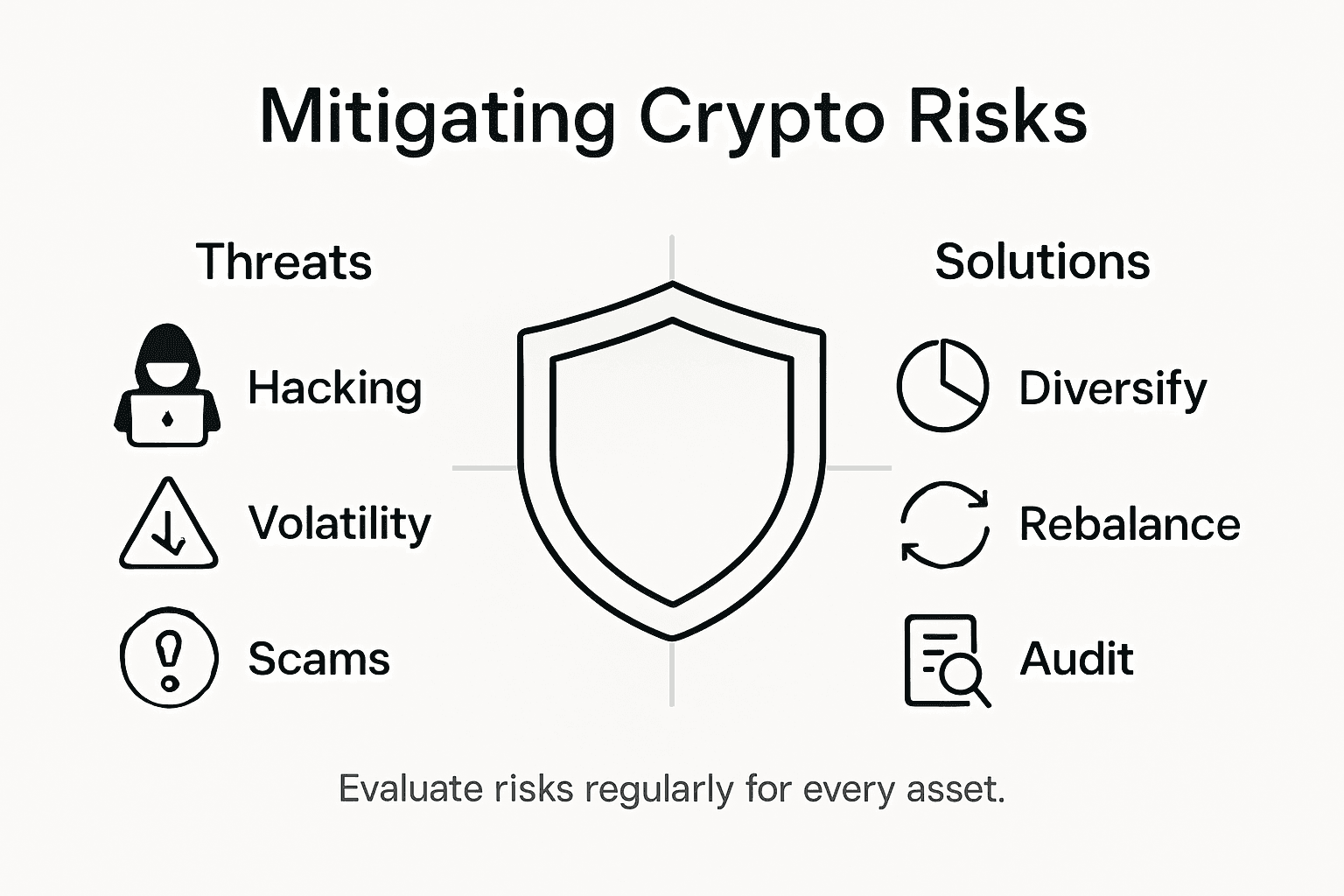
| Security Breaches | Hacks or phishing attacks | Strong authentication, regular training |
Pro tip: Develop a dynamic risk scoring matrix that continuously evaluates each digital asset across multiple risk dimensions, enabling real-time portfolio adjustments and proactive risk management strategies.
Strengthen Your Crypto Portfolio with Asset-Backed Security
Managing volatility and securing your investments are top priorities for any crypto investor. The article highlights the critical need for diversification that balances risk with stable asset exposure. Concepts like stablecoins, asset-backed tokens, and proof of reserves showcase practical ways to reduce uncertainty in a high-risk crypto environment.
At UK Financial Ltd, we address these challenges head-on by offering gold-backed digital assets that serve as a reliable hedge against market swings. Our portfolio includes rigorously vetted tokens such as the Maya Preferred PRA and gold-secured coins, combining blockchain innovation with tangible precious metal backing for unmatched portfolio stability and transparency. Experience real-time blockchain tracking and proof of reserve reports designed to meet strict regulatory standards and provide you peace of mind.
Discover how our secure, asset-backed investment solutions can complement your diversification strategy. Whether you are seeking to preserve wealth or explore advanced token allocation, visit our main platform and learn more about the future of crypto risk management.
Are you ready to protect your assets from volatility while maximizing growth potential

Explore our gold-backed digital assets now to start building a resilient crypto portfolio with transparent proof of reserves and regulatory compliance. Take control of your investment future today.
Frequently Asked Questions
What is crypto portfolio diversification?
Crypto portfolio diversification is a strategy used to manage digital assets by spreading investments across multiple cryptocurrencies and financial instruments to reduce risk and enhance potential returns.
Why is diversification important for cryptocurrency investing?
Diversification is crucial in cryptocurrency investing due to the high volatility and rapid changes in the market. It helps balance high-risk assets with more stable ones to optimize overall portfolio performance.
What types of assets should be included in a diversified crypto portfolio?
A diversified crypto portfolio should include various asset types such as stablecoins, utility tokens, governance tokens, and DeFi instruments. Each type serves a different purpose in risk management and potential returns.
How can I effectively manage risks in my crypto portfolio?
To manage risks effectively, consider implementing advanced techniques like diversification across uncorrelated asset classes, using stablecoins for stability, continuous market monitoring, and applying predictive analytics for risk assessment.
Recommended
- UK Financial Ltd – Gold-Backed Cryptocurrency Portfolio
- UK Financial Ltd Sets Official 30-Day Conversion Deadline for Three Exchange-Listed Tokens Ahead of Regulated Upgrade
- Official News | UK Financial Ltd
- News | UK Financial Ltd
- Asset Protection Strategies for California Families 2025 – Law Office of Eric Ridley