
Crypto-Backed Assets: Asset Security and Transparency

Global markets shift rapidly and traditional safe havens often face unprecedented pressures for transparency and compliance. For institutional investors seeking stable wealth preservation, gold-backed digital assets present a compelling balance of innovation and trust. Blockchain transparency combined with rigorous regulatory frameworks transforms gold into a 24/7 tradable asset with verifiable records, opening new doors for secure financial diversification beyond national borders.
Table of Contents
- Defining Crypto-Backed Assets And Misconceptions
- Different Categories Of Crypto-Backed Tokens
- How Blockchain Ensures Transparency And Trust
- Regulatory Compliance And Gold Reserve Proofs
- Risks, Investor Protections, And Industry Pitfalls
Key Takeaways
| Point | Details |
|---|---|
| Understanding Crypto-Backed Assets | Crypto-backed assets offer a transparent alternative to traditional cryptocurrencies, being directly linked to tangible or intangible assets. |
| Categories of Tokens | Different categories like asset-backed tokens, stablecoins, and utility tokens cater to various investment needs and risk profiles. |
| Importance of Regulatory Compliance | Adhering to global regulatory standards is crucial for ensuring investor protection and maintaining market integrity. |
| Risk Management Strategies | Investors should adopt a rigorous risk assessment framework to navigate price volatility and liquidity challenges effectively. |
Defining Crypto-Backed Assets and Misconceptions
Crypto-backed assets represent a groundbreaking financial innovation where digital tokens are directly linked to tangible or intangible assets through blockchain technology. European crypto-asset research757580_EN.pdf) reveals these digital representations can encompass everything from precious metals and real estate to intellectual property rights, providing investors unprecedented transparency and fractional ownership opportunities.
Understanding these assets requires dispelling several common misconceptions. Many investors mistakenly believe crypto-backed assets are inherently volatile or speculative. However, when properly structured, these tokens offer significant advantages:
- Direct Asset Representation: Digital tokens that mirror real-world asset values
- Blockchain Transparency: Immutable transaction records and verifiable ownership
- Fractional Investment: Enabling smaller investors to participate in high-value markets
- Global Accessibility: 24/7 trading across international boundaries
The CFA Institute research emphasizes that understanding crypto-assets goes beyond technological hype. Institutional investors must evaluate these instruments through rigorous frameworks that assess regulatory compliance, underlying asset quality, and potential economic impact.
Crypto-backed assets fundamentally differ from traditional cryptocurrencies by maintaining direct linkage to tangible value. While Bitcoin and similar cryptocurrencies derive value from market speculation, asset-backed tokens represent verifiable claims on specific, quantifiable resources. This structural difference provides a more stable and predictable investment mechanism.
The following table clarifies the distinction between crypto-backed assets and traditional cryptocurrencies:
| Aspect | Crypto-Backed Asset Tokens | Traditional Cryptocurrencies |
|---|---|---|
| Value Basis | Directly linked to real assets | Driven by market demand |
| Price Stability | Tied to asset, more predictable | Often highly volatile |
| Regulatory Scrutiny | Subject to regulatory frameworks | Less regulated |
| Investor Assurance | Based on asset audits or reserves | Based on code transparency |
Pro tip: Before investing in any crypto-backed asset, always verify the asset’s reserve documentation, blockchain authentication mechanisms, and regulatory compliance status.
Different Categories of Crypto-Backed Tokens
Crypto-backed tokens represent a diverse and complex ecosystem with multiple distinct categories designed to serve different investment and economic objectives. Comprehensive token research reveals a sophisticated taxonomy that helps investors and regulators understand these digital financial instruments more precisely.
Based on current academic analysis, crypto-backed tokens can be categorized into several primary types:
- Asset-Backed Tokens: Directly linked to tangible assets like gold, real estate, or commodities
- Stablecoins: Digital currencies designed to maintain consistent value through various stabilization mechanisms
- Utility Tokens: Providing specific access or functionality within blockchain ecosystems
- Security Tokens: Representing financial investments with regulatory compliance
Stablecoin classification research provides deeper insights into token mechanics, distinguishing between different stabilization approaches. These approaches include:
- Fiat-Collateralized Stablecoins: Backed by traditional currency reserves
- Crypto-Collateralized Stablecoins: Supported by other cryptocurrency holdings
- Algorithmic Stablecoins: Managed through complex mathematical protocols
- Hybrid Stablecoins: Combining multiple stabilization strategies
Each category of crypto-backed token offers unique advantages and potential risks. Asset-backed tokens provide direct value representation, while utility tokens enable specific blockchain interactions. Security tokens bridge traditional financial frameworks with blockchain technology, offering enhanced transparency and fractional ownership opportunities.
Pro tip: Always conduct thorough due diligence on the specific collateralization method and regulatory compliance of any crypto-backed token before investing.
How Blockchain Ensures Transparency and Trust
Blockchain technology represents a revolutionary approach to establishing trust and transparency in digital transactions, fundamentally transforming how financial and administrative systems operate. Blockchain infrastructure research reveals six critical features that collectively create an unprecedented level of institutional reliability:
- Decentralization: No single point of control or potential manipulation
- Immutability: Permanent, unalterable transaction records
- Traceability: Complete transaction history available for verification
- Security: Cryptographically protected transaction mechanisms
- Transparency: Open, verifiable record-keeping
- Smart Contract Automation: Self-executing agreements with predetermined conditions
Academic certification systems demonstrate blockchain’s practical applications in ensuring authentic, tamper-proof documentation. By creating distributed ledgers, blockchain eliminates traditional vulnerabilities associated with centralized record-keeping, providing multiple layers of verification and authentication.
The technological architecture of blockchain ensures that every transaction is simultaneously recorded across multiple independent nodes, making fraudulent modifications virtually impossible. Each transaction creates a permanent, transparent record that can be independently verified by network participants, dramatically reducing the potential for manipulation or unauthorized changes.

Pro tip: Always verify a blockchain system’s consensus mechanism and node distribution to understand its true transparency and security potential.
Regulatory Compliance and Gold Reserve Proofs
Navigating the complex landscape of crypto-backed asset regulation requires a comprehensive understanding of global financial standards and verification mechanisms. Global regulatory frameworks have established critical principles to ensure transparency, security, and investor protection in the emerging digital asset ecosystem.
The regulatory compliance for gold-backed tokens involves multiple critical components:
- Physical Asset Verification: Continuous auditing of gold reserves
- Custodial Transparency: Detailed reporting of asset storage and management
- Legal Documentation: Comprehensive ownership and transfer frameworks
- Third-Party Independent Audits: Regular comprehensive evaluations
- Real-Time Reserve Tracking: Digital mechanisms for instant verification
Gold-backed token legal considerations highlight the intricate process of maintaining regulatory compliance across different jurisdictions. Key requirements include:
- Transparent custody documentation
- Verifiable physical reserve holdings
- Adherence to international financial regulations
- Comprehensive reporting mechanisms
- Regular independent audits
The regulatory landscape demands that gold-backed tokens demonstrate a rigorous approach to asset backing, ensuring that each digital token represents a precise, verifiable fraction of physical gold reserves. This approach mitigates risks associated with traditional cryptocurrency volatility while providing institutional investors with a more stable and regulated investment vehicle.
Pro tip: Conduct thorough due diligence on a token’s audit history and regulatory compliance before making any investment decisions.
Risks, Investor Protections, and Industry Pitfalls
Navigating the complex world of crypto-backed assets demands a sophisticated understanding of potential risks and strategic investor protections. Financial stability risks in emerging digital markets present multifaceted challenges that require comprehensive due diligence and proactive risk management strategies.
Investors must remain vigilant about several critical risk categories:
- Price Volatility: Unexpected market fluctuations
- Liquidity Challenges: Potential difficulties converting assets
- Governance Vulnerabilities: Weak institutional oversight
- Regulatory Uncertainty: Evolving legal frameworks
- Operational Risks: Technical infrastructure weaknesses
Market integrity recommendations highlight essential protective measures for institutional investors, including:
- Comprehensive background investigations of token issuers
- Rigorous independent asset verification
- Continuous monitoring of regulatory compliance
- Diversification across multiple asset-backed tokens
- Implementing robust risk management protocols
The most sophisticated institutional investors understand that crypto-backed assets require a nuanced approach. Successful navigation demands not just financial acumen, but a deep understanding of technological infrastructure, regulatory landscapes, and potential systemic risks inherent in emerging digital financial ecosystems.
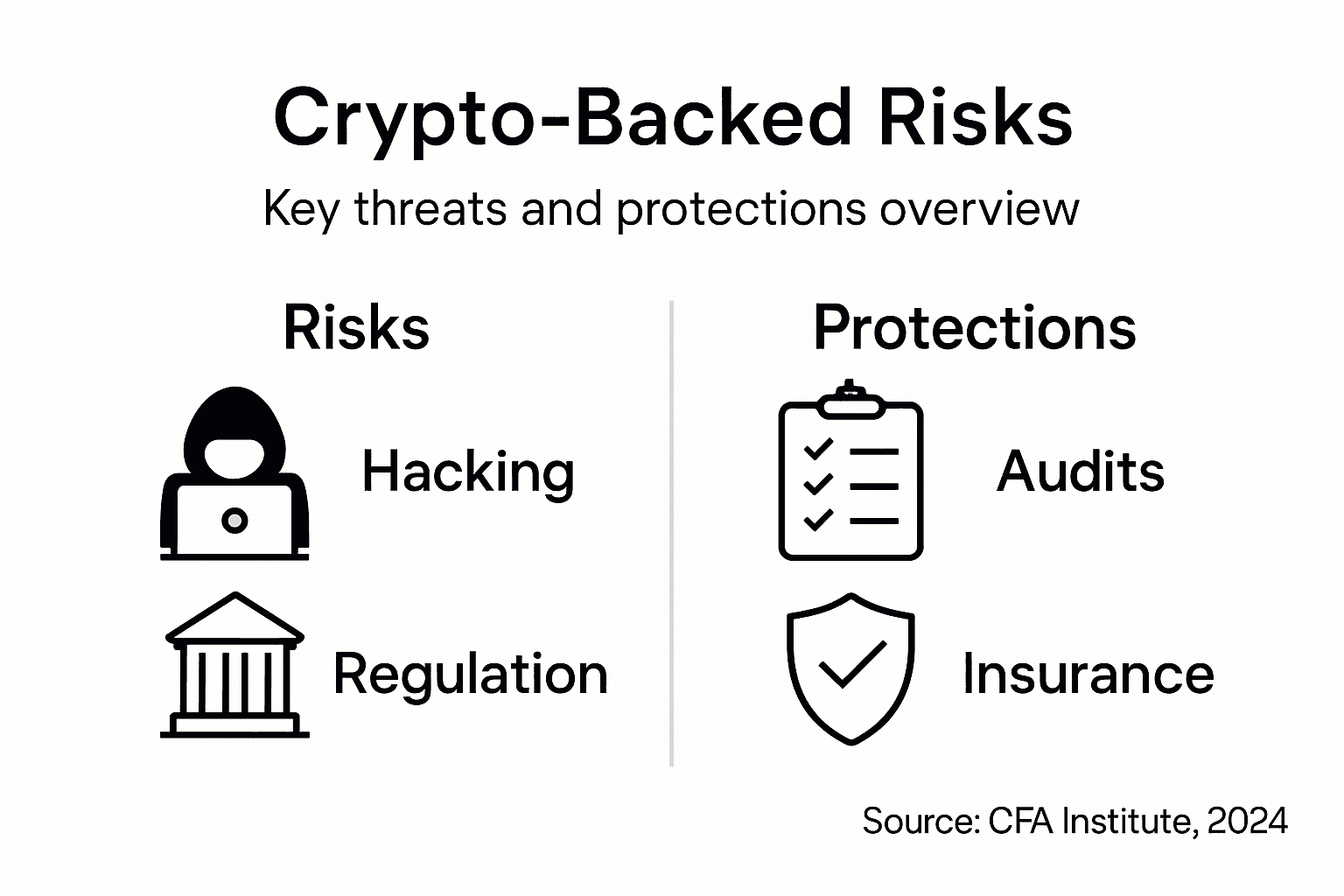
Here is a summary of key risk categories and recommended protections for crypto-backed asset investors:
| Risk Category | Example Scenario | Investor Protection |
|---|---|---|
| Price Volatility | Sudden market downturn | Diversification |
| Liquidity | Difficulty selling token | Multi-market access |
| Governance | Weak oversight | Independent audits |
| Regulation | Legal uncertainty | Compliance verification |
| Technical | Platform hack | Enhanced cybersecurity |
Pro tip: Develop a comprehensive risk assessment framework that includes technological, regulatory, and market-based evaluation criteria before committing significant capital.
Secure Your Investment with Transparent Crypto-Backed Gold Tokens
The article highlights the critical challenges investors face regarding trust, asset verification, and regulatory compliance in the emerging market of crypto-backed assets. If you are concerned about price volatility, unclear asset backing, and the lack of real-time transparency, it is essential to explore platforms designed to solve these very problems. UK Financial Ltd offers a robust solution by providing gold and silver-backed digital tokens supported by continuous audit documentation and live blockchain asset tracking. Their focus on asset security and transparency aligns perfectly with the need for trustworthy and verifiable investments discussed in the article.
Explore our trusted portfolio including the flagship Maya Preferred PRA and MayaCat meme coin. Benefit from real-time performance data, proof of reserve reports, and regulatory compliance efforts designed for both retail and institutional investors seeking to preserve wealth and diversify safely. Learn more about how precise corporate governance and secure blockchain infrastructure protect your holdings at UK Financial Ltd and discover how tangible asset linkage can reduce the risks typically associated with crypto investment.
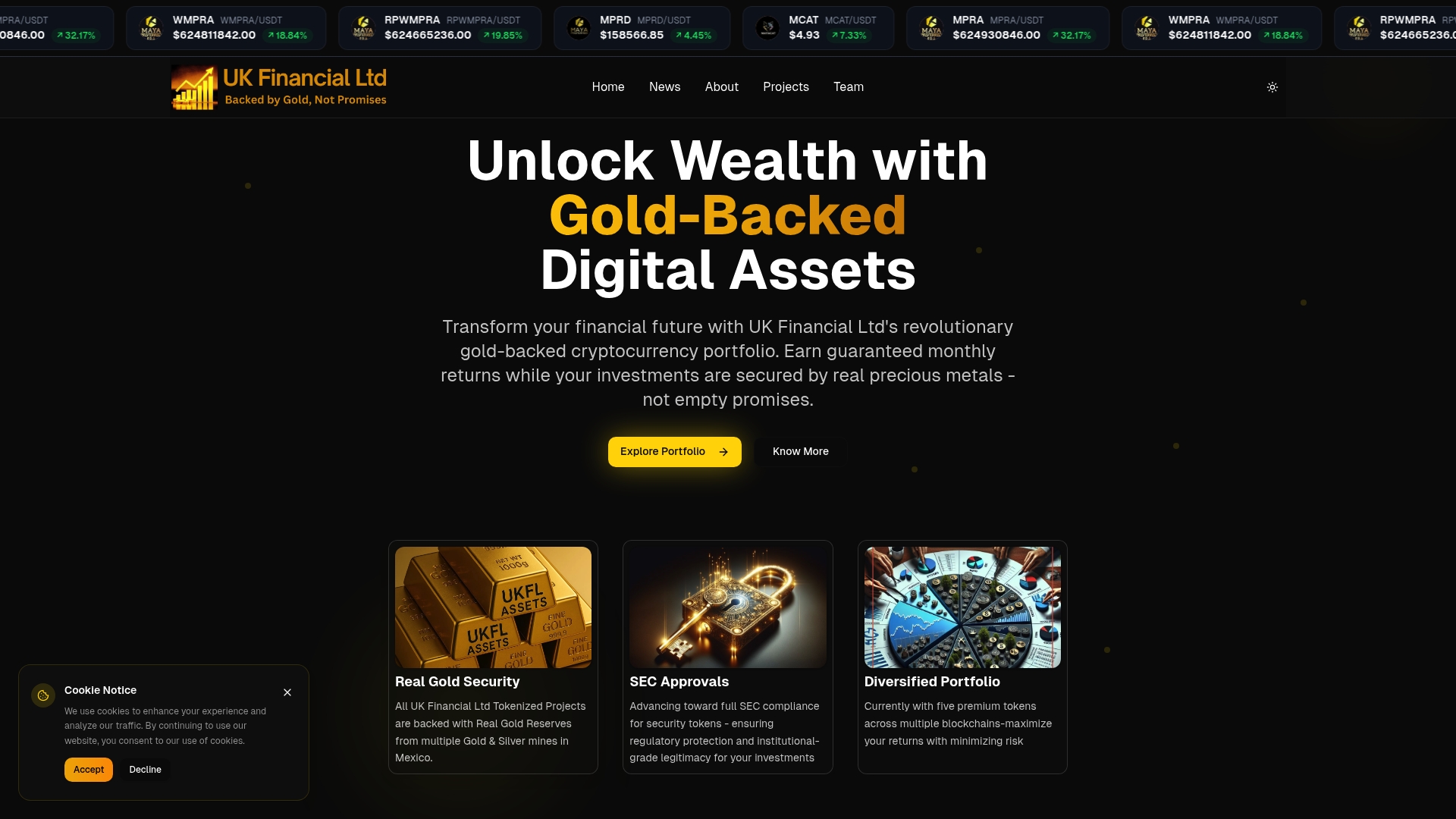
Experience the confidence of investing in crypto-backed tokens firmly anchored by precious metals. Visit UK Financial Ltd today and take the first step towards secure, transparent, and compliant digital asset ownership. See the detailed proof of reserve tracking and ongoing regulatory developments that put you in control now.
Frequently Asked Questions
What are crypto-backed assets?
Crypto-backed assets are digital tokens directly linked to tangible or intangible assets, like gold or real estate, leveraging blockchain technology for enhanced transparency and fractional ownership.
How do crypto-backed assets differ from traditional cryptocurrencies?
Unlike traditional cryptocurrencies, which derive value from market speculation, crypto-backed assets are tied to specific, quantifiable resources, providing a more stable and predictable investment option.
What role does blockchain play in ensuring asset security?
Blockchain ensures asset security through decentralization, immutability, traceability, and cryptographic protections, which collectively create a transparent, tamper-proof record of transactions.
What are the main risks associated with investing in crypto-backed assets?
Investment risks include price volatility, liquidity challenges, governance vulnerabilities, regulatory uncertainty, and operational risks related to the technical infrastructure.
Recommended
- UK Financial Ltd Announces CoinMarketCap Supply Verification And Market Positioning Review For Regulated Security Tokens SMPRA And SMCAT
- UK Financial Ltd – Gold-Backed Cryptocurrency Portfolio
- UK Financial Ltd Completes Compliance for SEC-Ready ERC-3643 Token Ahead of CATEX Trading
- UK Financial Ltd Makes History as MayaCat (SMCAT) Becomes the World’s First Exchange-Traded ERC-3643 Security Token
- Understanding Supply Chain Transparency in E-commerce – ORNER
- Understanding Why Authenticate Digital Documents for Security