
Crypto Asset Trends 2025: Impact on Institutional Investing

Selecting reliable digital assets has become a priority as institutional investors in the United Kingdom and European Union look to strengthen portfolio resilience while meeting evolving regulatory standards. The rapid growth of crypto assets is reshaping investment strategies, offering options that blend blockchain transparency with asset backing such as physical gold. This article explains how asset-backed digital assets now offer credible diversification, regulatory alignment, and access to the benefits of both traditional finance and innovative technology.
Table of Contents
- Defining Crypto Assets And Market Evolution
- Types Of Crypto Assets And Innovations In 2025
- Gold-Backed Tokens And Asset-Backed Solutions
- Regulatory Shifts In Key Markets Worldwide
- Risks, Compliance, And Institutional Perspectives
Key Takeaways
| Point | Details |
|---|---|
| Evolving Crypto Landscape | Crypto assets have transitioned into a sophisticated investment ecosystem, offering a diverse range of digital financial instruments. |
| Types of Crypto Assets | Categories have expanded to include Native Cryptocurrencies, Utility Tokens, Security Tokens, Stablecoins, and NFTs, each serving distinct investment purposes. |
| Regulatory Developments | Global regulatory frameworks are emerging, providing clearer guidelines which enhance investor protections and encourage institutional adoption. |
| Risk Management | Institutional involvement requires advanced risk management protocols, integrating comprehensive compliance and monitoring strategies to address the unique challenges of digital assets. |
Defining Crypto Assets and Market Evolution
Crypto assets have transformed from an experimental financial concept to a sophisticated investment ecosystem with complex market dynamics. Emerging taxonomies of digital assets reveal a rapidly evolving landscape where digital representations of value challenge traditional financial paradigms. These cryptographically secured digital instruments now encompass far more than simple currency replacements, representing a nuanced array of technological and financial innovations.
The market’s evolution traces a remarkable trajectory from Bitcoin’s initial decentralized payment vision to a diverse ecosystem of financial instruments. Native cryptocurrencies, tokens issued on specialized blockchain platforms, and hybrid digital assets now comprise a multifaceted market. Comprehensive market research indicates that these assets are increasingly recognized as legitimate investment vehicles, moving beyond speculative instruments to structured financial products with measurable economic utility.
Understanding crypto assets requires recognizing their fundamental characteristics. These digital instruments are characterized by several key attributes:
- Cryptographic security mechanisms
- Decentralized transaction verification
- Programmable economic properties
- Transparent transaction ledgers
- Potential for smart contract integration
Institutional investors now view crypto assets as a strategic portfolio diversification tool, appreciating their potential for uncorrelated returns and technological innovation. The market has matured from a niche speculative domain to a sophisticated financial sector with increasing regulatory oversight and institutional acceptance.
Pro Tip: When evaluating crypto assets, focus on understanding the underlying technological infrastructure and economic utility rather than short-term price fluctuations.
Types of Crypto Assets and Innovations in 2025
The crypto asset landscape in 2025 represents a sophisticated ecosystem of diverse digital financial instruments with increasingly complex functionalities. Emerging asset classifications demonstrate a remarkable evolution beyond traditional cryptocurrency models, introducing innovative financial technologies that bridge digital and traditional investment frameworks. These advanced crypto assets now offer institutional investors nuanced opportunities for portfolio diversification and strategic financial engagement.
Crypto asset types have expanded to include several sophisticated categories:
- Native Cryptocurrencies: Digital currencies operating on independent blockchains
- Utility Tokens: Digital assets providing access to specific blockchain services
- Security Tokens: Blockchain-based representations of traditional financial securities
- Stablecoins: Cryptocurrencies designed to maintain consistent value
- Non-Fungible Tokens (NFTs): Unique digital assets representing ownership of specific items
Next-generation crypto innovations are characterized by increasing integration with emerging technologies like artificial intelligence and advanced blockchain scaling solutions. These developments signal a transformative period where crypto assets transition from speculative instruments to robust, programmable financial tools with measurable economic utility. Institutional investors are particularly attracted to hybrid financial products that combine blockchain transparency with traditional investment reliability.
The technological infrastructure supporting these crypto assets continues to mature, with enhanced security protocols, improved interoperability, and more sophisticated economic models. Layer 2 scaling solutions and cross-chain communication mechanisms are expanding the potential applications of blockchain-based financial instruments, creating more accessible and efficient investment ecosystems.

Here’s a comparison of major crypto asset types and their typical investment impact:
| Asset Type | Main Purpose | Typical Investor Use | Risk Profile |
|---|---|---|---|
| Native Cryptocurrency | Value transfer and payments | Portfolio diversification | High volatility |
| Utility Token | Access to blockchain services | Participation in platforms | Moderate volatility |
| Security Token | Represent financial securities | Equity or bond exposure | Regulatory risk |
| Stablecoin | Price stability | Hedging and settlement | Low volatility |
| NFT | Unique digital ownership | Collectibles and art focus | Variable risk |
Pro Tip: Prioritize understanding the underlying technological infrastructure and economic utility of crypto assets before making investment decisions.
Gold-Backed Tokens and Asset-Backed Solutions
Gold-backed cryptocurrencies represent a sophisticated financial innovation bridging traditional asset preservation with blockchain technology’s transparency and efficiency. Gold-backed token structures provide institutional investors a unique opportunity to leverage digital assets while maintaining the intrinsic stability of physical gold reserves. These cryptographic instruments offer a compelling alternative to traditional investment vehicles by combining the liquidity of digital tokens with the time-tested value preservation of precious metals.
The operational framework of these asset-backed solutions involves several critical components:
- Collateralization: Physical gold securely stored in professional vaults
- Tokenization: Digital representation of specific gold quantities
- Audit Transparency: Regular verification of underlying physical assets
- Redemption Mechanisms: Options to convert tokens to physical gold
- Blockchain Verification: Immutable transaction records
Institutional hedging strategies increasingly recognize gold-backed tokens as sophisticated risk management instruments. These digital assets provide portfolio diversification with lower volatility compared to traditional cryptocurrencies, offering a nuanced approach to digital asset investment. Institutional investors appreciate the ability to maintain exposure to gold’s historical stability while benefiting from blockchain’s technological advantages.
The evolving regulatory landscape continues to enhance the credibility of asset-backed crypto solutions. Governments and financial regulators are developing frameworks that provide clarity and protection for investors, signaling growing mainstream acceptance of these innovative financial instruments. Advanced tokenization technologies now enable fractional ownership, liquidity, and instantaneous global transferability of traditionally illiquid assets like physical gold.
Pro Tip: Conduct thorough due diligence on the specific audit and redemption mechanisms of any gold-backed token before making investment decisions.
Regulatory Shifts in Key Markets Worldwide
The global regulatory landscape for cryptocurrencies and digital assets has undergone profound transformations in 2025, signaling a new era of institutional legitimacy and structured market participation. Comprehensive regulatory frameworks are emerging across key jurisdictions, demonstrating a sophisticated approach to integrating digital assets within established financial systems. These regulatory developments represent a critical milestone in bridging traditional financial infrastructure with blockchain-based innovations.
Key regulatory shifts are characterized by several pivotal developments:
- European Union: Implementation of Markets in Crypto-Assets (MiCA) regulation
- United States: Introduction of targeted digital asset oversight legislation
- United Kingdom: Enhanced compliance frameworks for crypto asset trading
- Asian Markets: Differentiated approaches balancing innovation and consumer protection
- Middle East: Emerging progressive regulatory environments
International regulatory harmonization efforts are transforming the digital asset ecosystem, creating more predictable and secure investment environments. Institutional investors now benefit from clearer guidelines that address critical concerns such as investor protection, market integrity, and anti-money laundering standards. These regulatory frameworks are moving beyond theoretical constructs toward practical, enforceable mechanisms that provide confidence and stability.
The evolving regulatory landscape reflects a nuanced understanding of digital assets’ potential and risks. Governments worldwide are crafting sophisticated approaches that balance innovation with robust investor safeguards, recognizing cryptocurrencies and tokenized assets as legitimate financial instruments. Advanced jurisdictions are developing adaptive regulatory models that can accommodate technological innovations while maintaining strong compliance and transparency standards.
The following table summarizes regulatory approaches in key regions:
| Region | Regulatory Approach | Impact on Market Participation |
|---|---|---|
| European Union | MiCA comprehensive framework | Clear investor protections |
| United States | Targeted digital asset laws | Boosts institutional confidence |
| United Kingdom | Enhanced compliance rules | Supports innovation, tight controls |
| Asia | Flexible, consumer-focused | Balances innovation and caution |
| Middle East | Progressive adaptation | Drives new digital markets |
Pro Tip: Continuously monitor regulatory developments in your primary investment jurisdictions, as compliance requirements can significantly impact digital asset investment strategies.
Risks, Compliance, and Institutional Perspectives
Institutional engagement with crypto assets demands sophisticated risk management approaches that transcend traditional financial frameworks. Comprehensive risk management protocols are emerging as critical infrastructure for banks and investment firms seeking responsible digital asset participation. These frameworks address the multifaceted challenges inherent in integrating blockchain-based financial instruments into established investment strategies.
Key risk management considerations include:
- Volatility Exposure: Advanced analytical modeling techniques
- Regulatory Compliance: Robust governance and reporting mechanisms
- Cybersecurity: Enhanced protective technological infrastructure
- Counterparty Risk: Sophisticated due diligence protocols
- Operational Governance: Transparent monitoring and control systems
Institutional risk frameworks are evolving to address the unique characteristics of digital assets. Traditional financial institutions are developing nuanced approaches that balance technological innovation with rigorous risk mitigation strategies. These frameworks prioritize comprehensive due diligence, continuous monitoring, and adaptive compliance mechanisms that can respond to the dynamic crypto asset ecosystem.
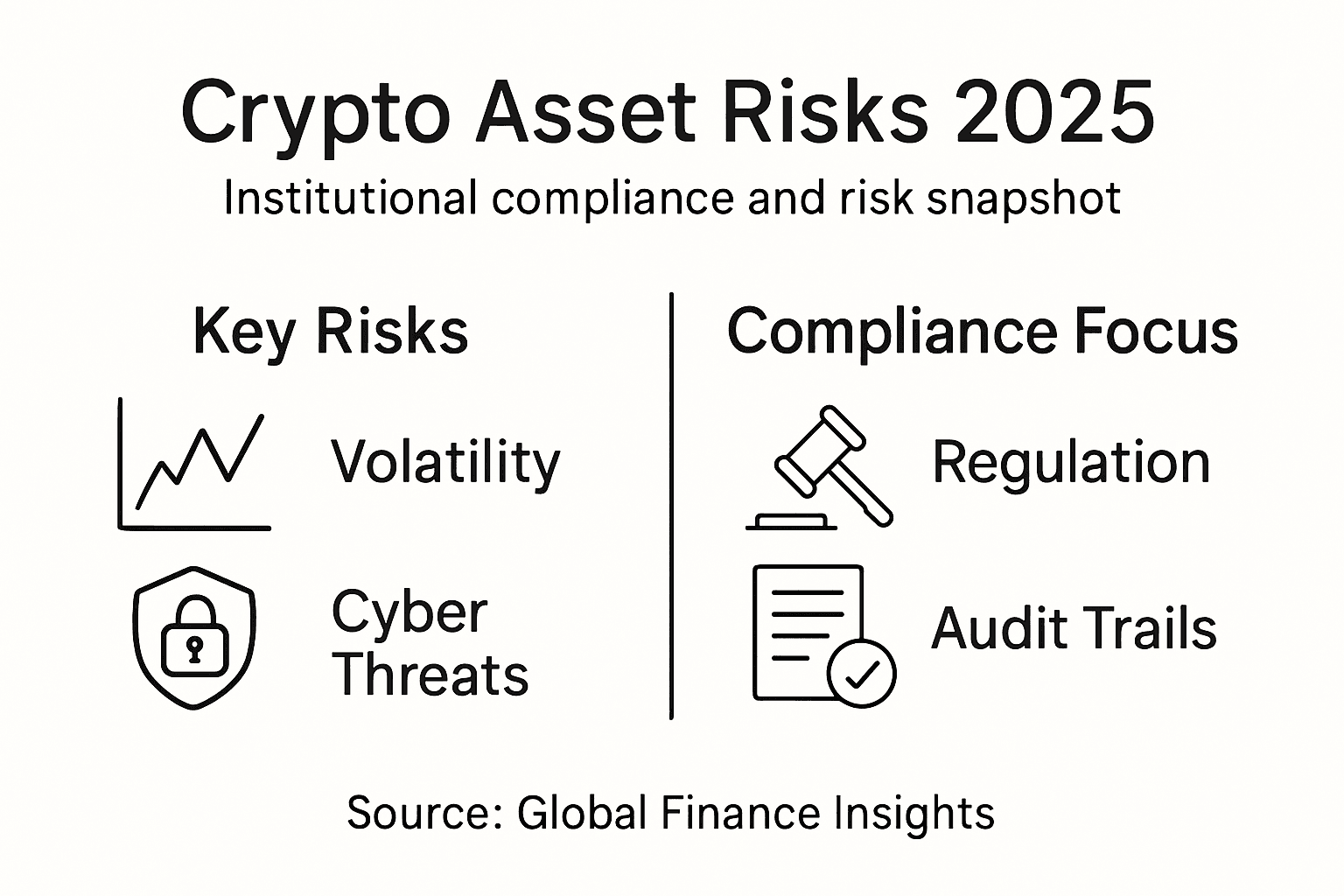
The intersection of technological innovation and institutional risk management represents a critical development in digital asset integration. Financial institutions are increasingly recognizing that successful crypto asset engagement requires more than traditional investment approaches. Advanced risk management strategies now incorporate sophisticated technological solutions, real-time monitoring capabilities, and flexible regulatory compliance mechanisms that can adapt to the rapidly changing digital finance landscape.
Pro Tip: Develop a multi-layered risk assessment strategy that combines quantitative analytics with qualitative regulatory intelligence for comprehensive crypto asset risk management.
Secure Your Future with Gold-Backed Digital Assets at UK Financial Ltd
The article highlights the increasing complexity and risk within crypto asset markets especially for institutional investors facing volatility, regulatory uncertainty, and technological challenges. At UK Financial Ltd, we understand the critical need to bridge innovation with stability by offering gold-backed tokens that combine blockchain transparency with the enduring value of physical precious metals. Our platform addresses concerns such as price volatility and regulatory compliance by providing fully collateralized, audited tokens like the Maya Preferred PRA and MayaCat meme coin. This offers investors transparent, secure exposure to asset-backed crypto assets with detailed proof of reserves and real-time tracking to enhance trust and confidence.
Investing now through UK Financial Ltd means you can diversify your portfolio with hybrid financial products designed for the evolving 2025 crypto landscape. Benefit from our commitment to compliance, security, and innovation to safeguard your wealth against the challenges outlined in the latest crypto asset trends and regulatory shifts.
Explore the future of stable, tangible crypto investments on our website https://ukfinancialltd.com and discover how asset-backed tokens can fortify your portfolio.

Ready to take control of your crypto portfolio with gold-backed security and regulatory transparency Visit UK Financial Ltd today to learn about our full suite of asset-backed digital tokens and start investing with confidence in 2025.
Frequently Asked Questions
What are crypto assets?
Crypto assets are digital instruments secured by cryptography, characterized by decentralized transaction verification, transparent ledgers, and programmable economic properties. They include native cryptocurrencies, tokens, hybrid digital assets, and more.
How have institutional investors adapted to crypto assets in 2025?
In 2025, institutional investors increasingly view crypto assets as viable portfolio diversification tools, appreciating their potential for uncorrelated returns and technological innovation, thanks to evolving market dynamics and regulatory frameworks.
What types of crypto assets should investors be aware of?
Investors should be familiar with various types of crypto assets, including native cryptocurrencies, utility tokens, security tokens, stablecoins, and non-fungible tokens (NFTs), each serving different purposes and investment strategies.
What are the risks associated with investing in crypto assets?
Investing in crypto assets involves several risks, including exposure to volatility, regulatory compliance challenges, cybersecurity threats, counterparty risks, and the need for robust operational governance to protect investments.
Recommended
- UK Financial Ltd Executes Compliance Tasks Ahead Of First-Ever ERC-3643 Exchange-Traded Token, SMCAT & Sets Date For Online Investor Governance Vote
- UK Financial Ltd – Gold-Backed Cryptocurrency Portfolio
- UK Financial Ltd Establishes United States Operations in Delaware, Announces Texas Expansion
- UK Financial Ltd Sets Official 30-Day Conversion Deadline for Three Exchange-Listed Tokens Ahead of Regulated Upgrade
- The Big Question: Are Crypto ETFs About to Explode?