
Blockchain in Finance: Transforming Asset Security and Trust

Over one-third of American financial institutions now consider blockchain essential for future operations. The landscape of finance is shifting as blockchain technology introduces transparency, security, and efficiency that traditional systems cannot match. With digital assets and programmable money changing global markets, understanding blockchain’s evolving role helps professionals and investors gain a strategic advantage while reducing risks in a rapidly modernizing American financial sector.
Table of Contents
- Defining Blockchain’s Role in Modern Finance
- Types of Blockchain Networks in Financial Systems
- Tokenization of Assets and Proof of Reserve
- Key Functions: Transparency, Security, Efficiency
- Risk Management and Regulatory Compliance Challenges
Key Takeaways
| Point | Details |
|---|---|
| Blockchain Revolutionizes Finance | Blockchain transforms financial systems by enhancing transparency, security, and efficiency, while eliminating intermediaries. |
| Types of Blockchain Networks | Financial institutions can choose from public, private, and consortium networks based on their operational needs and regulatory compliance requirements. |
| Tokenization Benefits | Tokenization introduces fractional ownership and increased liquidity, allowing greater access to diverse asset classes for investors. |
| Navigating Regulatory Challenges | Financial institutions must adopt sophisticated risk management and compliance strategies to address the complexities of decentralized finance and blockchain applications. |
Defining Blockchain’s Role in Modern Finance
Blockchain technology represents a seismic shift in financial infrastructure, transforming how institutions manage, transfer, and secure digital assets. At its core, blockchain functions as a decentralized and immutable digital ledger that records transactions across a distributed network of computers, eliminating traditional intermediaries and reducing systemic risks.
The fundamental power of blockchain in finance emerges through several groundbreaking capabilities. Transparent transactions become possible through cryptographic verification, where every financial interaction is permanently recorded and publicly traceable. This creates unprecedented levels of accountability, making fraudulent activities exponentially more difficult. Financial institutions can now track asset movements with surgical precision, knowing each transaction carries an unalterable digital signature.
Blockchain introduces three revolutionary mechanisms that distinguish it from traditional financial systems:
- Decentralization: No single entity controls the entire network
- Immutability: Transaction records cannot be retroactively altered
- Cryptographic Security: Advanced encryption protects every transaction
The technology’s impact extends far beyond cryptocurrency. Institutional investors are increasingly recognizing blockchain’s potential for streamlining complex financial processes like cross-border payments, securities trading, and asset tokenization. By removing intermediaries, blockchain dramatically reduces transaction costs and settlement times from days to minutes, creating unprecedented operational efficiency.
Moreover, blockchain enables programmable money through smart contracts—self-executing agreements with terms directly written into code. These digital contracts automatically trigger financial actions when predefined conditions are met, reducing human error and creating more transparent, predictable financial interactions. Imagine insurance payouts that process instantly, loan agreements that self-execute, or investment distributions that happen seamlessly without manual intervention.
Types of Blockchain Networks in Financial Systems
Blockchain technology offers multiple network configurations that cater to different financial ecosystem requirements, each with unique architectural characteristics and operational implications. Financial institutions strategically select blockchain network types based on specific organizational needs, regulatory compliance, and desired levels of decentralization and control.
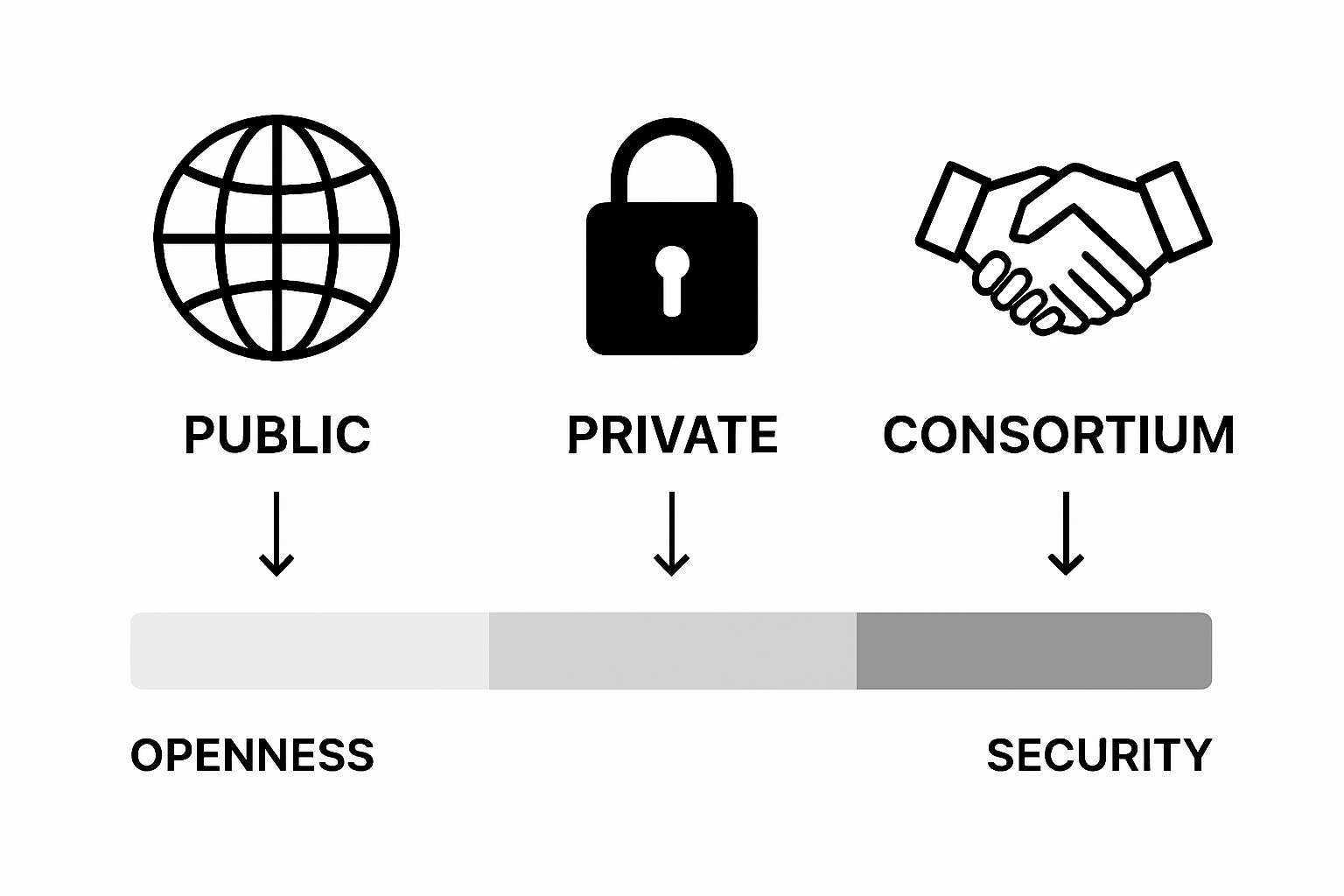
Three primary blockchain network architectures dominate the financial landscape: public, private, and consortium networks. Public blockchains represent fully decentralized systems where anyone can participate, validate transactions, and contribute to network consensus. Bitcoin and Ethereum exemplify this model, offering maximum transparency but potentially compromising transaction speed and scalability for financial applications.
Private blockchain networks provide a stark contrast, restricting access to predefined participants within a single organizational framework. These networks prioritize:
- Enhanced security controls
- Faster transaction processing
- Granular access management
- Compliance with internal governance protocols
Consortium blockchains emerge as a sophisticated middle ground, enabling multiple financial institutions to collaborate within a shared, semi-decentralized infrastructure. This model allows participating organizations to maintain collective oversight while distributing computational responsibilities across trusted network members. Such collaborative frameworks prove particularly valuable for complex financial processes like cross-border settlements, interbank transactions, and shared regulatory reporting mechanisms.
By understanding these network variations, financial professionals can strategically implement blockchain solutions that balance operational efficiency, security requirements, and collaborative potential. The choice between public, private, and consortium networks ultimately depends on an organization’s specific technological capabilities, regulatory environment, and strategic objectives.
Tokenization of Assets and Proof of Reserve
Tokenization represents a groundbreaking financial innovation that transforms traditional asset management by converting real-world assets into digital tokens on blockchain networks. This process enables fractional ownership, increased liquidity, and unprecedented transparency for assets ranging from real estate and commodities to intellectual property and financial instruments.

Securities trading applications demonstrate blockchain’s transformative potential by breaking down complex assets into tradable digital representations. These blockchain-based tokens carry embedded authentication, ownership rights, and transaction history, creating a new paradigm of asset management that eliminates traditional intermediaries and reduces transactional friction.
The proof of reserve mechanism emerges as a critical component in ensuring token authenticity and financial accountability. This verification process involves:
- Independent auditing of underlying asset reserves
- Real-time verification of token backing
- Transparent reporting of asset holdings
- Cryptographic validation of asset ownership
Tokenization introduces several revolutionary capabilities for financial markets. Digital tokens can represent partial ownership, allowing investors to purchase fractional shares of high-value assets previously inaccessible to average investors. Smart contract technologies enable automatic dividend distributions, transfer restrictions, and programmable compliance mechanisms that dramatically reduce administrative overhead.
By bridging traditional financial assets with blockchain technology, tokenization creates a more inclusive, transparent, and efficient investment ecosystem. Investors gain unprecedented access to global markets, while issuers benefit from reduced capital raising costs and enhanced liquidity options.
Key Functions: Transparency, Security, Efficiency
Blockchain technology fundamentally transforms financial infrastructure through three critical pillars: transparency, security, and efficiency. These core functions represent a paradigm shift from traditional financial systems, offering unprecedented levels of trust and operational optimization.
Blockchain’s decentralized nature enables comprehensive tracking and verification of financial transactions, creating an immutable record that eliminates information asymmetry. Every transaction becomes a permanent, publicly verifiable entry that cannot be retroactively altered, providing real-time visibility into financial movements and dramatically reducing the potential for fraudulent activities.
The security mechanisms inherent in blockchain technology go far beyond conventional protection strategies:
- Cryptographic verification of every transaction
- Distributed network architecture preventing single-point failures
- Advanced encryption protecting sensitive financial data
- Multi-layered authentication protocols
- Immutable transaction records preventing unauthorized modifications
In terms of operational efficiency, blockchain dramatically reduces transactional friction by eliminating intermediaries and automating complex processes through smart contracts. Financial institutions can now execute cross-border transactions, settlement processes, and compliance checks with unprecedented speed and precision. The technology enables near-instantaneous verification and transfer of assets, reducing processing times from days to mere minutes.
By integrating these three fundamental functions, blockchain creates a financial ecosystem that is simultaneously more transparent, secure, and efficient than any preceding technological infrastructure. The result is a transformative approach to managing financial assets that prioritizes trust, accountability, and technological innovation.
Risk Management and Regulatory Compliance Challenges
Blockchain technology introduces complex risk management and regulatory challenges that demand sophisticated approaches from financial institutions. The decentralized nature of blockchain creates unprecedented regulatory complexity, requiring innovative frameworks to balance technological innovation with established financial governance principles.
Decentralized Finance (DeFi) represents a particularly nuanced regulatory landscape, presenting multifaceted risks across technical, economic, and operational domains. Financial institutions must navigate a complex ecosystem where traditional regulatory mechanisms struggle to maintain comprehensive oversight. These challenges emerge from blockchain’s fundamental characteristics: anonymity, cross-border transactions, and distributed governance structures.
Key risk management considerations for blockchain financial applications include:
- Cybersecurity vulnerabilities in smart contract architectures
- Potential for money laundering and illicit financial activities
- Complex jurisdictional compliance requirements
- Volatility in digital asset valuations
- Limited historical precedent for regulatory intervention
Regulatory compliance demands a multilayered approach that integrates technological safeguards with robust governance protocols. Financial institutions must develop sophisticated monitoring systems capable of tracking transactions across decentralized networks while maintaining user privacy and ensuring regulatory adherence. This requires advanced algorithmic techniques for identifying suspicious activities, verifying transaction legitimacy, and preventing potential financial crimes.
The emerging blockchain regulatory landscape demands unprecedented collaboration between technology developers, financial institutions, and government regulators. Success will require flexible, adaptive frameworks that can accommodate rapid technological innovation while protecting fundamental financial system integrity and investor interests.
Secure Your Financial Future with Blockchain-Backed Precious Metals
The article highlights critical challenges such as asset security, transparency, and regulatory compliance in blockchain finance. If you are concerned about risks like fraud, opaque transactions, and complex regulatory landscapes, you are not alone. Blockchain’s promise of decentralization and immutability also demands sophisticated solutions for proof of reserve and real-time transparency to build trust.
At UK Financial Ltd, we address these exact concerns by offering a suite of gold-backed digital assets that combine the revolutionary benefits of blockchain with the stability of verified precious metal reserves. Our platform provides real-time blockchain asset tracking, proof of reserve reports, and stringent SEC compliance plans. These features directly combat the issues of security, asset authenticity, and transparency raised in the article. By choosing our gold and silver-backed tokens, such as the flagship Maya Preferred PRA, you gain access to innovative financial products designed for safe, efficient investments.
Take control of your investments with the confidence that comes from transparent, asset-backed tokens.
Explore our transformative solutions today and see how blockchain technology can truly enhance your financial security.
Discover Our Asset-Backed Tokens
Learn About Our Proof of Reserve Verification
Visit UK Financial Ltd for Full Details

Join the future of secure digital investing now and protect your wealth with tangible assets secured by blockchain technology. Act today to experience transparency, security, and compliance like never before at UK Financial Ltd.
Frequently Asked Questions
What is blockchain technology and how does it transform finance?
Blockchain technology serves as a decentralized and immutable digital ledger, revolutionizing how financial institutions manage, transfer, and secure digital assets. It eliminates traditional intermediaries, enhances transparency, and reduces systemic risks.
How does tokenization work and what are its benefits in finance?
Tokenization involves converting real-world assets into digital tokens on a blockchain, enabling fractional ownership and increased liquidity. It provides unprecedented transparency and reduces transactional barriers for investors in various asset classes.
What are the different types of blockchain networks in finance?
The primary types of blockchain networks in finance include public, private, and consortium networks. Public blockchains are completely decentralized, private blockchains restrict access to specific participants, and consortium blockchains facilitate collaboration among multiple organizations within a semi-decentralized framework.
What are the main challenges of regulatory compliance in blockchain finance?
The regulatory challenges within blockchain finance include navigation of complex jurisdictional compliance requirements, potential cybersecurity vulnerabilities, and the unique risks posed by decentralized finance (DeFi) models, all of which require sophisticated monitoring and governance protocols.
Recommended
- UK Financial Ltd – Gold-Backed Cryptocurrency Portfolio
- UK Financial Ltd Sets Official 30-Day Conversion Deadline for Three Exchange-Listed Tokens Ahead of Regulated Upgrade
- Official News | UK Financial Ltd
- UK Financial Ltd Confirms Official Corporate Structure of the Maya Preferred Project and Its Dual-Class Token System